

Overview
Trip Overview
The North Annapurna Base Camp Trek takes you to a side of the Annapurna massif that relatively few trekkers experience. Instead of following the busy southern trail through Chhomrong and Machhapuchhre Base Camp, this journey approaches Annapurna I from the north through Myagdi District, following a remote mountain valley towards Panchakunda and North Annapurna Base Camp.
At approximately 4,190 metres, North Annapurna Base Camp places trekkers beneath the enormous northern face of Annapurna I (8,091 m). The mountain is the tenth-highest in the world and occupies an important place in mountaineering history: Maurice Herzog and Louis Lachenal reached its summit in 1950, completing the first successful ascent of an 8,000-metre mountain.
Quick Trip Facts
- Trek Name: North Annapurna Base Camp Trek
- Duration: 7 Days
- Starting Point: Pokhara
- Ending Point: Pokhara
- Maximum Altitude: Approximately 4,190 m at North Annapurna Base Camp
- Trek Difficulty: Moderate to Challenging
- Best Seasons: March to May and September to November
- Accommodation: Basic lodges, tent-houses and simple mountain accommodation
- Meals: Breakfast, lunch and dinner during the trekking section
- Main Destination: North Annapurna Base Camp
- Major Attractions: Annapurna I, Panchakunda/Narchyang Lake, Maurice Herzog Trail, remote Myagdi valleys, waterfalls and alpine landscapes
- Trekking Style: Remote and off-the-beaten-track Himalayan trek
- Permit: Annapurna Conservation Area Permit and any applicable trekking documentation
- Guide: Experienced trekking guide recommended
North Annapurna Base Camp Trek Price
The cost of the North Annapurna Base Camp Trek varies depending on group size:
- Solo Traveller: USD 602 per person
- Group of 2–3: USD 550 per person
- Group of 4–5: USD 500 per person
Larger group? Contact Hop Nepal for a customised group rate.
But history is only part of what makes this trek different.
One of the defining places along the route is Panchakunda, a beautiful high-altitude lake area at roughly 4,050 metres. From here, the final trail leads towards North Annapurna Base Camp, where the scale of Annapurna I becomes dramatically apparent.
Unlike Nepal's established teahouse treks, the higher section of the North ABC route has very limited trekking infrastructure. This gives the journey a more raw, expedition-like character, but it also means trekkers need to be better prepared for basic facilities, changing weather, and long days on the trail.
Hop Nepal's 7-day North ABC itinerary is designed for travellers with limited time who still want to experience this emerging trekking route and stand beneath one of the most historically significant mountains in the Himalayas.
Why Trek to North Annapurna Base Camp?
Nepal has many famous trekking routes, but North Annapurna offers something increasingly difficult to find: a major Himalayan destination without a heavily developed trail around it.
The classic Annapurna Base Camp route is lined with villages and established teahouses. North ABC feels very different. Beyond Hum Khola, you enter a quieter valley where mountain scenery, rivers, waterfalls, open alpine terrain, and basic camps dominate the journey.
For trekkers who have already experienced Nepal’s established routes, or travellers specifically looking for something less conventional, the trek offers an interesting alternative without requiring technical mountaineering skills.
It is particularly suited to travellers interested in remote trekking, mountain history, photography, camping and less-crowded Himalayan trails.
What Makes North ABC Different from the Classic Annapurna Base Camp Trek?
The North Annapurna Base Camp Trek and the classic ABC Trek are two very different approaches to the Annapurna massif.
Classic ABC approaches the mountains from the south through places such as Chhomrong, Bamboo, Deurali and Machhapuchhre Base Camp. It is one of Nepal's best-established trekking corridors, with teahouses available throughout much of the trail.
North ABC approaches Annapurna I through Myagdi and the Miristi Khola valley. Its trekking trail begins around Hum Khola and continues towards Panchakunda before reaching the northern base camp. Accommodation and tourism infrastructure become much more limited once you enter the upper valley. This difference changes the entire nature of the trek.
Classic ABC feels like a traditional Himalayan teahouse journey. North ABC feels closer to a short wilderness expedition. That is the real reason to choose it.
North Annapurna Base Camp Trek – 7 Days Itinerary Overview
- Day 1: Drive from Pokhara to Bhurung Tatopani and trek to Upper Narchyang (approx. 2,140 m)
- Day 2: Trek from Upper Narchyang to Chhotepa (approx. 2,370 m)
- Day 3: Trek from Chhotepa to Sandhi Kharka (approx. 3,164 m)
- Day 4: Trek from Sandhi Kharka to North Annapurna Base Camp (approx. 4,190 m) and return to Sandhi Kharka
- Day 5: Trek from Sandhi Kharka to Thulo Bugin (approx. 3,500 m)
- Day 6: Trek from Thulo Bugin to Lete (approx. 2,480 m)
- Day 7: Drive from Lete to Pokhara (approx. 822 m)
TOP TREK MOMENTS
Highlights
- Reach North Annapurna Base Camp at approximately 4,190 m
- Trek beneath the northern side of Annapurna I (8,091 m)
- Follow the historic Maurice Herzog Trail.
- Travel through the traditional settlement of Upper Narchyang.
- Trek through Chhotepa, Sandhi Kharka and Thulo Bugin.
- Experience a quieter side of the Annapurna Conservation Area.
- Cross changing landscapes from farmland and forest to alpine and glacial terrain.
- See waterfalls, mountain rivers and remote Himalayan valleys.
- Complete a different return route through Lete rather than simply retracing the entire approach.
- Experience basic tent-house and mountain accommodation on a developing trekking route.
- Finish the adventure in Pokhara.
DAY BY DAY
Detailed Itinerary
Day 1
Day 2
Day 3
Day 4
Day 5
Day 6
Day 7
ROUTE VISUAL
Google Map
ELEVATION PROFILE
Altitude Map
Highest point: North Annapurna Base Camp; overnight at Sandhi Kharka (4190 m)
WHAT'S INCLUDED
Detailed Inclusions
- Transportation required for the itinerary from Pokhara towards the North ABC trail and return to Pokhara
- Experienced trekking guide
- Annapurna Conservation Area Permit and applicable trekking documentation included in the booked package
- Basic lodge, tent-house or mountain accommodation during the trek
- Breakfast, lunch and dinner during the trekking section
- Guide's salary, meals and accommodation
- Trekking coordination and local logistical support
- Assistance with accommodation and meal arrangements along the remote sections of the route
- Basic trip and emergency coordination by Hop Nepal
WHAT'S EXCLUDED
Detailed Exclusions
- International flights to and from Nepal
- Kathmandu–Pokhara–Kathmandu transportation unless specifically included in your booking
- Hotels in Kathmandu or Pokhara before and after the trek
- Travel and medical insurance
- Emergency helicopter evacuation or medical treatment
- Porter service unless arranged separately
- Personal trekking equipment
- Bottled drinks, alcoholic drinks and additional snacks
- Hot showers, charging, Wi-Fi or other personal services where fees apply
- Personal expenses
- Tips for the guide, porter and driver
- Anything not specifically listed under Cost Includes
ESSENTIAL TREK INFO
Good to Know
North Annapurna Base Camp Trek Difficulty
The North ABC Trek is best described as moderate to challenging.
There is no technical climbing on the standard trekking route, but technical difficulty is only one factor in judging a trek.
You must also deal with:
- daily walks of approximately four to seven hours
- a maximum altitude of 4,190 metres
- rapidly changing mountain weather
- sections of rocky and uneven trail
- basic accommodation
- limited services in the upper valley
- several consecutive trekking days without a dedicated rest day
Hiking Bees similarly classifies the trek as moderate to challenging and notes rocky trails, forest tracks, suspension bridges and altitude exposure above 3,000 metres.
We would recommend the seven-day itinerary primarily to travellers with reasonable cardiovascular fitness and experience walking for several hours on consecutive days. You do not need to be an athlete, but arriving without preparation will make the higher sections unnecessarily difficult.
Altitude and Acclimatisation
The trek progresses from approximately 2,140 m at Upper Narchyang to 2,370 m at Chhotepa, 3,164 m at Sandhi Kharka and finally 4,190 m at North Annapurna Base Camp.
There is no dedicated acclimatisation day in this particular seven-day itinerary. For that reason, walking slowly becomes particularly important once you move above 3,000 metres.
Headache, unusual tiredness, nausea, dizziness and difficulty sleeping can be early signs of altitude-related illness. Symptoms should be reported to the guide rather than hidden simply to keep up with the group. If somebody needs more time to acclimatise, an additional day is far better than forcing the planned itinerary.
Panchakunda Lake / Narchyang Lake
One of the most striking natural attractions of the North Annapurna Base Camp Trek is Panchakunda Lake, located in the high alpine environment of Narchyang in Myagdi. The glacial lake lies at approximately 4,050–4,100 metres and is encountered on the approach towards North Annapurna Base Camp.
The lake is also referred to in different route descriptions as Narchyang Lake and was historically known locally as Dikicho. Its turquoise water, surrounding glaciers and dramatic mountain walls make it one of the most memorable places on the entire trek.
For many trekkers, Panchakunda is not simply somewhere passed on the way to base camp. It is one of the principal attractions of the northern Annapurna journey.
The Maurice Herzog Trail and the 1950 Annapurna Expedition
North ABC has a connection with Himalayan mountaineering history that few other trekking routes in Nepal can match. The route is commonly known as the Maurice Herzog Trail, referring to the French expedition led by Maurice Herzog that explored the northern side of Annapurna I in 1950.
The expedition initially investigated neighbouring Dhaulagiri before turning its attention towards Annapurna I. On 3 June 1950, Maurice Herzog and Louis Lachenal reached the summit of Annapurna I at 8,091 metres. Their achievement became the first confirmed successful ascent of any mountain above 8,000 metres.
The expedition's descent was extremely difficult, and both climbers suffered severe frostbite.
Today's trekking trail is not a technical mountaineering route to the summit of Annapurna. However, travelling through the northern valleys gives trekkers a geographical and historical connection with one of the most important expeditions in Himalayan climbing history. That combination of wilderness and mountaineering heritage is one of the strongest characteristics that set North ABC apart from Nepal's conventional base camp treks.
Best Time for the North Annapurna Base Camp Trek
Spring: March to May
Spring is one of the best times to do the North ABC Trek.
Temperatures become gradually warmer, the lower forests turn greener, and rhododendrons begin blooming along sections of the trail. Mountain views are generally clear in the mornings, while the higher areas around Sandhi Kharka and North Annapurna Base Camp remain cool.
March can still bring snow at higher elevations, while April usually offers a good balance of stable weather, comfortable daytime temperatures and clear Himalayan scenery. By late May, clouds and occasional pre-monsoon rainfall become more frequent.
Autumn: September to November
Autumn is generally considered the best overall season for the North Annapurna Base Camp Trek.
After the monsoon, the atmosphere becomes cleaner and Himalayan visibility improves significantly. Trails gradually dry out, temperatures remain comfortable during the daytime and weather conditions are generally more stable.
September can still experience some residual rainfall, particularly early in the month, while October and November usually provide some of the clearest mountain views of the year.
The combination of blue skies, dry trails and excellent views of Annapurna I makes autumn particularly suitable for photography and high-altitude trekking.
Winter: December to February
Winter offers a much quieter experience on the North Annapurna route. However, this season is less recommended for visiting North Annapurna Base Camp.
Lower sections can remain pleasant during sunny days, but temperatures drop sharply at higher elevations. Snow may cover sections around Sandhi Kharka, Thulo Bugin and North Annapurna Base Camp, particularly after winter storms.
Night-time temperatures can fall well below freezing, and deeper snow may occasionally make the upper trail difficult or temporarily inaccessible.
Experienced trekkers with proper winter equipment may still enjoy the route, especially during periods of stable weather.
Monsoon: June to August
The monsoon period is generally the least predictable season for the North Annapurna Base Camp Trek. Heavy rain can affect Myagdi's mountain roads and create muddy or slippery conditions on forest trails. Streams become stronger, waterfalls increase dramatically and landslide risk becomes more significant on both roads and trekking sections.
The landscape can be exceptionally green and waterfalls are at their most powerful, but clouds can frequently obscure mountain views. Trekkers considering North ABC during the monsoon should have additional flexibility in their itinerary because road access and trail conditions can change quickly after prolonged rainfall.
Physical Fitness and Training for North ABC
You do not need to be a professional athlete to complete the North Annapurna Base Camp Trek, but arriving with reasonable cardiovascular fitness will make the experience considerably more enjoyable.
Trekkers should ideally begin preparing around six to eight weeks before departure. Training should include regular walking or hiking, stair climbing, cardiovascular exercise and some leg-strength work.
Where possible, complete progressively longer hikes while carrying the same daypack you expect to use in Nepal. Your training should prepare you to remain active for several consecutive days, rather than simply completing a single difficult walk.
Useful exercises include:
- Hill walking
- Stair climbing
- Cycling
- Jogging or brisk walking
- Squats and lunges
- Step-ups
- Core-strength exercises
- Long weekend hikes carrying a daypack
The most important preparation is consistency. Being comfortable walking uphill and downhill for five or six hours is more useful for North ABC than focusing purely on speed or gym strength.
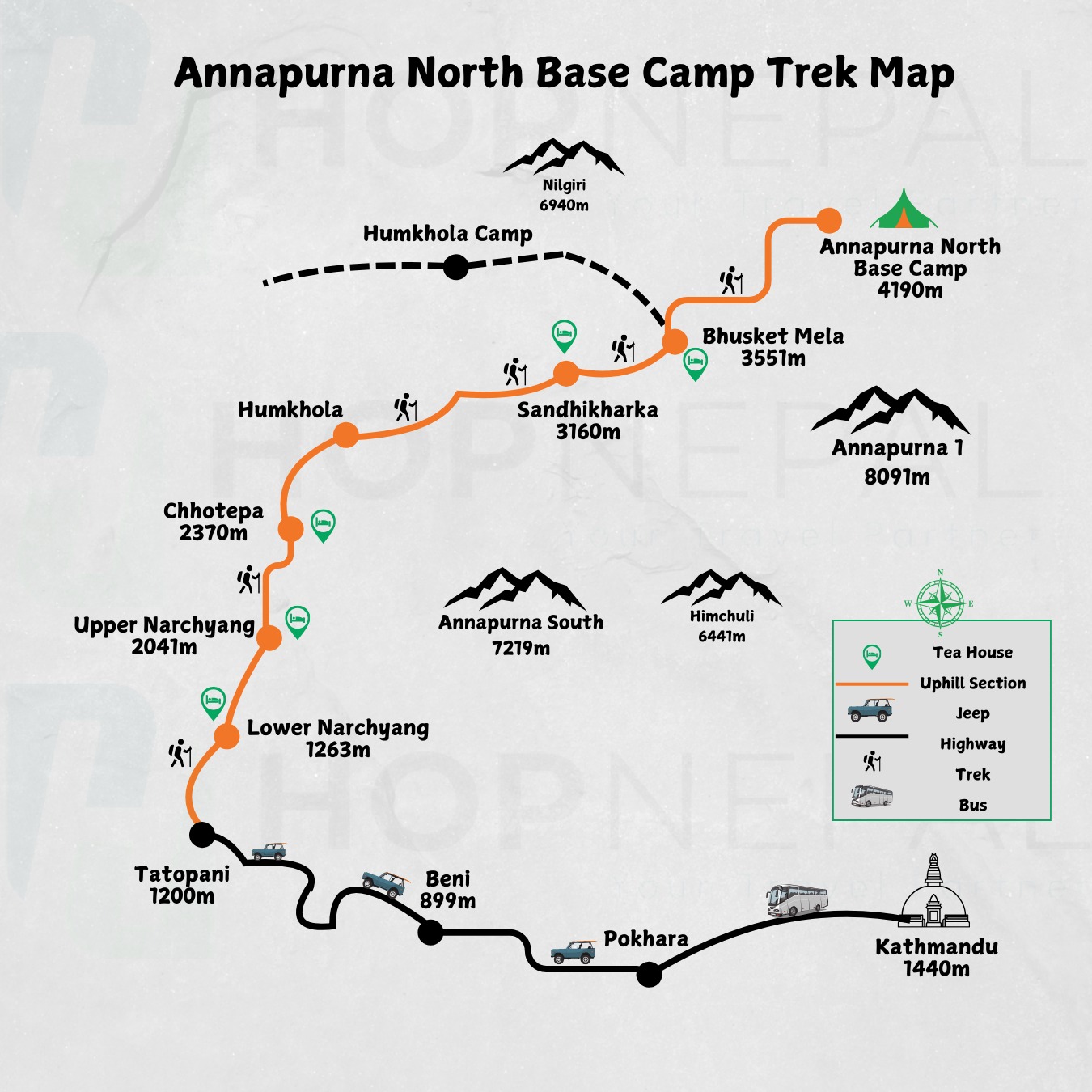
North ABC Trek Map
Accommodation on the North ABC Trek
North ABC should not be marketed as a comfortable teahouse trek.
Facilities are developing, but the upper route remains much more basic than established areas such as the classic ABC trail or Everest Base Camp. The Hiking Bees reference currently describes accommodation as a mixture of teahouses and tent houses, with simpler facilities at higher elevations.
Trekkers should be prepared for:
- Basic sleeping arrangements
- Shared toilets
- Limited electricity
- Little or no Wi-Fi
- Fewer opportunities for hot showers or device charging
That simplicity is part of the experience. North ABC is best approached with the expectation of a remote Himalayan trek rather than a lodge-to-lodge holiday.
Food During the Trek
Food choices become more limited as the route moves higher.
Where local kitchens are available, meals typically centre around practical trekking foods such as dal bhat, noodles, potatoes, eggs, porridge, soups and hot drinks. Dal bhat remains especially useful on long trekking days because it combines rice, lentils and vegetables into a filling meal.
Trekkers should also carry a small personal supply of energy bars, nuts or other trail snacks rather than relying on being able to purchase them at every stop.
North Annapurna Base Camp Trek Permits
The North ABC route lies within the Annapurna Conservation Area.
NTNC's current permit system specifically lists “Annapurna I Trek (Maurice Herzog Trail)” as an ACAP destination. As currently published by NTNC, the Annapurna Conservation Area entry fee is:
- Foreign nationals: NPR 3,000
- SAARC nationals: NPR 1,000
- Children under 10: No permit fee
What to Pack for North Annapurna Base Camp
North ABC requires proper Himalayan trekking equipment because weather conditions can change quickly between the lower Myagdi valleys and the 4,190-metre elevation.
Clothing
- Thermal base layers
- Quick-drying trekking shirts
- Trekking trousers
- Fleece or insulated mid-layer
- Down jacket
- Waterproof and windproof shell
- Warm hat and sun hat
- Gloves
- Several pairs of trekking socks
Footwear and Equipment
- Broken-in waterproof trekking boots
- Trekking poles
- 35–45 litre daypack
- Four-season sleeping bag
- Headlamp
- Power bank
- Reusable water bottles
- Water purification system or tablets
Personal Essentials
- Sunglasses with good UV protection
- High-SPF sunscreen
- Lip balm
- Personal medication
- Small first-aid supplies
- Blister treatment
- Toiletries
- Trekking snacks
A sleeping bag capable of handling sub-zero nights is particularly important because the upper accommodation is basic and temperatures can fall sharply after sunset.
Current North Annapurna Base Camp Trail Conditions
The North Annapurna Base Camp route is a developing mountain trail, so road and trekking conditions should always be checked immediately before departure.
As of early September 2026, the Maurice Herzog Trail and the Narchyang–Humkhola access road have reopened following landslide clearance after heavy monsoon rainfall. Trekking activity has resumed in the area. However, reopening does not mean conditions will remain unchanged throughout the season.
September sits around the transition from monsoon to autumn, and additional rainfall can still cause:
- Muddy trails
- Slippery rocks
- Increased stream levels
- Small landslides
- Temporary road interruptions
- Changes to vehicle access
Hop Nepal checks local road, weather and trail information before groups travel into the North ABC region. Travellers should also maintain some flexibility in case the itinerary needs to be adjusted for safety.
Responsible Trekking on the North ABC Trail
North Annapurna Base Camp is still relatively undeveloped compared with Nepal's major trekking routes. Keeping it clean and protecting its environment is therefore especially important. Trekkers should follow a simple principle: carry into the mountains only what you need and carry back everything that should not remain there.
Avoid leaving plastic bottles, food wrappers, batteries, wet wipes or other non-biodegradable waste on the trail. Use reusable drinking bottles wherever possible and refill or purify water rather than buying unnecessary disposable plastic. At Panchakunda and other water sources, never wash directly in the lake or contaminate the water with soap, shampoo or chemicals. Respect temples, stupas, prayer flags and places regarded as sacred by local communities.
Use existing trails rather than creating shortcuts through vegetation, and avoid disturbing wildlife. Where accommodation and food are provided by local communities, using those services directly contributes to the developing tourism economy of Narchyang and the wider Myagdi region. Responsible trekking helps ensure that North ABC remains a wilderness experience for the people who visit after you.
Who Is the North ABC Trek Best For?
This trek is particularly well suited to:
- Fit first-time Himalayan trekkers who have good hiking experience and understand that accommodation will be basic.
- Experienced trekkers looking for something quieter after completing routes such as classic ABC, Mardi Himal, Everest Base Camp or Annapurna Circuit.
- Photographers interested in remote mountain landscapes rather than busy tourist viewpoints.
- Mountaineering enthusiasts who want to experience the historic northern approach to Annapurna I.
- Adventure travellers willing to trade comfort for isolation and wilderness.
It is less suitable for travellers who expect private bathrooms, reliable Wi-Fi, extensive menus or luxury accommodation every night.
Why Trek North Annapurna Base Camp with Hop Nepal?
North ABC is still developing as a trekking destination, which makes good local coordination especially important.
Transport conditions can change. Accommodation is limited. Weather can affect the upper trail, and there are fewer services available if something goes wrong.
Hop Nepal's role is therefore not simply to provide someone to walk in front of you.
The journey requires coordination between transport, permits, guide support, mountain accommodation, meals, current trail information and emergency planning. Our approach is also flexible. If weather, altitude or trail conditions mean the plan should change, reaching base camp on the exact published schedule should never take priority over traveller safety.
North ABC rewards trekkers precisely because it is less predictable and less commercialised than Nepal's famous routes. We help you experience that remoteness without leaving the important logistics to chance.
COMMON QUESTIONS
FAQ
Q 1
Q 2
Q 3
Q 4
Q 5
Q 6
Q 7
Q 8
Q 9
Q 10
Q 11
Q 12
Q 13
Q 14
Q 15
Q 16
Q 17
Q 18
Q 19