
Are you going to trek the legendary Annapurna Circuit in 2026? It is very important that one understands how much a trekking permit costs for proper budgeting and also for legal compliance during a Himalayan adventure. Unlike in unrestricted trekking areas, multiple permits are required to protect the fragile mountain environment, preserve local culture, and support conservation efforts in one of Nepal's most spectacular trekking areas.
The Annapurna region is under a strict permit regimes that mandate all trekkers to procure the Annapurna Conservation Area Permit (ACAP) and the Trekkers' Information Management System (TIMS) card. The two permits serve different purposes: the ACAP is used to generate income for environmental conservation within the protected area, while the TIMS card is used to help ensure trekker safety. The fees vary by nationality, with different rates for foreign trekkers, SAARC country citizens, and Nepali trekkers.
The comprehensive guide is for 2026 and will feature the specific permit costs for the Annapurna Circuit trek, the location and means of obtaining ACAP permits in Kathmandu, ACAP and TIMS permits, and the fee scale for several categories of nationalities. This will ensure the accuracy and usefulness of the information you expect and will be of significant use when planning your Annapurna trek.
Nepal Trekking Permit Cost Overview
Nepal’s Trekking Permit System balances the collection of tourism-generated funds with the protection of the environment and the safety of trekkers. Knowing the permit system and pricing structures will help trekkers plan their treks in the Himalayas.
Types of Trekking Permits in Nepal
Nepal has divided its trekking areas into three categories of permit zones, each having different regulatory requirements and altogether different costs:
- Open / Unrestricted Areas:Major trekking areas such as the Annapurna Circuit, Everest Base Camp, Langtang Valley, and Helambu have permits only within the Conservation Area and TIMS Card. In open areas, there is no requirement for a guide; however, guides can be hired for safety and cultural understanding.
- Restricted Areas: These include remote border areas such as Upper Mustang, Manaslu, Upper Dolpo, and Kanchenjunga, which require special permits, including the RAP, in addition to conservation permits. These areas enforce organized treks with licensed guides and minimum group requirements-usually 2+ trekkers. RAP fees are well beyond those of regular conservation permits, which can range from 50 to 500 USD per person per week, depending on the region and season.
- Protected Areas: Conservation areas, such as the Annapurna Conservation Area, Sagarmatha National Park, and Langtang National Park, require specific conservation area permits that help fund environmental protection, trail maintenance, and community development programs. Trekking through such protected areas requires you to have these permits, whether independent or agency-assisted.
Restricted vs Non-Restricted Areas
The Annapurna Circuit is within the boundaries of the Annapurna Conservation Area, which is a non-restricted protected zone and therefore requires an ACAP, not a Restricted Area Permit. The non-restricted permit allows trekkers to travel independently without a guide, although guides can be useful on treks.
This contrasts with the Upper Mustang region, which, though located in the Annapurna region, demands an expensive RAP fee of 500 USD for 10 days, plus a guide. Thus, it is important to understand these differences to avoid confusion during one’s search for these Annapurna region treks.
Why Costs Vary by Nationality
Nepal works on a tiered pricing system of permit issuance, balancing access with funding conservation:
- Foreign Nationals are charged at standard international rates, thereby funding most conservation programs and infrastructure development. This is because tourism revenue is vital for the conservation of the mountain.
- Nationals of SAARC countries are offered discounted rates, thereby encouraging regional tourism cooperation and cultural exchange. These rates are 50-70% lower than those applicable to foreign nationals.
- Citizens of Nepal are given minimal charges or even free entrance to all conservation areas due to the rights they enjoy as citizens of the state.
Government Regulation Overview
The Nepal Tourism Board, the Department of National Parks and Wildlife Conservation, and the Ministry of Culture, Tourism, and Civil Aviation are responsible for trekking permits, with fees charged annually to cover conservation needs and infrastructure maintenance. The fees cover all park maintenance and conservation activities, reforestation efforts, and community development around the park. However, the quality of service varies from one conservation area to another.
Annapurna Circuit Permit Cost
It is required to obtain two essential permits before commencing the Annapurna Circuit trek. Understanding what each permit is for, including its importance, can increase your knowledge beyond government bureaucracy.
Required Permits for Annapurna Circuit
ACAP Permit (Annapurna Conservation Area Permit)
The ACAP allows people to trek within the Annapurna Conservation Area, which is one of Nepal’s largest conservation areas, covering 7,629 square kilometers. It was founded in 1986 and is the world’s pioneering community-based conservation model, uniting nature conservation with sustainable tourism development. The fees for the permits go to:
- Trail construction and maintenance within the conservation area
- Waste management systems: Porter carried out waste removal
- Reforestation and erosion control programs.
- Clean drinking water facilities at strategic locations.
- Preservation of Cultural Heritage in Traditional Villages.
- Alternative energy projects are reducing the need for firewood.
- Support local schools and health posts.
- Wildlife protection and habitat conservation
TIMS Card (Trekkers' Information Management System)
The TIMS card is a system for trekkers' registration and tracking. It was introduced in 2008 as part of a strategy to improve trekker safety and facilitate coordinated emergency rescue if needed. TIMS makes provision for:
- A centralized database of all trekkers with details of the itinerary.
- Contact details for coordinating rescue operations during an emergency.
- Trekker whereabouts tracking through checkpoint registrations
- Statistical data for tourism planning and policy development
- Insurance verification for trekkers
- Missing persons alerts, coordination of searches
Annapurna Circuit Permit Cost for Foreigners
Foreign nationals from other countries outside of the SAARC region have to pay standard international rates for Annapurna circuit permit fees. These fees remain constant throughout the year, with occasional adjustments for inflation.
ACAP Fee for Foreigners
Cost: NPR 3,000 or approximately USD $21
This charge applies to all foreign nationals, regardless of the duration of their trek. Whether you choose to trek for 12 days or take your time over 21 days, the ACAP fee remains the same at NPR 3,000. The permit is valid for trekking through the entire Annapurna Conservation Area.
Payment is made only in Nepali rupees and must be made to the official permit offices. Although the equivalent in USD fluctuates with the exchange rate, it can be budgeted at $20 to $25, considering rate fluctuations.
TIMS Permit Cost for Foreigners
Individual Trekker: NPR 2,000 or approximately USD $14
Organized Trekker: NPR 2,000 or approximately USD $14
The cost for TIMS for independent and agency-organized foreign trekkers is the same. Earlier, the cost for FIT was slightly higher than the cost for agency-organized foreign trekkers. Now the cost is the same for both. In reality, the difference exists for administrative and tracking purposes.
Total Estimated Permit Cost for Foreigners
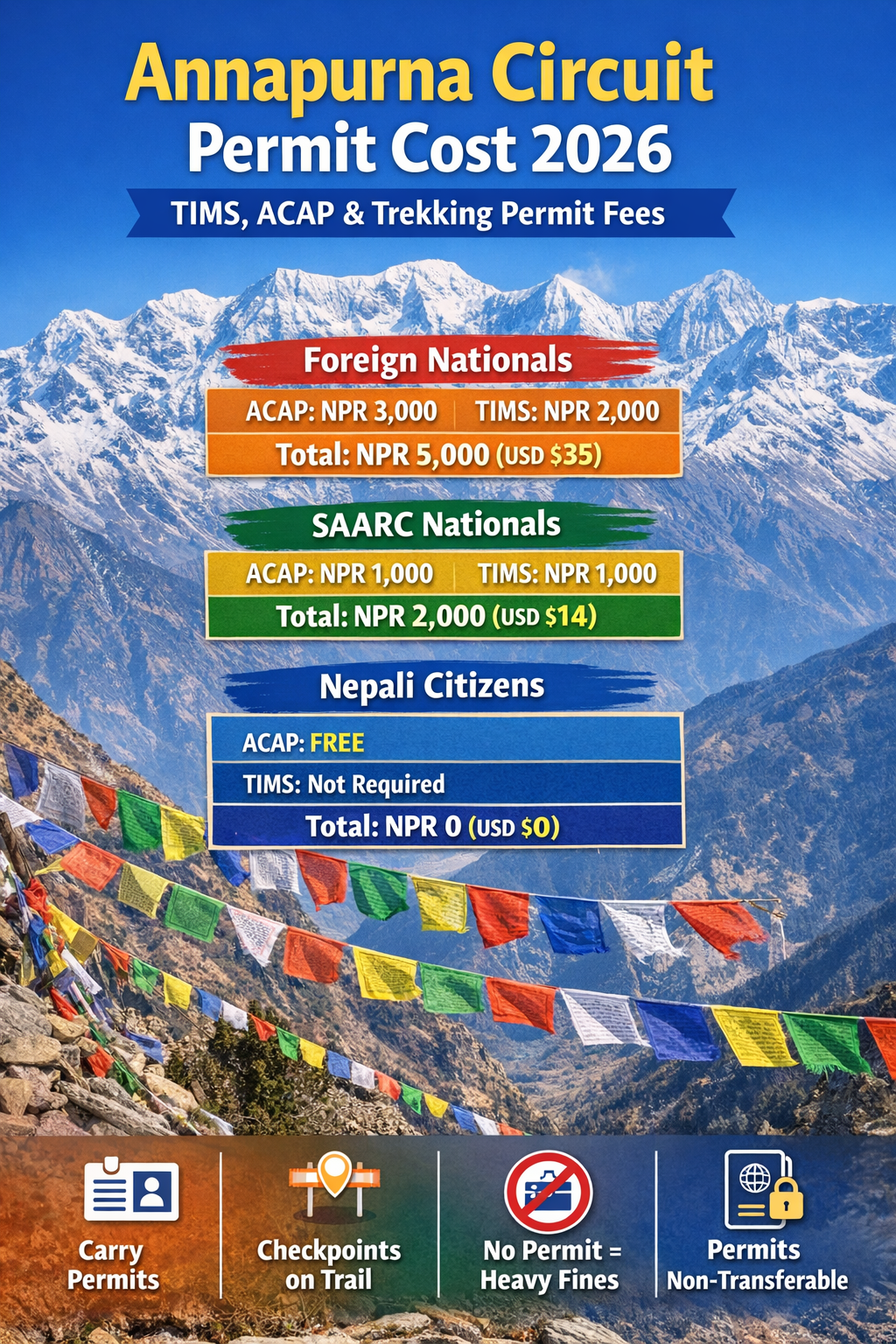
ACAP: NPR 3,000 or USD $21
TIMS: NPR 2,000 or USD $14
Total : NPR 5,000 or approximately USD $35
This covers the entire permit fee for foreign nationals trekking the Annapurna Circuit. Further expenses will include trekking equipment, accommodation, meals, guide and porter hire (if needed), transportation, and individual expenses, but the basic permit requirement is a reasonable NPR 5,000.
Annapurna Circuit Permit Cost for SAARC Nationals
The citizens of SAARC nations can take advantage of reduced permit fees, thereby boosting tourism within South Asia.
ACAP Fees for SAARC
Cost: NPR 1,000 or approximately USD $7
SAARC nationals pay merely one-third of the rate paid by foreign nationals for ACAP. This is a significant cost-saving factor. The discounted rate applies to the citizens of:
- Afganisthan
- Bangladesh
- Bhutan
- India
- Maldives
- Pakistan
- Sri Lanka
TIMS Cost for SAARC Nationals
Individual Trekker: NPR 1,000 or approximately USD $7
Organized Trekker: NPR 1,000 or approximately USD $7
Likewise, the fees charged by TIMS for SAARC national citizens are only half of those charged for the foreign national permit.
Total Permit Cost for SAARC Nationals
ACAP: NPR 1,000 or USD $7
TIMS: NPR 1,000 or USD $7
Total:N PR 2,000 or approximately USD $14
SAARC trekkers get a reduction of NPR 3,000, which is around USD $2,1, compared to other foreign nationals. This offers a 60% discount on permit costs. This reduces the overall cost of trekking the Annapurna Circuit for SAARC trekkers.
Required Documents for SAARC Permits
To obtain SAARC-rate permits, provide:
- Valid passport from a SAARC member country
- Recent and colored 4 passport-size photographs
- Completed ACAP and TIMS application forms
- Proof of SAARC nationality
Permit offices strictly verify SAARC nationality before issuing the SAARC permits. Attempts to use fake documents or to fraudulently claim SAARC status result in permit denial, fines, and potential trekking bans.
Annapurna Circuit Permit Cost for Indian Nationals
The citizens of India fall under the SAARC category, for which the fees are discounted, unlike those of other foreign countries. The discounted fees remain valid throughout the year unless and until changes are made.
ACAP Fee for Indian Nationals
Cost: NPR 1,000 or approximately USD $7
This charge will apply to all Indian trekkers entering and coming into the Annapurna Conservation Area. It makes no difference whether you complete the trek in 10 days or stretch it to 20+ days. The fee to the ACAP authority will still remain NPR 1,000.
Payment must be made in Nepali rupees at authorized permit offices. Due to exchange rate fluctuations, the USD equivalent may vary slightly.
TIMS Permit Cost for Indian Nationals
Individual Trekker: NPR 1,000 or approximately USD $7
Organized Trekker: NPR 1,000 or approximately USD $7The fee for TIMS is the same for independent Indian trekkers and agency-organized Indian trekkers. It is lower than the standard fee for foreign nationals.
Total Estimated Permit Cost for Indian Nationals
ACAP: NPR 1,000 or USD $7
TIMS: NPR 1,000 or USD $7
Total: NPR 2,000, or approximately USD $ 14. This includes the full cost of the mandatory permit for Indian citizens who plan to trek in Annapurna. Other minor costs, such as accommodation, food, guide and porterage, transport, and miscellaneous items, are not included.
Annapurna Circuit Permit Cost for Nepali Citizens
There is no charge for permits for Nepali citizens who wish to trek within their home country. Domestic trekking regulations and requirements vary from those of foreign treks.
ACAP Fee for Nepali Citizens
Cost: Free
The Nepalese citizens are not required to pay the fee while entering the Annapurna Conservation Area. The permit is mainly restricted for foreign nationals and SAARC citizens.
TIMS Permit Cost for Nepali Citizens
Individual Trekker: Not Required
Organized Trekker: Not Required TIMS registration is generally not required for Nepali citizens who are trekking in the Annapurna region.
Total Estimated Permit Cost for Nepali Citizens
ACAP: NPR 0
TIMS: NPR 0
Total: NPR 0. Nepali trekkers do not need permits for the Annapurna Circuit trek. But they will need a valid Nepali Citizenship Certificate for verification during checks.
Additional trekking costs, such as accommodation, meals, transport, and guide and porter services, may still apply depending on the chosen travel route.
TIMS Permit Cost
The Trekkers Information Management System remains the core of trekking safety in Nepal. Consistent fee systems are in place on most trekking routes.
What is TIMS?
TIMS is a comprehensive database that records trekkers' presence in popular trekking areas of Nepal. The system was introduced in 2008 by the Nepal Tourism Board and the Trekking Agencies' Association of Nepal (TAAN). Safety for trekkers is improved via:
- Registration & Tracking: Trekkers are registered with details such as full name, nationality, passport numbers, emergency contacts, trekking route and itineraries, expected return dates, details of the guide and agency (if appointed), and the insurance policy details.
- Checkpoint Monitoring: TIMS checks at popular routes are monitored by the system, which digitally traces the whereabouts of trekkers. If trekkers are not found at the expected point of check-out, search-and-rescue operations can be initiated immediately.
- Emergency Response: In emergency situations, TIMS provides instant access to trekkers' pertinent information, emergency contacts, insurance data, and last-known locations, helping speed up response time.
Why is TIMS required?
TIMS became mandatory after there were several high-profile cases of missing trekkers in remote areas, where the authorities had little information for any effective search operation. The system has already been invaluable in:
- Natural disasters
- Individual trekker accidents or illness
- Missing person searches
- Weather emergency evacuations
- Political unrest requiring foreigner tracking
Individual vs Group Trekkers
- Individual (FIT) Trekkers carry green TIMS cards. FIT trekkers do not have the support of any agency and have to arrange for themselves.
- Organized (Agency) Trekkers receive blue TIMS cards and trek with registered trekking agencies that employ local guides, porters, and provide logistical support. The application for TIMS cards is normally handled by trekking agencies for their clients.
ACAP Permit Office Kathmandu
Obtaining permits in Kathmandu before your trek is strongly recommended, though some permits can be obtained at trailhead checkpoints.
Official ACAP Permit Office Location
Nepal Tourism Board Office
Address: Bhrikuti Mandap, Kathmandu
The Nepal Tourism Board's headquarters is where the main permit counter is located, and most trekkers apply for their permits here. The office is in an easily accessible area in Kathmandu and is only a 30-minute walk or a short taxi ride from Thamel.
Alternative Locations:
ACAP permits can also be obtained at:
- Pokhara Tourism Board Office
- Besisahar checkpoint, which is the starting point of the Annapurna Circuit
- Entry checkpoints along various Annapurna routes
Documents Required for ACAP
- Original passport with Nepal entry visa
- 4 recent passport-size photographs
- Completed the ACAP application form, which is available at the office, or you can also download it online.
- Exact permit fee in Nepali rupees.
Office Hours
Sunday to Thursday: 9:00 AM to 5:00 PM (summer)
Sunday to Thursday:10:00 AM to 4:00 PM (winter)
Friday and Saturday: Closed
Nepal has a five-day work week with Saturday declared a weekly holiday. You should plan the permit acquisition, keeping this in mind. It should not include Fridays, Saturdays, or public holidays, as the offices are closed on those days.
Processing Time
Same-day processing is possible for ACAP permits with complete documentation. The best time is early morning, around 9 to 10 am, where the processing is faster. During the peak trekking season, which runs from September to November and March to May, processing will take 1 to 2 hours.
Can Agencies Process ACAP Permits?
Yes, registered trekking agencies can obtain ACAP and TIMS permits on behalf of their clients. This is commonly done for treks facilitated by organized trek packages, which can save you time as well as the language problems associated with permit offices. It requires submitting copies of your passport, photos, and filled-out forms. These permits usually take 1 or 2 working days to obtain in Kathmandu.
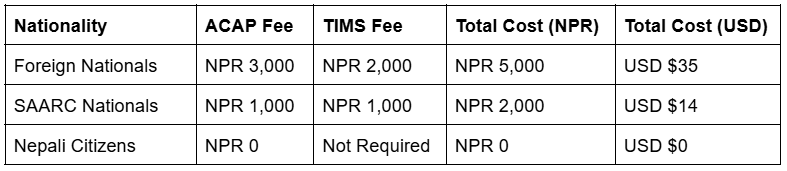
Annapurna Circuit Permit Cost Summary Table
Important Permit Rules Trekkers Must Know
You must understand and comply with permit requirements. This is important because it facilitates legal trekking activities and promotes conservation activities that preserve the Annapurna region for posterity.
Permits Must Be Carried During Trek
The physical permit card should always be carried in a waterproof pouch. There are many checkpoints where officials check the permits. The checkpoint areas include:
- Besisahar
- Manang village
- Thorong Phedi or High Camp
- Muktinath
- Jomsom
Checkpoints Along the Trail
The checkpoints have been established at strategic locations. They verify:
- Verification of permit validity and authenticity.
- Recording Trekkers' Information in Logbooks.
- Update the TIMS database with the trekker's whereabouts.
- Provide Safety Information and Weather Updates.
- Collect data on conservation areas.
Penalties for Trekking Without Permits
If you trek without valid permits, you face a penalty. Trekking without a permit is illegal and strictly prohibited. The penalties and fines include:
- Heavy fines
- Immediate trek termination and escort back to the trailhead
- Confiscation of trekking equipment
- Deportation from Nepal
- Future trekking bans in Nepal
- Legal prosecution in serious cases
Permit Non-Transferability
These permits are issued to individuals and cannot be transferred, sold, or shared. Permits are of the following types:
- Trekker's photograph
- Passport number
- Full name matching passport exactly
- Issue date and validity period
Frequently Asked Questions
Q. How much is the Annapurna Circuit permit cost?
The total cost of the Annapurna Circuit permit for foreign tourists is NPR 5,000, or approximately USD $35. The ACAP fee is NPR 3,000, and the TIMS card costs NPR 2,000. Citizens of SAARC countries pay only NPR 2,000, or approximately USD $14, whereas Nepalese citizens do not have to pay any fee for the permit. This includes environmental conservation, trail maintenance, and trekker safety schemes implemented in the Annapurna Conservation Area.
Q. Is TIMS mandatory for the Annapurna Circuit?
Yes, TIMS cards are often mandatory for all trekkers in the Annapurna region. The TIMS system allows for updating trekker safety data and coordinating rescues in emergencies, thereby providing useful statistics on tourism. Neither ACAP nor TIMS is sufficient for legal trekking in the Annapurna Conservation Area; both are required.
Q. Do SAARC nationals get a discount on Annapurna permits?
Yes, there are significant discounts for SAARC nationals for both ACAP and TIMS permits. The ACAP permit costs NPR 1,000 instead of NPR 3,000 and the TIMS permit costs NPR 1,000 instead of NPR 2,000. This totals a savings of NPR 3,000 which is about USD $21, representing a discount of 60% against the rate for foreign nationals.
Q. Can I get an ACAP permit online?
No, ACAP cannot be obtained through the online application process. All permits must be applied for in person at an office in Kathmandu, Pokhara, or at a point of entry with the original passport, photos, and in rupees. However, the trekking agencies can apply for a permit on behalf of the trekker. This can be done by submitting the required documents via email or in person.
Q. Where is the ACAP permit office in Kathmandu?
The ACAP permit office has its location at the headquarters of Nepal Tourism Board, Bhrikuti Mandap, in Kathmandu. To get these permits, one must visit on Sunday through Thursday, between 9 AM and 5 PM. This location is accessible by taxi from Thamel or by a 30-minute walk. Passport, four photos, permit application form, and exact fee in Nepali rupees are requirements for same-day processing.