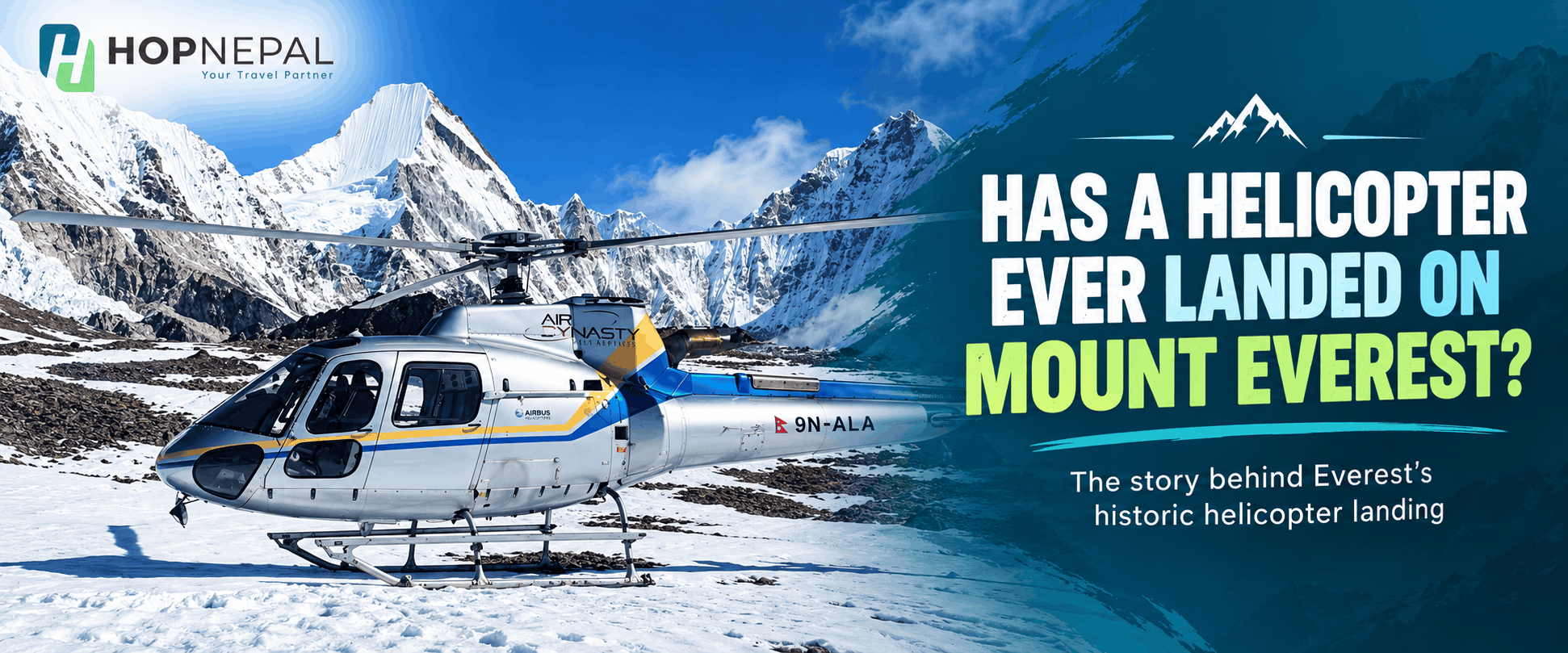
Yes, a helicopter has landed on the summit of Mount Everest. On 14 May 2005, during a test flight, French test pilot Didier Delsalle became the first person to land a helicopter there.
The Eurocopter AS350 B3 helicopter reached the summit of Everest, at an elevation of 8,848 metres (29,029 ft). The helicopter stayed in contact with the summit for 3 minutes and 50 seconds before taking off safely. This remarkable achievement earned Delsalle an official world record recognised by the Fédération Aéronautique Internationale (FAI), the international governing body for air sports.
More than two decades later, the achievement remains one of the most extraordinary events in high-altitude aviation. However, it does not mean that helicopters can routinely land on Everest or transport tourists to its summit.
So, how did a helicopter manage to reach the top of Mount Everest, and why has this extraordinary achievement never become a regular commercial service?
Who Was the First Person to Land a Helicopter on Mount Everest?
Didier Delsalle, a French helicopter test pilot working for Eurocopter, became the first person to successfully land a helicopter on the summit of Mount Everest.
On 14 May 2005, Delsalle flew a Eurocopter AS350 B3 Écureuil from Lukla in Nepal's Everest region towards the mountain's summit. Unlike ordinary helicopter flights, this mission was designed to test the aircraft's capabilities under extreme high-altitude conditions.
The helicopter had been prepared for the mission by reducing unnecessary weight, while the pilot and his team carried out extensive testing and flight preparations. Delsalle approached the summit while dealing with strong winds, extreme cold and the difficulties of operating a helicopter in thin mountain air.
According to the FAI, he successfully positioned the helicopter's left landing skid in the snow on the summit ridge and maintained contact for 230 seconds. The helicopter then took off and returned safely to Lukla.
Did Didier Delsalle Land on Mount Everest Twice?
Yes. After completing the historic helicopter landing on 14 May 2005, Didier Delsalle successfully repeated the flight the following day, 15 May. The second attempt was made because the team initially encountered difficulty retrieving the flight-recording data from the first landing.
The data from the original flight was subsequently recovered, confirming that the first landing had met the requirements for the aviation record.
These two successful summit flights demonstrated the extraordinary performance of the AS350 B3 and the skill required to operate at such an altitude. However, the flights were experimental aviation achievements, not demonstrations of a practical passenger transport service.
What Helicopter Landed on the Summit of Mount Everest?
The helicopter used for the historic mission was a Eurocopter AS350 B3 Écureuil, also known as the AStar. This single-engine helicopter was developed for demanding operations, including flights in mountainous terrain and at high altitudes.
The AS350 B3 was selected because of its powerful engine, relatively lightweight design and suitability for challenging mountain flying. For the Everest mission, the aircraft was prepared to minimise unnecessary weight, allowing it to operate more effectively in the extremely thin air near the summit.
The helicopter carried the pilot rather than a group of paying passengers. This distinction matters because carrying additional people, fuel or equipment increases the aircraft's weight and the power required to fly safely.
Key Facts About the Everest Summit Helicopter Landing
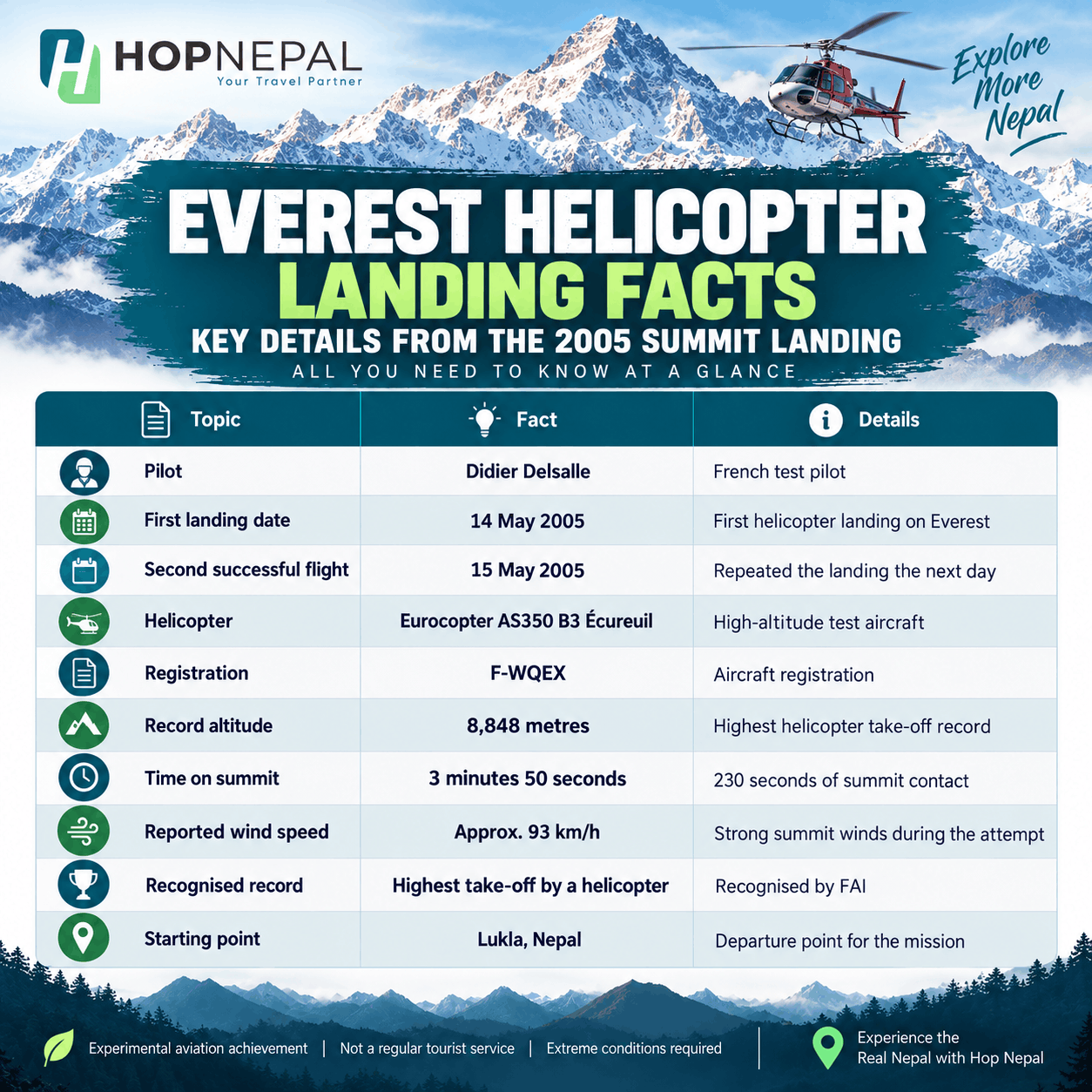
• Pilot: Didier Delsalle (France)
• Date of first landing: 14 May 2005
• Second successful flight: 15 May 2005
• Helicopter: Eurocopter AS350 B3 Écureuil
• Helicopter registration: F-WQEX
• Official record altitude: 8,848 metres
• Time on summit: 3 minutes 50 seconds
• Reported wind speed: Approximately 93 km/h
• Recognised record: Highest take-off by a helicopter
• Starting point: Lukla, Nepal
Why Was the 2005 Everest Helicopter Landing So Difficult?
Landing a helicopter on Mount Everest involves several challenges that rarely occur together during ordinary helicopter flights. The summit stands at 8,848.86 metres above sea level, where atmospheric pressure is substantially lower than at sea level.
The helicopter must generate enough lift to remain airborne while overcoming strong winds, cold temperatures and the lack of suitable landing space.
Extremely Thin Air
One of the greatest challenges is the low air density near the summit. Helicopter rotor blades generate lift by moving air. As altitude increases, air density decreases, reducing the amount of lift the blades can generate under otherwise comparable conditions.
At approximately 8,849 metres, standard atmospheric pressure is only around one-third of sea-level pressure. This makes hovering and landing considerably more demanding than at lower altitudes. Thin air also affects engine performance and reduces the available margin for safe flight operations.
Strong Winds and Turbulence
Mount Everest is exposed to powerful winds, particularly near the summit ridge. During Delsalle's record-breaking flight, the FAI reported winds of approximately 93 km/h.
Mountain winds can generate powerful updrafts and downdrafts, which can rapidly change a helicopter's position and the power required to maintain control. Near a narrow mountain summit, these unpredictable air movements create serious safety concerns.
Extreme Cold
The summit temperature during the record attempt was reported to be around −33°C. Such conditions create additional challenges for equipment, aircraft systems and pilots.
Cold temperatures may benefit some aspects of helicopter performance by increasing air density relative to warmer air at the same pressure altitude. Nevertheless, severe cold also poses operational hazards and complicates precise landing.
Limited Landing Space
Mount Everest does not have a flat helicopter landing pad at its summit. Its uppermost section consists of exposed snow and ice along a narrow mountain ridge, with steep drops on either side.
During the record attempt, Delsalle had to position the helicopter carefully and maintain contact with the snow rather than use a conventional prepared landing surface. Any sudden movement or loss of control could have had catastrophic consequences.
Aircraft Weight and Performance
A helicopter's weight strongly influences its ability to hover and land at high altitude. Passengers, luggage, fuel, and additional equipment all increase the lift required.
The Everest record flight was conducted using a lightweight aircraft configuration without ordinary passenger loads. The conditions of that experiment are therefore very different from those of a commercial helicopter tour carrying several travellers.
What World Record Did the Everest Helicopter Landing Set?
Didier Delsalle's flight established the FAI world record for the highest take-off by a helicopter at 8,848 metres.
The record was achieved on 14 May 2005 and remains associated with the Eurocopter AS350 B3. To qualify for the record, the helicopter had to remain on the ground for at least two minutes.
Delsalle maintained contact with the summit for 3 minutes and 50 seconds, exceeding the required duration by 1 minute and 50 seconds. It is important to distinguish the highest helicopter take-off record from the highest altitude ever reached by a helicopter. In 1972, French pilot Jean Boulet reached an altitude of 12,442 metres in an Aérospatiale SA 315B Lama, establishing the FAI absolute helicopter altitude record.
Boulet's aircraft reached a higher altitude than Mount Everest's summit but did not land there. Delsalle's achievement was different: he demonstrated that a helicopter could reach Everest, make a controlled landing and successfully take off again.
Why Don't Helicopters Land on the Summit of Mount Everest Today?
While the 2005 flight demonstrated that a helicopter can reach the Everest summit under exceptional conditions, it did not establish a reliable or safe means of transporting passengers to the top.
Commercial helicopter services require safety margins for changes in aircraft performance, passenger loads and emergencies. A flight that can be performed in a carefully planned aviation test is not necessarily viable as a routine passenger service. The main reasons helicopters do not offer routine Everest summit landings include:
- Limited aircraft performance: Extremely thin air reduces rotor efficiency and restricts the weight a helicopter can safely carry.
- Unpredictable weather: Strong summit winds, turbulence and rapidly changing visibility make precise landings hazardous.
- Unsuitable terrain: The narrow, snow-covered summit offers no conventional landing area for passenger operations.
- Minimal safety margins: Engine problems, unexpected downdrafts or sudden weather changes can become especially dangerous at such an extreme altitude.
- Passenger safety: Transporting tourists introduces additional weight, safety requirements and operational risks.
Consequently, no regular commercial helicopter service carries tourists to the summit of Mount Everest.
Can Tourists Reach Mount Everest by Helicopter?
Tourists can experience the Everest region by helicopter, but they cannot book a routine flight that lands on the summit. Commercial Everest helicopter tours operate at much lower altitudes, allowing travellers to enjoy spectacular views of the Himalayan landscape without undertaking a multi-week trek.
These flights generally follow routes through the Khumbu region, with views of mountains such as Everest, Lhotse, Nuptse and Ama Dablam.
A typical sightseeing itinerary may include an aerial view of Everest Base Camp, a short stop at a high-altitude viewpoint, where permitted, and a visit to the Everest View Hotel area. The exact route depends on weather, aviation restrictions, helicopter performance and the operator's approved flight plan.
Can a Helicopter Rescue Climbers from the Summit of Everest?
A helicopter landing on Everest's summit should not be confused with a practical helicopter rescue operation.
High-altitude helicopter rescues are an important part of mountaineering safety in Nepal. However, their feasibility depends on altitude, aircraft performance, terrain, weather and the condition of the person requiring assistance.
Helicopters may be used to evacuate climbers or trekkers from suitable locations in the Everest region when flight conditions allow. At higher elevations, rescue operations become more complicated. Some require specialised techniques, including external-load or long-line extraction, rather than a conventional landing.
The successful 2005 summit landing does not mean a helicopter can safely collect an injured climber from the top of Mount Everest. Climbers must therefore plan for emergencies without assuming that helicopter evacuation will be possible from every altitude.
Can You See the Summit of Mount Everest Without Climbing It?
Yes. It is not necessary to reach the summit to enjoy impressive views of Mount Everest.
Visitors can explore the Everest region via helicopter sightseeing flights or trekking routes in the Khumbu region of Nepal. The trek to Everest Base Camp is one of the most popular, following the standard route via Lukla, Namche Bazaar, Tengboche, Dingboche and Gorak Shep. You can trek to Everest Base Camp (5,364 metres), but the summit is not visible from Base Camp itself. For spectacular views of Everest's summit and surrounding mountains, visit the nearby Kala Patthar viewpoint.
For those with limited time, Everest helicopter sightseeing flights are available subject to weather and operating conditions.
Conclusion
The first helicopter landing on the summit of Mount Everest remains one of the most extraordinary achievements in aviation history.
On 14 May 2005, Didier Delsalle successfully landed a Eurocopter AS350 B3 at 8,848 metres, remained on the summit for nearly four minutes and safely returned to Lukla. His record-setting flight demonstrated what an exceptionally capable helicopter and experienced pilot could achieve under carefully planned conditions.
Yet the achievement also highlights the difference between experimental aviation and ordinary mountain tourism. Mount Everest's summit remains inaccessible to routine helicopter passenger services because of extreme altitude, unpredictable weather and difficult terrain. Fortunately, travellers do not have to reach 8,848.86 metres to appreciate the beauty of the world's highest mountain.
With Hop Nepal, you can explore Everest trekking itineraries and helicopter sightseeing options designed around the remarkable scenery of the Khumbu region.
Frequently Asked Questions
Has a helicopter ever landed on top of Mount Everest?
Yes. French test pilot Didier Delsalle successfully landed a Eurocopter AS350 B3 at the summit of Mount Everest on 14 May 2005. The helicopter remained there for 3 minutes and 50 seconds before taking off.
Who was the first helicopter pilot to land on Mount Everest?
Didier Delsalle was the first pilot to land a helicopter on the summit of Mount Everest. He completed the historic flight on 14 May 2005 while working as a test pilot for Eurocopter.
How many times has a helicopter landed on the summit of Everest?
The historic mission included two successful summit flights by Didier Delsalle, on 14 and 15 May 2005. These were exceptional test flights rather than commercial passenger operations.
What helicopter was used to land on Mount Everest?
The aircraft was a Eurocopter AS350 B3 Écureuil, registration F-WQEX. It was selected for its high-altitude performance and operated in a lightweight configuration for the mission.
How long did the helicopter stay on Everest?
The helicopter remained in contact with the summit for 230 seconds during the record-setting flight on 14 May 2005.
Can a helicopter fly higher than Mount Everest?
Yes. The FAI absolute helicopter altitude record is 12,442 metres, established by Jean Boulet in 1972. Reaching an altitude above Everest is different from safely landing and taking off on its summit.
Why can't helicopters regularly land on Everest?
The summit's thin air, strong winds, difficult terrain and limited aircraft performance make routine helicopter landings unsafe and impractical. The 2005 landing was a specially prepared aviation test.
Can a helicopter land at Everest Base Camp?
Helicopters may operate at Everest Base Camp for authorised purposes under suitable conditions. However, commercial sightseeing flights do not necessarily land there, and tourists should not assume an Everest Base Camp landing is included.
Is an Everest helicopter tour safer than climbing Mount Everest?
An Everest sightseeing flight avoids the prolonged exposure and technical mountaineering hazards of attempting the summit. However, high-altitude aviation still carries risks associated with weather, terrain, and aircraft operations. The two activities have very different risk profiles.