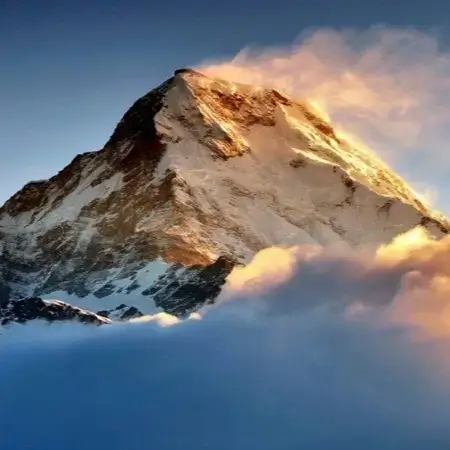

Climbing Mount Everest represents one of mountaineering’s greatest achievements. Rising approximately 8,849 metres above sea level, the world’s highest mountain has attracted climbers for more than a century. However, the journey to its summit exposes people to extreme altitude, unstable ice, powerful winds, avalanches and physical exhaustion.
So, how many people have died on Mount Everest?
According to the latest figures from the Himalayan Database, 344 people have died on Mount Everest as of 2026. The total includes climbers, guides and high-altitude workers who lost their lives on different routes and during different stages of an expedition.
The Himalayan Database recorded 339 fatalities up to December 2025. Five additional deaths were reported during the 2026 Everest season, bringing the current figure to 344.
Mount Everest Death Toll at a Glance
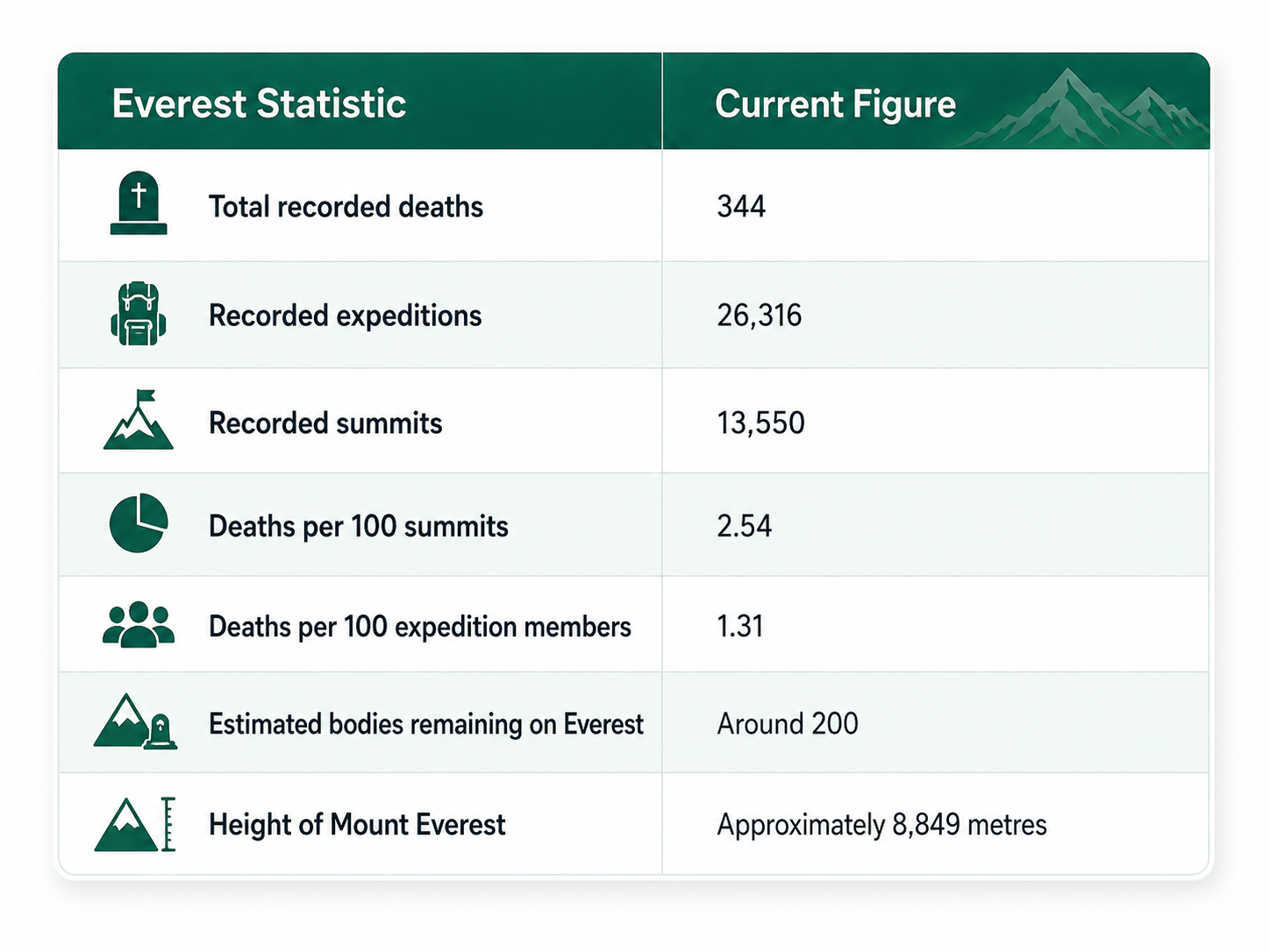
The current Himalayan Database report records 344 deaths, 13,550 summits and 26,316 expedition members. This equates to approximately 2.54 deaths per 100 summits and 1.31 deaths per 100 expedition members.
These percentages should not be interpreted as an exact personal probability of dying. A climber’s individual risk depends on experience, route, weather, acclimatisation, health, oxygen use, guiding support and decision-making.
Early Everest Expeditions and Fatalities
The history of Everest fatalities began before anyone successfully reached the summit. During early British expeditions in the 1920s, mountaineers and local high-altitude workers entered largely unknown terrain with basic equipment, limited weather information and little understanding of extreme-altitude medicine.
The first successful ascent did not take place until 29 May 1953, when Tenzing Norgay Sherpa and Edmund Hillary reached the summit through the Southeast Ridge route. The Himalayan Database records expeditions on Everest from 1921 and recognises the 1953 climb as its first confirmed ascent.
Since then, climbing equipment, fixed-rope systems, weather forecasting, supplementary oxygen and rescue coordination have improved considerably. Nevertheless, Everest remains an unpredictable and potentially fatal environment.
What Is the Death Rate on Mount Everest?
The latest database figures show approximately:
- 1.31 deaths per 100 expedition members
- 2.54 deaths per 100 successful summits
These are two different statistical comparisons. The first compares fatalities with the number of expedition members, while the second compares them with the number of recorded summits.
Everest has the highest total number of recorded mountaineering deaths among Himalayan peaks, largely because it attracts far more climbers than most other 8,000-metre mountains. However, it does not have the highest fatality rate. Peaks such as Annapurna I, Dhaulagiri I and Kangchenjunga have historically recorded higher death-to-summit ratios.
Between 1921 and 2025, the average was approximately five Everest deaths per year. From 2010 to 2025, the annual average increased to roughly seven as the total number of climbers and support workers on the mountain grew. At the same time, the normalised fatality rate declined because summit numbers increased faster than deaths.
Main Causes of Death on Mount Everest
No single danger is responsible for every Everest tragedy. Fatal accidents may result from natural hazards, medical emergencies, technical mistakes or several problems occurring together.
The leading recorded causes through the end of 2025 include:
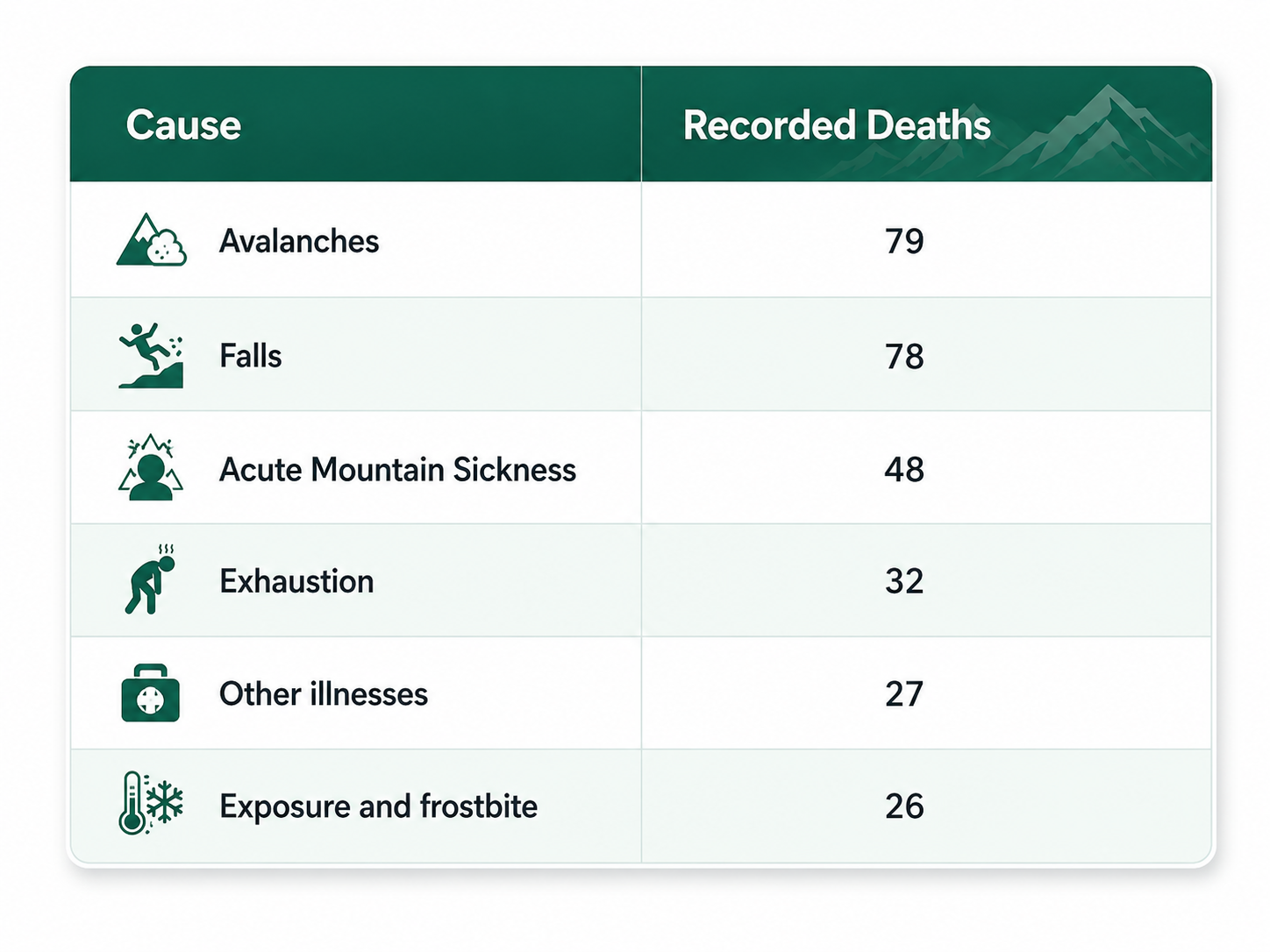
These figures are based largely on an analysis of Himalayan Database records. Other fatalities are classified as disappearances, crevasse accidents, falling ice, unknown causes or miscellaneous incidents.
Avalanches and Icefall Collapse
Avalanches are among the leading causes of death on Everest. They can be triggered by unstable snow, earthquakes, collapsing seracs or changes in temperature.
The Khumbu Icefall on the Nepal side is particularly hazardous. It is a constantly moving section of the glacier, filled with crevasses, unstable ice towers and blocks that can collapse without warning.
In April 2014, an ice avalanche in the Khumbu Icefall killed 16 Nepali high-altitude workers. The tragedy demonstrated how Sherpas and route-fixing teams often face repeated exposure to the mountain’s most unstable areas.
Falls and Crevasse Accidents
Steep slopes, hard ice, narrow ridges and hidden crevasses make falls one of the most common causes of Everest fatalities. A minor mistake involving crampons, a fixed rope, a ladder or an anchor can be fatal. The danger increases when climbers are exhausted, disoriented or affected by oxygen deprivation.
Falls may also occur because high-altitude illness affects balance, judgement and coordination. Medical researchers have noted that classifying a death can be difficult because a fall may have been caused by altitude-related cognitive or physical impairment.
Acute Mountain Sickness
The human body cannot fully adapt to the conditions found near the summit of Everest. As elevation increases, atmospheric pressure decreases, making less oxygen available with every breath.
Severe altitude illness may appear as high-altitude cerebral oedema (HACE) or high-altitude pulmonary oedema (HAPE). HACE is considered an advanced form of AMS, while HAPE can occur independently or alongside AMS and HACE.
High-Altitude Cerebral Oedema: Fluid accumulates in the brain, causing confusion, loss of coordination, hallucinations and unconsciousness.
High-Altitude Pulmonary Oedema: Fluid accumulates in the lungs, producing breathlessness, weakness, coughing and respiratory failure.
Immediate descent is the most important response. However, above the highest camps, moving an incapacitated climber can be extremely difficult.
Exhaustion
Everest summit attempts commonly last many hours. Climbers may leave Camp IV at night, reach the summit the following morning and then spend several more hours descending. Cold, dehydration, limited food, sleep deprivation and insufficient oxygen gradually reduce physical strength. A climber who uses most of their energy to reach the summit may not have enough strength to return safely.
This is why expedition leaders establish turnaround times. Reaching the summit too late can mean descending in darkness, in worsening weather or after oxygen supplies have become critically low.
Exposure, Frostbite and Hypothermia
Temperatures on the upper mountain can fall far below freezing, while powerful winds dramatically increase heat loss. Frostbite may develop quickly on exposed skin.
Hypothermia affects both physical movement and mental judgement. A climber may become confused, remove protective equipment or stop moving even when remaining still is dangerous. Equipment failures, damaged gloves, wet clothing or delays caused by congestion can increase exposure.
Sudden Illness and Medical Emergencies
Some climbers die from heart attacks, strokes and other medical conditions. Extreme altitude places enormous stress on the cardiovascular and respiratory systems.
Even a person who appears physically fit at sea level may experience serious complications at high altitude. Pre-expedition medical screening reduces certain risks but cannot guarantee safety.
Extreme Weather
Everest weather can change rapidly. Clear conditions may be replaced by high winds, snowfall or whiteout conditions, making navigation and movement extremely difficult.
Accurate forecasting has improved expedition planning, but weather predictions are never perfect. Climbers also compete for a limited number of suitable summit days, meaning that many people may be on the same route at once.
Where Do Most Deaths Happen on Everest?
Danger exists throughout an Everest expedition, but several locations are especially hazardous.
The Khumbu Icefall
Climbers using the Nepal route must travel through the Khumbu Icefall between Base Camp and Camp I.
Teams cross crevasses using aluminium ladders and follow routes between unstable ice formations. Because the glacier moves continuously, the route must be monitored and repaired throughout the season. Sherpa guides and high-altitude workers frequently make more journeys through the Icefall than visiting climbers, increasing their exposure to objective hazards.
The Lhotse Face
The Lhotse Face is a long, steep wall of hard ice leading towards Camp III. Climbers use fixed ropes, ascenders and crampons to move across terrain where a fall can result in serious injury or death. Falling ice, equipment problems and exhaustion are significant dangers in this section.
The South Col and Camp IV
Camp IV is located at nearly 8,000 metres. It is the final major camp before a summit attempt from Nepal and sits at the edge of the Death Zone. Climbers normally rest briefly, prepare oxygen equipment and wait for favourable weather before leaving for the summit. However, meaningful physical recovery is almost impossible at this altitude.
The Death Zone
The term “Everest Death Zone” refers to the area above approximately 8,000 metres. At this elevation, the body deteriorates even while resting. Thinking becomes slower, muscles weaken and basic movements require great effort. Supplementary oxygen can reduce the effects but does not make the environment safe.
The Summit Ridge
The final route towards the summit is narrow and exposed. Slow-moving climbers, rope problems or congestion can create delays. Every additional minute at this altitude consumes oxygen and energy. A delay that appears minor at a lower elevation may become life-threatening in the Death Zone.
Do More Climbers Die While Descending Everest?
The descent is one of the most dangerous parts of an Everest climb. After reaching the summit, climbers may be dehydrated, mentally impaired and physically exhausted. They must still negotiate the same fixed ropes, steep slopes and exposed sections that they climbed earlier.
Summit fever can make this problem worse. A climber may continue upwards despite moving too slowly, running low on oxygen or continuing beyond a safe turnaround time. Two climbers who died during the 2026 season had successfully reached the summit but died while descending: one near the Hillary Step and another at Camp III.
The summit is therefore only the halfway point of a successful expedition. A climb is not complete until the entire team returns safely.
What Were the Deadliest Years on Mount Everest?
Some seasons became especially deadly because of major natural disasters or severe weather.
1996 Everest Disaster
A severe storm trapped climbers high on Everest in May 1996. Eight people died during the best-known part of the disaster, including experienced expedition leaders and clients.
The tragedy became widely known through books, documentaries and the film “Everest”. It also encouraged closer examination of commercial guiding, turnaround times, oxygen management and decision-making at extreme altitude.
2015 Nepal Earthquake and Everest Avalanche
On 25 April 2015, a powerful earthquake struck Nepal and triggered an avalanche that hit Everest Base Camp. Nineteen people were reported to have been killed on the mountain in a single day, making it one of the deadliest individual disasters in Everest history.
2014 Khumbu Icefall Disaster
Sixteen Nepali workers died when an ice avalanche struck the Khumbu Icefall. Most commercial climbing activity on the Nepal side was subsequently cancelled for the season.
2023 Everest Season
The 2023 season recorded 18 deaths, making it the deadliest modern season in the Himalayan Database’s figures through 2025. Unlike years dominated by one large natural disaster, many of the 2023 fatalities occurred in separate incidents involving illness, falls and disappearances.
Why Are There So Many Bodies on Mount Everest?
Around 200 bodies are believed to remain on Everest. Recovering a body from high altitude is extremely dangerous, technically challenging and expensive. A frozen body may become much heavier because of accumulated ice. Recovery teams may need several highly experienced Sherpas, specialised equipment, additional oxygen and favourable weather.
In some locations, a recovery attempt could place many living climbers at risk. Helicopters cannot safely perform normal rescue operations near the summit, meaning that bodies must generally be lowered manually through steep and exposed terrain.
Families and expedition operators may therefore decide that recovery is not possible. Some bodies become covered by snow, fall into crevasses or are moved by changing ice. Others remain visible near established climbing routes. Melting ice may expose remains that have been hidden for years. In 2024, partial remains believed to belong to British climber Andrew Irvine, who disappeared in 1924, were discovered during a National Geographic expedition.
Are Bodies Used as Landmarks on Everest?
A small number of visible bodies have historically been described as informal route markers. The best-known example was the climber known as Green Boots, whose body rested in a shallow cave on the Northeast Ridge.
For many years, Green Boots was believed to be Tsewang Paljor. Documents reported in 2026 instead identified the climber as Dorje Morup, another member of the 1996 Indo-Tibetan Border Police expedition.
Bodies should not be treated merely as landmarks or attractions. Each represents a person, a grieving family and an expedition tragedy. Responsible Everest storytelling should approach the subject with accuracy and respect.
How Can Climbers Reduce the Risk?
No Everest expedition can be made completely safe. However, preparation and responsible decision-making can improve a climber’s chances of returning safely.
Gain High-Altitude Experience
Everest should not be a climber’s first major mountain. Experience on progressively higher and more technical peaks allows mountaineers to understand how they respond to altitude.
Choose a Responsible Expedition Operator
A reputable operator should provide experienced guides, adequate oxygen, dependable communications, realistic guide-to-client ratios and a clear rescue plan. Choosing an expedition solely because it has the lowest price may involve compromises in staffing, oxygen provision, equipment, acclimatisation planning or emergency support.
Acclimatise Properly
Climbers need enough time to adjust gradually to increasing altitude. Rushing the acclimatisation process increases the risk of serious altitude illness.
Follow the Turnaround Time
Reaching the summit is optional; returning is essential. Climbers must be prepared to turn around when the weather worsens, oxygen supplies run low, or progress becomes too slow.
Manage Oxygen Carefully
Teams should calculate oxygen requirements conservatively and carry emergency reserves. Regulators, masks and cylinders must be inspected before the summit attempt.
Listen to Guides and Your Body
Headaches, confusion, loss of coordination, difficulty breathing and unusual weakness must never be ignored. Descent may be necessary even when the summit appears close.
Final Verdict: How Many Climbers Have Died on Everest?
At least 344 people have died on Mount Everest as of 2026. The total includes deaths caused by avalanches, falls, altitude sickness, exhaustion, exposure, illness and other accidents across more than a century of expeditions.
The figure makes Everest the Himalayan mountain with the highest total number of fatalities, but not the highest death rate. Its large death toll is partly connected to the enormous number of people who attempt the mountain.
Modern equipment, experienced guides and improved forecasting have reduced some risks. Yet no technology can completely control altitude, weather, falling ice or human judgement. Everest is not conquered simply by standing on its summit. A successful expedition also requires safe decision-making throughout the descent and a responsible effort to bring the entire team home safely.
Frequently Asked Questions About Mount Everest Deaths
1. What is the biggest cause of death on Mount Everest?
Avalanches and falls are among the leading recorded causes of death on Everest. Other major causes include altitude illness, exhaustion, exposure, sudden medical emergencies and disappearances. Because several factors may contribute to one accident, the exact classification can vary between reports.
2. Do most Everest deaths occur in the Death Zone?
Many individual fatalities occur high on the mountain, especially during summit attempts and the descent. However, large disasters in the Khumbu Icefall and at Base Camp also account for a substantial part of the total death toll.
3. Is Everest the deadliest mountain in the world?
Everest has the highest recorded number of deaths among Himalayan peaks, but it does not have the highest death-to-summit rate. Annapurna I and several other peaks have considerably higher statistical fatality ratios.
4. Are all Mount Everest deaths officially recorded?
Most recognised fatalities are documented through expedition reports and historical research compiled by the Himalayan Database. However, the total may change when missing climbers are confirmed dead, historical records are corrected or new information becomes available. The database currently records 344 deaths on Everest.
5. Do people die after successfully reaching Everest’s summit?
Yes. Reaching the summit does not mean the expedition is complete. Some climbers die during the descent because of exhaustion, falls, altitude illness, deteriorating weather or depleted oxygen supplies.
6. What does the Mount Everest Death Zone mean?
The Death Zone generally refers to elevations above 8,000 metres. At these heights, the human body receives insufficient oxygen to maintain normal function for extended periods.
7. Does supplementary oxygen prevent deaths on Everest?
Supplementary oxygen can help climbers function at extreme altitude, but it does not remove every danger. Climbers may still experience equipment failure, falls, avalanches, frostbite, exhaustion or medical emergencies.
8. What is summit fever?
Summit fever describes the determination to continue towards a summit despite warning signs such as exhaustion, poor weather, slow progress or insufficient oxygen. It can cause climbers to ignore their turnaround time or underestimate the difficulty of descending.
9. Why do people continue climbing Everest despite the deaths?
People attempt Everest for different reasons, including personal ambition, adventure, professional mountaineering goals and the desire to test their physical and mental limits.
How many people have died on Mount Everest?
A January 2026 statistical compilation based on Himalayan Database records counted 339 deaths on Mount Everest through the end of 2025. This includes climbers, guides, Sherpas and other expedition workers on both the Nepal and Tibet sides of the mountain.
How many people have died on Mount Everest as of 2026?
The confirmed historical total stood at 339 deaths through 2025. However, additional fatalities were reported during the 2026 climbing season, so the complete total for 2026 will be higher once all incidents are verified and added to the Himalayan Database. The database is generally updated twice a year.
How many people died on Mount Everest in 2026?
At least five fatalities had been reported on Mount Everest by May 22 during the 2026 spring climbing season. Because annual records may be revised after expeditions finish and incidents are verified, the final 2026 figure should be treated as provisional until the Himalayan Database publishes its update.
How many people die climbing Mount Everest each year?
There is no fixed number of Mount Everest deaths per year. Some climbing seasons record only a few fatalities, while years affected by avalanches, earthquakes, severe storms or overcrowding can have considerably higher death tolls. The annual figure therefore varies according to weather, route conditions, expedition activity and major mountain disasters.
What is the death rate on Mount Everest?
A 2026 peer-reviewed study found that the mortality rate among mountaineers travelling above Everest Base Camp declined from approximately 1.4% during 1921–2006 to 0.7% during 2007–2024. The percentage depends on how researchers define attempts, climbers, summit ascents and deaths, so different publications may present slightly different Everest death rates.
What percentage of people who climb Mount Everest die?
Recent research suggests that the risk of death above Base Camp is below 1%, but this should not be interpreted as an individual climber’s exact chance of dying. Personal risk depends on experience, physical condition, acclimatisation, oxygen use, weather, route conditions, guide support and decisions made during the summit attempt.
What are the most common causes of death on Mount Everest?
The main causes of death on Mount Everest include:
- Extreme altitude and oxygen deprivation
- Exhaustion and impaired consciousness
- High-altitude illness
- Falls and climbing accidents
- Avalanches and collapsing ice
- Crevasse falls
- Hypothermia and severe weather
- Sudden medical emergencies
- Climbers becoming separated or disappearing
Recent research indicates that hypoxia, exhaustion, dehydration, hypothermia and altitude illness often combine rather than producing one clearly identifiable cause of death.
Where do most deaths occur on Mount Everest?
Many climber deaths occur during summit day, particularly at extreme elevations where oxygen levels are critically low. Research covering 2007–2024 found that 76.5% of climber fatalities occurred on summit day. Fatal accidents involving Sherpas and route workers were more likely to occur during route preparation, particularly in hazardous sections such as the Khumbu Icefall.
Is descending Mount Everest more dangerous than climbing up?
Descending from the summit is one of the most dangerous stages of an Everest expedition. Climbers are usually exhausted, dehydrated, exposed to prolonged oxygen deprivation and may have limited supplies of supplemental oxygen. Although summit-descent mortality on standard routes declined from 3% in 1982–2006 to 0.8% in 2007–2024, descent remains a critical period for accidents and medical emergencies.
What is the Death Zone on Mount Everest?
The Death Zone generally refers to elevations above 8,000 metres, or approximately 26,000 feet. At this altitude, the amount of available oxygen is too low for the human body to function normally for an extended period. Climbers can experience extreme fatigue, poor judgement, confusion, loss of coordination, frostbite and life-threatening altitude illness.
How many dead bodies are still on Mount Everest?
There is no verified official count of the bodies remaining on Mount Everest. A widely repeated estimate suggests that more than 200 bodies may still be on the mountain, but the exact number is unknown because some remains are hidden in crevasses, buried by snow or ice, moved by glaciers, recovered privately or never located.
Why are dead bodies left on Mount Everest?
Recovering a body from high on Everest can place the recovery team at serious risk. Remains may be frozen into the mountain, located in steep terrain or positioned inside the Death Zone, where rescuers have limited oxygen and very little time. Recovery operations are also technically difficult and can require large teams, favourable weather and substantial financial resources.
What happens when someone dies on Mount Everest?
The expedition operator, local authorities and the climber’s family normally discuss whether recovery is possible. Bodies located near Base Camp or lower sections may be brought down when conditions allow. At higher elevations, recovery may be delayed or considered too dangerous. In some situations, the remains stay on the mountain permanently.
How many Sherpas have died on Mount Everest?
A statistical compilation published before the 2026 climbing season recorded 130 fatalities among hired high-altitude workers, representing approximately 39% of the 339 recorded deaths through 2025. This category includes Sherpas and other expedition workers who fix ropes, establish camps, carry equipment and support climbers.
Is climbing Everest without supplemental oxygen more dangerous?
Yes. Climbing without supplemental oxygen places far greater stress on the body and increases exposure to severe hypoxia, exhaustion and impaired decision-making. A 2026 Everest statistical review reported that more than half of the recorded fatalities involved people who were not using supplemental oxygen, although individual circumstances and data availability vary.
Why is climbing Mount Everest so dangerous?
Mount Everest combines extreme altitude, very low oxygen levels, freezing temperatures, powerful winds, unstable glaciers, avalanches, crevasses and rapidly changing weather. Climbers must also cross dangerous areas such as the Khumbu Icefall and spend time above 8,000 metres, where physical and mental performance deteriorates quickly.
Is Mount Everest safer today than it was in the past?
Statistically, Everest has become safer than it was during earlier periods of mountaineering. Better weather forecasting, fixed ropes, supplemental oxygen, communication systems, experienced guides and improved rescue coordination have contributed to lower mortality rates. Nevertheless, Everest remains an extreme environment where rescue may be difficult or impossible.
Do Everest Base Camp trekkers face the same death rate as summit climbers?
No. Trekking to Everest Base Camp is different from participating in a Mount Everest summit expedition. Most Everest mortality statistics examine expedition members, Sherpas and workers who travel above Base Camp. Base Camp trekkers remain at much lower elevations, although they must still take altitude sickness, weather and proper acclimatisation seriously.
Can anyone survive climbing Mount Everest?
Many climbers successfully return from Everest, but survival depends on more than physical fitness. Relevant high-altitude experience, gradual acclimatisation, reliable expedition support, suitable weather, proper equipment and a willingness to turn back are all essential. Reaching the summit is optional; returning safely must remain the main objective.