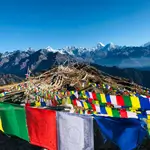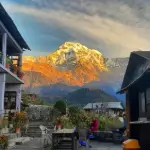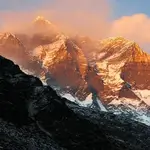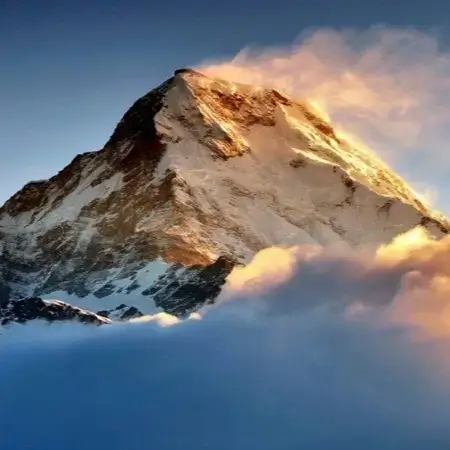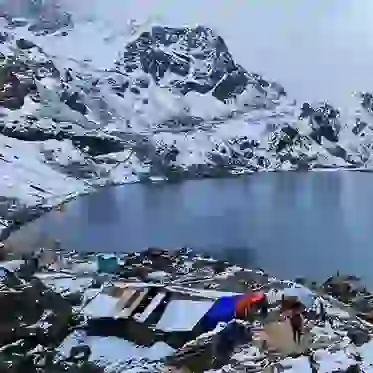

Trekking beneath Mount Kanchenjunga (8,586 m) takes you into one of Nepal's most remote Himalayan regions. Rising in the far east of Nepal near the borders with India and Tibet, Kanchenjunga is the third-highest mountain in the world and offers a very different trekking experience from the busier Everest and Annapurna regions.
The isolation is part of its attraction, but it also means that planning a Kanchenjunga trek involves more than simply choosing an itinerary. Parts of the route fall within a restricted trekking area, while the trail also passes through the Kanchenjunga Conservation Area. Foreign travellers therefore need the correct government permits before entering the region.
For most international trekkers, the two main permit requirements are the Kanchenjunga Restricted Area Permit (RAP) and the Kanchenjunga Conservation Area Permit (KCAP). The Restricted Area Permit must be processed through an authorised Nepali trekking agency rather than applied for independently. Nepal's Department of Immigration currently lists the Taplejung restricted-area fee at USD 20 per person per week for the first four weeks and USD 25 per person per week thereafter.
Quick Answer: How Much Does a Kanchenjunga Trek Permit Cost in 2026?
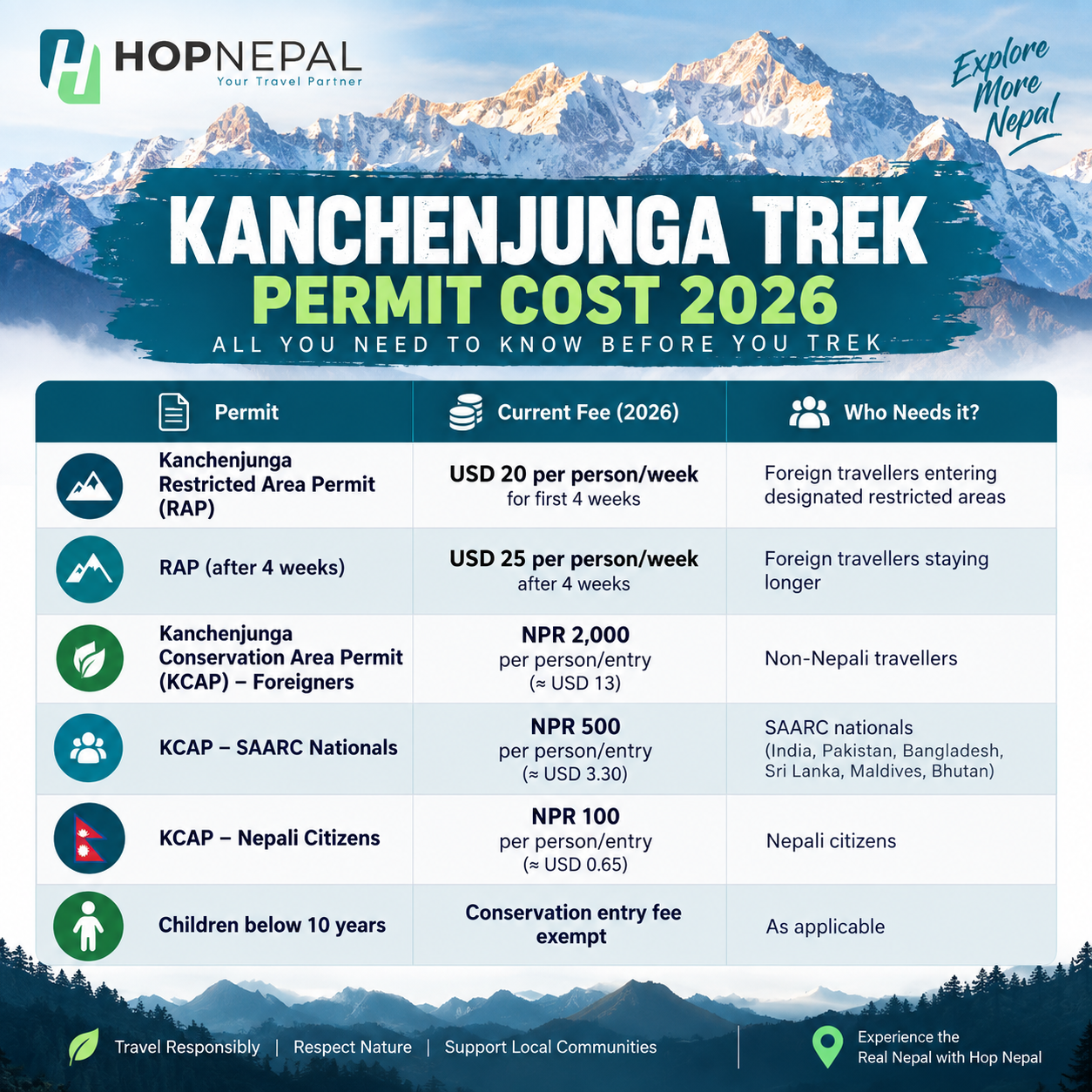
The exact cost of a Kanchenjunga trekking permit depends mainly on how long a foreign trekker remains in the designated restricted area.
The Department of Immigration's current restricted-area schedule lists USD 20 per week for Taplejung for the first four weeks and USD 25 per week thereafter. Nepal Tourism Board's general protected-area fee schedule currently lists the Kanchenjunga Conservation Area fee at NPR 2,000 for foreigners, NPR 500 for SAARC nationals and NPR 100 for Nepali citizens, with children below 10 exempt from the conservation-area entry fee.
What Permits Are Required for the Kanchenjunga Trek?
Kanchenjunga differs from many standard trekking destinations in Nepal because its trekking route combines a protected conservation area with government-designated restricted zones.
Foreign trekkers planning the Kanchenjunga Circuit Trek, Kanchenjunga North Base Camp Trek or Kanchenjunga South Base Camp Trek should therefore plan around two main permits: the Restricted Area Permit for the controlled sections of Taplejung and the Kanchenjunga Conservation Area entry permit.
Having a conservation-area permit does not replace the Restricted Area Permit. Similarly, having an RAP does not remove the need to pay the conservation-area entry fee. They serve different purposes and are administered under different government systems.
Kanchenjunga Restricted Area Permit
The Kanchenjunga Restricted Area Permit, commonly called the RAP, is the most important special permit for foreign trekkers travelling through the restricted sections of the Kanchenjunga region.
The Department of Immigration currently identifies restricted areas within Phaktanglung Rural Municipality wards 6 and 7, Milwakhola Rural Municipality ward 5 and Sririjunga Rural Municipality ward 8 in Taplejung. The current fee is USD 20 per person per week for the first four weeks, followed by USD 25 per week if the permitted stay extends beyond four weeks.
The fee relates to the permitted stay in the restricted area rather than simply the total number of days on your Nepal holiday. Therefore, two Kanchenjunga itineraries with the same overall duration may not have exactly the same RAP cost if they spend different amounts of time in the restricted zone.
For example, if an itinerary requires approximately two chargeable weeks within the restricted area, the RAP would normally be approximately USD 40 per person under the current first-four-weeks rate. The final calculation should always be made from the confirmed itinerary used in the permit application.
Kanchenjunga Conservation Area Permit
The second requirement is the Kanchenjunga Conservation Area Permit, often shortened to KCAP.
The Kanchenjunga Conservation Area covers approximately 2,035 sq km in eastern Nepal and protects an ecologically important Himalayan landscape that supports wildlife, including snow leopards, Himalayan black bears, musk deer, and red pandas. Unlike the Restricted Area Permit, which is charged according to time spent in the restricted zone, the conservation fee is an entry fee.
The current general Nepal Tourism Board protected-area schedule lists the Kanchenjunga Conservation Area fee at NPR 2,000 for foreign nationals, NPR 500 for SAARC nationals and NPR 100 for Nepali citizens per entry.
The Department of National Parks and Wildlife Conservation's Kanchenjunga information also lists NPR 2,000 for foreigners, NPR 500 for SAARC nationals and NPR 100 for Nepali visitors.
Kanchenjunga Permit Cost for Foreigners
Travellers from Australia, the United Kingdom, the United States, Canada, Europe, China, Japan and other non-Nepali countries should budget for both the restricted-area fee and the Kanchenjunga Conservation Area fee.
For a foreign visitor spending two chargeable weeks within the restricted zone, an illustrative permit calculation would be USD 40 for the RAP plus NPR 2,000 for KCAP.
This should not be presented as a universal, fixed "Kanchenjunga permit package" because the RAP component varies with the number of weeks for which the restricted-area permission is valid.
Kanchenjunga Permit Cost for Indian and SAARC Travellers
Indian citizens are considered foreign nationals for Nepal's restricted-area trekking permit system, even though India is a SAARC member. The current Department of Immigration Taplejung fee schedule does not publish a separate discounted SAARC RAP rate, so the applicable restricted-area fee is USD 20 per person per week for the first four weeks under the present schedule.
SAARC nationality does, however, affect the conservation-area entry fee. Nepal Tourism Board’s general fee schedule currently lists NPR 500 per person per entry for SAARC nationals entering the Kanchenjunga Conservation Area.
This distinction is useful for searchers looking specifically for the Kanchenjunga trek permit cost for Indian citizens, as the RAP and conservation permit should not be confused with one another.
Kanchenjunga Permit Cost for Nepali Citizens
The Restricted Area Permit administered by Nepal’s Department of Immigration applies to foreign tourists entering restricted trekking areas. Nepali citizens therefore do not pay the RAP charge applied to foreign tourists.
For the conservation area, the current general protected-area schedule lists an entry fee of NPR 100 per Nepali visitor per entry. Nepali travellers should carry acceptable identification and comply with any local registration, conservation or route-specific requirements in force at the time of travel.
Can You Trek Kanchenjunga Solo in 2026?
This is one of the most important changes to Kanchenjunga trekking regulations in 2026.
Previously, restricted-area permits were generally required for at least two foreign trekkers. That created a problem for individual travellers who wanted a private Kanchenjunga trek but could not find another person to share their permit with.
On 22 March 2026, Nepal's Department of Immigration revised the policy and allowed individual foreign travellers to receive restricted-area trekking permits. However, this does not mean that a foreigner can independently walk into Kanchenjunga without professional support.
Under the revised system, a solo traveller can be the only tourist on the permit, but the trek must still be organised through a registered trekking agency and accompanied by a licensed trekking guide. Contemporary reporting on the Department of Immigration announcement also states that one guide may accompany a maximum of seven trekkers.
Do You Need a Licensed Guide for the Kanchenjunga Trek?
Yes. Kanchenjunga is a restricted trekking region, and the Restricted Area Permit must be obtained through an authorised trekking agency.
The Department of Immigration states that permits for Nepal's restricted trekking areas are issued through listed trekking agencies rather than directly to individual foreign tourists. The March 2026 reform changed the minimum number of travellers required for a permit; it did not remove the agency and guide requirements.
This requirement is particularly relevant in Kanchenjunga because it is one of Nepal's more remote long-distance trekking destinations. Settlement becomes sparse at higher elevations, weather can change quickly, communication facilities are limited, and some sections of the route cross isolated alpine terrain.
A qualified guide, therefore, has a role beyond simply complying with permit rules. Your guide helps with route management, accommodation coordination, communication, acclimatisation decisions, checkpoints and emergency response.
Documents Required for a Kanchenjunga Restricted Area Permit
Trekkers normally provide their personal documents to the trekking agency, while the registered agency handles the formal Restricted Area Permit application. The Department of Immigration's current permit procedure requires supporting documentation for the trekker, insurance, itinerary, and agency.
Typical traveller-side requirements include:
- A valid passport and valid Nepal visa covering the trekking period.
- Passport details and a recent photograph for the permit application
- Confirmed Kanchenjunga trekking itinerary
- Travel or trekking insurance documentation
- Details required by the authorised trekking agency
- Licensed guide and trekking staff details arranged through the agency
The trekking company must also provide the required government licences, tax documentation, agency guarantee, itinerary, and other regulatory documents when processing the application.
Is Travel Insurance Required for the Kanchenjunga Permit?
Insurance documentation is included among the Department of Immigration's current required documents for restricted-area trekking applications. The requirements include insurance information for foreign trekkers as well as insurance documentation for accompanying Nepali guides and staff.
For Kanchenjunga, travellers should not choose a policy based only on whether it satisfies paperwork requirements. The region is remote and reaches elevations above 5,000 metres on common itineraries, so a suitable policy should cover the maximum trekking altitude of your itinerary, medical treatment and emergency evacuation, including helicopter evacuation where applicable.
Trekkers should check their own insurer's altitude limits and exclusions rather than assuming that ordinary overseas travel insurance automatically covers high-altitude trekking in Nepal.
How Do You Get a Kanchenjunga Trek Permit?
A foreign traveller cannot simply arrive at the Department of Immigration and apply independently for a Kanchenjunga RAP.
The registered trekking agency submits the Restricted Area Permit application on behalf of the traveller. The application includes passport and visa information, insurance documents, the trekking programme and required agency documentation. The Department of Immigration states that complete applications received sufficiently in advance of the end of office hours can generally be processed on the same working day.
The Kanchenjunga Conservation Area entry permit is separate. Government conservation information states that conservation entry permits can be obtained through designated counters, including the National Parks counter at the Nepal Tourism Board Tourist Service Centre in Bhrikutimandap, Kathmandu, or at the conservation-area entrance.
When booking through Hop Nepal, it is much simpler for travellers to send the required information in advance, allowing the trekking team to coordinate permit arrangements before departure.
Can You Get the Restricted Area Permit in Taplejung?
Trekkers should not plan to reach Taplejung and then try to arrange the RAP independently.
The Restricted Area Permit is administered by Nepal’s Department of Immigration and must be applied for through an authorised trekking agency. Therefore, it should be arranged as part of the pre-trek preparation rather than treated like a simple entrance ticket purchased at the trailhead.
The conservation-area entry process differs, as conservation entry permits may be available at designated checkpoints.
Do You Need Separate Permits for Kanchenjunga North and South Base Camp?
The basic permit structure does not suddenly change depending on whether your itinerary focuses on Kanchenjunga North Base Camp, South Base Camp or the complete Kanchenjunga Circuit.
The important factor is whether the itinerary enters the designated conservation and restricted areas and how long the traveller remains within the restricted zone. A longer full-circuit itinerary can therefore cost more in RAP fees than a shorter itinerary because the restricted-area permit is time-based.
Your approved trekking itinerary is important because restricted-area travel is tied to the route and duration submitted during the permit process. Travellers should discuss route changes with their trekking agency rather than making significant unapproved diversions after the permit has been issued.
Do You Need a TIMS Card for the Kanchenjunga Trek?
Nepal Tourism Board's current TIMS information specifically lists several Kanchenjunga trekking routes, including Kanchenjunga Base Camp routes, under the revised TIMS system. However, older TAAN guidance contains an exemption for visitors holding restricted-area permits. Because these published sources are not fully consistent, trekkers should have their registered trekking agency confirm the applicable TIMS requirement when the RAP and itinerary are processed.
Why Is Kanchenjunga a Restricted Trekking Area?
Kanchenjunga lies in Nepal's far eastern border region, and parts of the trekking route pass through areas that the Government of Nepal regulates as restricted zones.
Restricted-area permits help the government manage movement through sensitive border districts while maintaining official records of foreign visitors travelling through remote terrain.
At the same time, the Kanchenjunga Conservation Area protects one of Nepal's important Himalayan ecosystems. The region contains forests, alpine habitats, glaciers, and high-mountain environments that support species including the red panda, snow leopard, musk deer, blue sheep, and Himalayan black bear.
The permit system therefore has two distinct elements: restricted-area management and environmental conservation.
What Happens If Your Kanchenjunga Trek Takes Longer Than Planned?
The RAP is issued against a specific period and itinerary. Travellers should therefore make sure the permitted duration provides sufficient time for the route they intend to follow.
If the restricted-area stay extends beyond the period covered by the permit, additional government charges may apply. The current Taplejung schedule charges USD 20 per week during the first four weeks and USD 25 per week thereafter.
This matters more on Kanchenjunga than on shorter treks because weather, acclimatisation or logistical delays can affect a remote Himalayan itinerary. Any necessary permit adjustments should be handled through the trekking agency rather than ignored on the trail.
Plan Your Kanchenjunga Trek with Hop Nepal
The Kanchenjunga Trek rewards travellers seeking something more remote than Nepal's conventional trekking routes. The journey takes you through isolated Himalayan valleys, traditional settlements, high mountain passes and extraordinary scenery beneath the world's third-highest mountain.
Its remoteness also means that permits, insurance, route planning, acclimatisation and guide arrangements need to be organised correctly before departure.
Hop Nepal can help arrange your Kanchenjunga trekking itinerary, a licensed guide, required permits, transportation, and all trekking logistics so you can concentrate on the journey rather than the paperwork.
Frequently Asked Questions About Kanchenjunga Trek Permits
How much is the Kanchenjunga Restricted Area Permit in 2026?
The Department of Immigration's current September 2026 schedule lists the Taplejung Restricted Area Permit at USD 20 per person per week for the first four weeks and USD 25 per week thereafter.
How much does the Kanchenjunga Conservation Area Permit cost?
The current general Nepal Tourism Board schedule lists NPR 2,000 for foreign nationals, NPR 500 for SAARC nationals and NPR 100 for Nepali citizens per entry.
Can I trek Kanchenjunga alone in 2026?
A single foreign traveller can now receive a restricted-area permit following the March 2026 rule change, but a licensed guide and registered trekking agency remain required. Solo, therefore, means travelling without another tourist, not trekking through a restricted area without a guide.
Can I apply for the Kanchenjunga RAP myself?
No. Nepal's Department of Immigration states that restricted-area trekking permits are issued through authorised trekking agencies.
Is a guide compulsory for Kanchenjunga?
Yes. Foreign trekkers entering the restricted region need to travel under the current restricted-area system with a licensed trekking guide arranged through a registered agency.
Do Indian citizens need a Restricted Area Permit for Kanchenjunga?
Yes. Indian travellers are foreign nationals for the restricted-area permit requirement. The current Taplejung RAP schedule does not show a separate discounted SAARC rate.
Do Nepali citizens need the foreign Restricted Area Permit?
No. The Department of Immigration's requirement for restricted-area trekking permits is intended for foreign tourists. Nepali citizens should instead follow the applicable conservation-area and local travel requirements.
Are children exempt from the Kanchenjunga permit?
Nepal Tourism Board lists children below 10 as exempt from the Kanchenjunga Conservation Area entry fee. Restricted-area requirements should be confirmed with the trekking agency for any foreign minor travelling into the controlled zone.
Is the Kanchenjunga permit valid for both North and South Base Camp?
The same basic RAP and conservation-area permit system is used for Kanchenjunga routes. The required RAP duration, however, depends on the actual route and time spent within the restricted area.