
Small words, big impact.
You do not need to speak fluent Nepali to travel around Nepal. But learning a few Nepali words for tourists can make everyday interactions easier, friendlier and far more memorable.
A simple Namaste when you meet someone, Dhanyabad when a local helps you or Mitho chha after enjoying a meal can make a surprisingly positive impression.
Nepal is also far more linguistically diverse than many first-time visitors realise. The 2021 census recorded 124 mother tongues, while Nepali remains the country's official language and the most widely spoken mother tongue. If you would like to understand this diversity before your trip, read Hop Nepal's complete guide to the languages of Nepal.
For most international travellers, however, learning a few basic Nepali expressions is enough to make your journey more personal.
Here are 11 useful Nepali words and phrases every tourist visiting Nepal should know.
11 Nepali Words at a Glance
- Namaste – नमस्ते : Hello / Greetings
- Dhanyabad – धन्यवाद : Thank you
- Pani dinus – पानी दिनुस् : Please give me water
- Mitho chha – मिठो छ: It's tasty / Delicious
- Kati ho? – कति हो? : How much?
- Hajur – हजुर : Yes / Pardon? / Polite acknowledgement
- Sanchai chha? – सन्चै छ? : How are you? / Are you well?
- Thik chha – ठीक छ : Okay / Fine
- Bistarai, bistarai – बिस्तारै, बिस्तारै : Slowly, slowly
- Maaph garnus – माफ गर्नुस् : Excuse me / Sorry
- Pheri bhetaula – फेरि भेटौँला : See you again / Goodbye
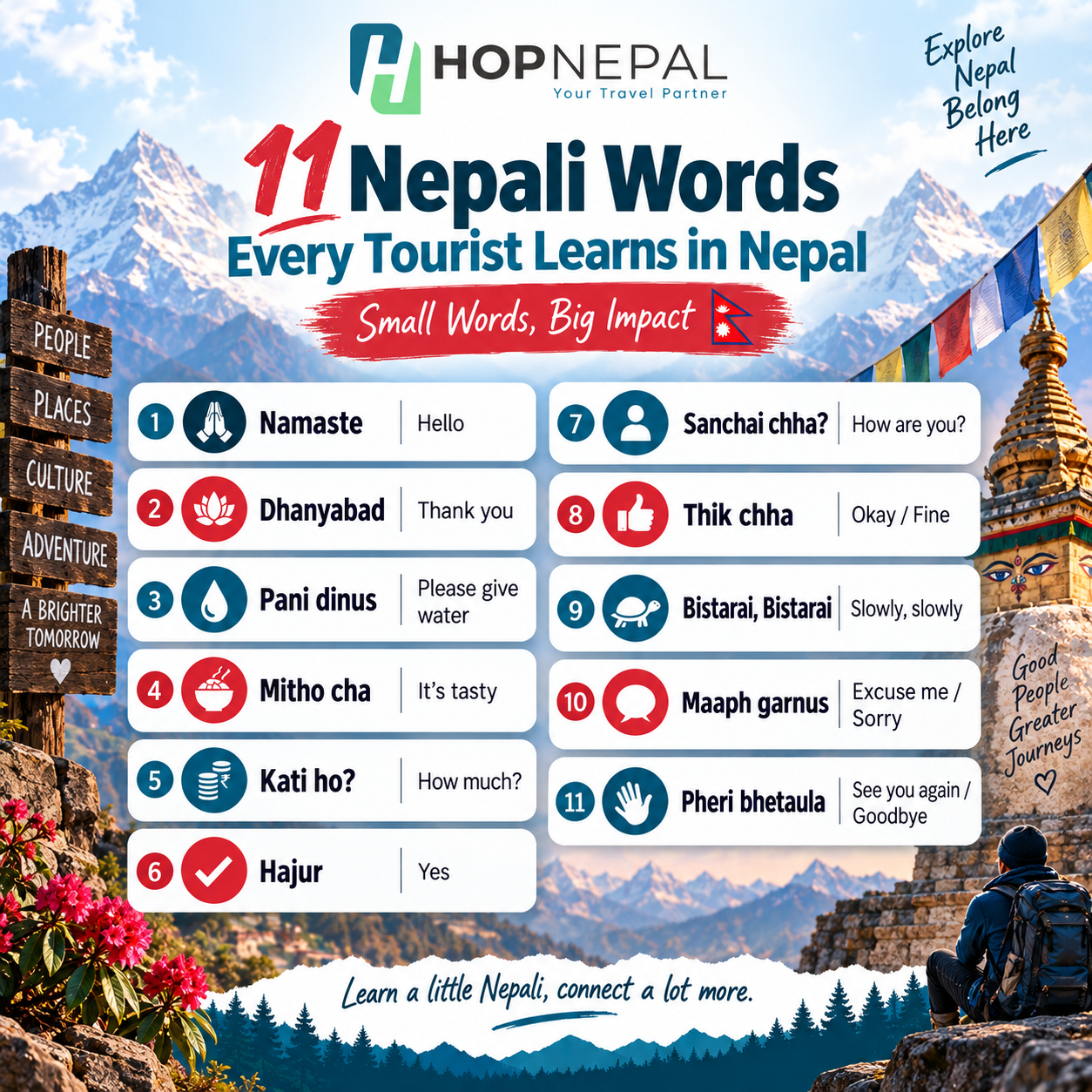
You may notice slightly different English spellings online, such as chha/cha, Dhanyabad/Dhanyabaad or Maaf/Maaph. These are Romanised versions of Nepali, so minor spelling differences are common.
The goal as a traveller is not perfect pronunciation. It is being understood and an effort is being made.
Basic Words in Nepali Language: English to Nepali Meanings
If you are searching for Nepali words every tourist learns in Nepal, with meanings, this guide serves as a practical list of Nepali words for everyday travel rather than a full dictionary. It gives you useful Nepali words in English, the Nepali script, simple meanings and pronunciation so you can recognise and use them during your trip.
Travellers also often search for English-to-Nepali vocabulary or tools to translate words into Nepali. Direct translation can help, but context matters. A word such as Hajur, for example, may mean “yes”, “pardon?” or a respectful acknowledgement depending on how it is used.
For readers looking for Nepali words every tourist learns in Nepal in English, the Romanised spellings below make each phrase easier to read even if you cannot read Devanagari. Use them as a starting point, then listen to local speakers to improve your pronunciation naturally.
1. Namaste – नमस्ते
Meaning: Hello / Greetings
Pronunciation: Na-ma-stay
If there is only one Nepali word you learn before arriving in Nepal, make it Namaste.
It is probably the most recognisable basic Nepali phrase for tourists and can be used in a wide range of everyday situations.
You can say Namaste when meeting your trekking guide, arriving at a hotel, entering a local shop, meeting a homestay host or greeting someone on a mountain trail.
People may also place their palms together in front of the chest while saying Namaste.
Unlike English greetings such as “good morning” and “good afternoon”, Namaste can be used throughout the day.
If your Nepal trip begins with sightseeing in the capital, try using it while exploring the communities and heritage areas included in Hop Nepal's Kathmandu Valley Cultural Tour .
It is simple, respectful and useful almost everywhere.
2. Dhanyabad – धन्यवाद
Meaning: Thank you
Pronunciation: Dhan-ya-baad
Dhanyabad means “thank you” and is another Nepali word worth learning before your trip.
Use it when somebody gives you directions, serves your meal, carries your luggage, helps arrange transport or assists you during your trek.
You do not need to build an entire Nepali sentence around it. Simply smile and say: Dhanyabad.
For stronger appreciation, you may hear Dherai dhanyabad , which means “Thank you very much.”
It is a particularly useful expression during village stays and cultural experiences where travellers have more opportunities to interact directly with local families. Travellers looking for these experiences can also explore Hop Nepal's homestays in Nepal .
3. Pani Dinus – पानी दिनुस्
Meaning: Please give me water
Pronunciation: Paa-nee dee-nus
You will probably learn the word pani fairly quickly in Nepal. It means water.
Add dinus, and you have a simple request: Pani dinus. “Please give me water.”
It can be useful in restaurants, local eateries, hotels and teahouses.
On a trek, you may also need to specify whether you want bottled water, boiled drinking water or a refill.
It is worth remembering that a few basic Nepali phrases become especially useful once you move beyond major tourism centres and into smaller mountain settlements.
4. Mitho Chha – मिठो छ
Meaning: It's tasty / It's delicious
Pronunciation: Mee-tho chha
Nepali food deserves its own vocabulary. If you have just finished a good plate of dal bhat, momo or another local dish, say: Mitho chha!
It is one of the easiest ways to compliment the person who prepared your meal.
Food plays an important role in everyday culture in Nepal. Dal bhat remains a staple meal, while dishes, ingredients and food traditions vary considerably between communities and regions. Hop Nepal's broader guide to the culture of Nepal also explores traditional food alongside language, festivals and customs.
One useful combination to remember is "Dhanyabad". Mitho chha. “Thank you. It's delicious.”
You probably will not need a translation after using it a few times.
5. Kati Ho? – कति हो?
Meaning: How much?
Pronunciation: Ka-tee ho?
If you enjoy shopping while travelling, remember: Kati ho?
This is one of the most practical Nepali phrases for travellers. You may use it when looking at souvenirs, buying something from a small shop or asking the price of an item at a local market.
You can also say Yo kati ho? meaning “How much is this?”
You may encounter different ways of asking prices in Nepal, including Kati parchha? , but Kati ho? is short and easy for visitors to remember.
Try it while browsing local markets rather than immediately switching to English.
6. Hajur – हजुर
Meaning: Yes / Pardon? / Polite acknowledgement
Pronunciation: Ha-jur
Hajur is one of those Nepali words that becomes much more interesting once you actually spend time in Nepal.
Some phrase lists simply translate it as Yes. That is not wrong, but it is incomplete.
Depending on the situation and tone, Hajur can communicate respectful agreement, acknowledgement, “I'm listening”, or even something similar to “Pardon?” when responding to someone who has called you.
For example, somebody calls your name. You may answer: Hajur? Someone politely asks you a question and you agree. You might reply: Hajur.
This flexibility is one reason tourists often start recognising the word quickly.
Nepal's communication styles are closely connected with respect, age, family and community relationships. For more cultural context, Hop Nepal's guide to the people of Nepal introduces communities living across different regions of the country.
7. Sanchai Chha? – सन्चै छ?
Meaning: How are you? / Are you well?
Pronunciation: San-chai chha?
Once you have mastered Namaste, you can take the conversation one step further. Ask: Sanchai chha?
It is commonly understood as “How are you?” The literal feeling is closer to asking whether someone is well.
Someone may reply: Sanchai chhu. Meaning: “I'm fine / I'm well.”
A more respectful or formal version may sound slightly different, but visitors do not need to master Nepali grammar before attempting basic conversation.
Even knowing this short exchange can help create a friendlier interaction with guides, drivers, lodge owners or hosts you meet repeatedly during your journey.
8. Thik Chha – ठीक छ
Meaning: Okay / Fine / Alright
Pronunciation: Theek chha
Thik chha is one of the most versatile expressions you will hear in Nepal. It can mean “Okay”, “Fine” or “That's alright”.
Your guide asks whether the departure time works. Thik chha. Someone checks whether your room is okay. Thik chha. You agree with a simple arrangement. Thik chha.
Spend enough time in Nepal and you may find yourself saying it automatically.
9. Bistarai, Bistarai – बिस्तारै, बिस्तारै
Meaning: Slowly, slowly
Pronunciation: Bis-ta-rai
This may become one of your favourite Nepali expressions if you are travelling to Nepal for trekking.
Bistarai means “slowly”. And you may hear people repeat it: Bistarai, bistarai. Slowly, slowly.
On mountain trails, there is often little advantage in rushing. A guide may use the word when encouraging you to maintain a steady pace on an uphill section, to cross difficult terrain carefully, or simply to stop trying to walk faster than necessary.
If trekking is one of the main reasons you are visiting Nepal, Hop Nepal's guide to the top treks in Nepal for different experience levels can help you compare routes before deciding where to go.
For trekkers, Bistarai is more than vocabulary. It is useful advice.
10. Maaph Garnus – माफ गर्नुस्
Meaning: Sorry / Excuse me
Pronunciation: Maaf gar-nus
Need to get past someone? Accidentally bump into another traveller? Want to politely interrupt somebody? Try: Maaph garnus.
It can be used similarly to “Excuse me” or “Sorry”.
A more formal version you may hear is Maaf garnuhos.
You do not need to worry too much about mastering formal variations as a tourist. Your tone, body language and willingness to communicate usually provide plenty of context.
This expression can be particularly useful in busy markets, on public transport, on crowded streets, and on narrow trekking trails.
11. Pheri Bhetaula – फेरि भेटौँला
Meaning: See you again
Pronunciation: Phe-ri bhe-tau-la
Not every goodbye needs to be permanent. Pheri bhetaula carries the idea of “See you again.”
You might say it to a trekking guide after completing a route, to a family after staying in their home or to someone you met several times during your trip.
For travellers spending time with local communities, phrases like this often become more meaningful than vocabulary memorised before arrival.
This is particularly true during cultural and homestay experiences. Hop Nepal's Homestay Nepal in Kathmandu is one example of accommodation designed around local interaction and Nepali hospitality.
At the end of the stay: Namaste. Dhanyabad. Pheri bhetaula. Hello became thank you. Thank you became see you again. That is not a bad progression for three very small phrases.
Unique Nepali Words with Meaning
Some travellers search for unique Nepali words with meaning or deep meaning. The most useful examples are not always poetic words; sometimes they are ordinary expressions whose meaning changes with tone, relationship and situation.
Hajur can show both respect and agreement; Bistarai can be both a practical instruction and a reminder not to rush; and Pheri bhetaula expresses the warmer idea of meeting again rather than simply ending a conversation. Learning these small cultural details helps you understand how Nepali words are actually used, not just how they appear in an English translation.
Do You Need to Speak Nepali When Travelling in Nepal?
No.
You can travel around Nepal without speaking Nepali, particularly when using tourism services.
The most popular language, English, is widely used by guides, travel agencies, hotels, and other businesses that deal with international visitors. Major tourism destinations such as Kathmandu, Pokhara and popular trekking regions are accustomed to receiving travellers from around the world.
However, being able to travel without Nepali does not mean learning a few words is pointless.
Knowing some basic Nepali phrases for tourists is especially useful when visiting local markets, smaller villages, family-run businesses, and areas away from major tourist centres.
It also changes the nature of the interaction. Instead of expecting everyone you meet to speak your language, you are making a small effort to use theirs.
Nepal Speaks More Than Nepali
Travellers should also remember that Nepali is not the only language spoken in Nepal.
According to Nepal's 2021 census, the country has 124 recorded mother tongues. Nepali is the largest, but Maithili, Bhojpuri, Tharu, Tamang, Bajjika, Avadhi, Nepal Bhasa/Newari and many other languages are spoken by communities throughout the country.
This linguistic diversity reflects Nepal's broader ethnic and cultural diversity. If you are interested in understanding the communities behind the destinations you visit, read Hop Nepal's guide to the cultural diversity and ethnic groups of Nepal .
So, while these 11 expressions are useful across many travel situations, they should not be taken to mean that everyone in Nepal speaks Nepali as their first language. That diversity is part of the experience of travelling here.
The Best Way to Learn Nepali While Travelling
Do not try to memorise fifty phrases before boarding your flight. Start small.
Learn Namaste, Dhanyabad, Kati ho? , Hajur and Thik chha. Then add words according to what you are doing.
Eating your way through Nepal? Remember Mitho chha. Going trekking? You will probably hear Bistarai. Staying with a local family? Try Sanchai chha? Shopping? Kati ho? Leaving somebody you have enjoyed meeting? Pheri bhetaula.
That approach is far easier than treating Nepali like an exam. Travellers who want more opportunities for this kind of cultural interaction can browse Hop Nepal's homestay experiences across Nepal
When Should You Visit Nepal?
You can practise these phrases at any time of year, but what you experience during your trip will depend heavily on the season.
Autumn is particularly popular for trekking and mountain views, while spring attracts visitors with warmer conditions and rhododendron-filled landscapes. Other seasons can be suitable depending on the region and type of trip.
If you are still deciding when to travel, Hop Nepal's month-by-month Nepal travel guide for 2026 explains where to go throughout the year.
Once you arrive, keep your Nepali vocabulary simple: Namaste. Dhanyabad. Mitho chha. That is already enough to start.
Final Thoughts: Small Nepali Words Can Create Meaningful Connections
Learning Nepali words for tourists is not about trying to become fluent during a short holiday. It is about making an effort.
Nepal's mountains, trekking routes, heritage sites and landscapes may be what initially attract you to the country, but your interactions with people often become some of the memories that stay with you longest.
Eleven words will not teach you Nepali. But they can help you greet someone respectfully, say thank you, compliment a meal, ask for a price, slow down on a trek, and say goodbye properly.
And sometimes that is exactly where cultural connection begins.
Learn a little Nepali. Connect a lot more.
Planning your own journey? Explore Hop Nepal's Nepal tours, treks and travel experiences and start building your trip around the places, people and experiences you want to discover.
FAQs About Nepali Words for Tourists
What are the most useful Nepali words for tourists?
Some of the most useful Nepali words for travellers are Namaste for hello, Dhanyabad for thank you, Kati, ho? for how much, Thik chha for okay, Mitho chha for delicious and Pheri bhetaula for see you again.
How do you say hello in Nepali?
Say Namaste – नमस्ते. It is Nepal's most recognisable greeting and can be used at any time of day.
How do you say thank you in Nepali?
Dhanyabad – धन्यवाद means thank you. Dherai dhanyabad means thank you very much.
What does Hajur mean in Nepali?
Hajur can mean yes, but its meaning depends on context. It can also function as a respectful acknowledgement, “I'm listening” or “Pardon?” when somebody calls or speaks to you.
What does Mitho chha mean?
Mitho chha means “it's tasty” or “it's delicious”. It is an easy way to compliment Nepali food.
How do tourists ask “How much?” in Nepali?
Say Kati ho? To specifically ask “How much is this?”, you can say Yo kati ho?
What does Bistarai mean?
Bistarai means slowly. Trekkers may hear guides say Bistarai, bistarai, meaning “slowly, slowly”, when encouraging a steady walking pace.
Do people in Nepal speak English?
English is commonly used in Nepal's tourism industry, particularly in Kathmandu, Pokhara and established trekking areas. Travellers generally do not need to speak Nepali, although knowing basic phrases can improve everyday interactions.
Is Nepali the only language spoken in Nepal?
No. Nepal is highly multilingual. The 2021 census recorded 124 mother tongues, including Nepali, Maithili, Bhojpuri, Tharu, Tamang and Nepal Bhasa, among many others.
Is Nepali difficult for tourists to learn?
Learning the entire language takes time, but tourists can easily memorise a handful of common expressions such as Namaste, Dhanyabad, Hajur, Thik chha and Kati ho? You do not need to understand Nepali grammar to use these expressions during a short trip.
Where can I find a basic list of Nepali words in English?
This article provides a short English-to-Nepali travel reference with 11 common expressions, their Devanagari spellings, pronunciations, and meanings. It is intended for tourists who want practical vocabulary rather than a large dictionary.
Can I use English-to-Nepali translation for every travel situation?
English-to-Nepali translation is useful for simple words and short phrases, but a direct translation does not always capture tone or cultural context. Listening to your guide, host, or other Nepali speakers is often the best way to learn how a phrase is naturally used.
Is there a PDF version of “Nepali words every tourist learns in Nepal with meaning PDF”?
This guide is currently presented as an online article so it can be updated easily. You can bookmark the page for quick reference while travelling in Nepal.
What Nepali phrase should I learn before trekking?
In addition to Namaste and Dhanyabad, learn Bistarai, which means "slowly". You may hear it regularly when walking in the mountains.