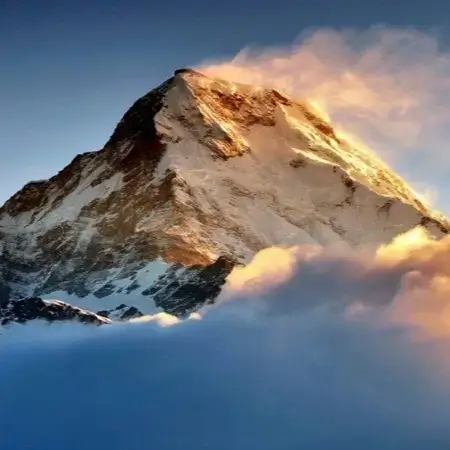
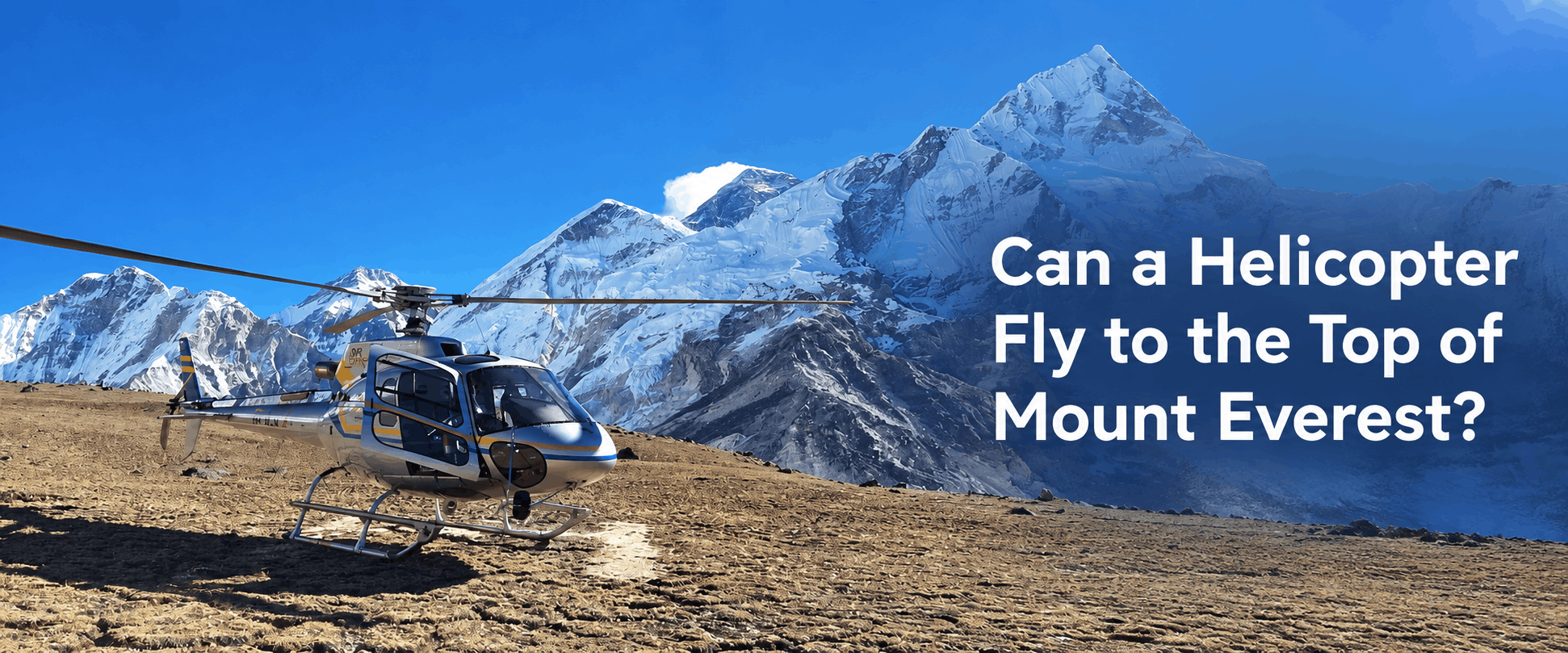
A helicopter has reached and landed on the summit of Mount Everest, but that does not mean tourists can book a helicopter flight to the top of the world's highest mountain.
The extraordinary event happened in May 2005 when French test pilot Didier Delsalle flew a Eurocopter AS350 B3 to the summit of Everest. On 14 May, he made contact with the summit at 8,848 metres and remained there for 3 minutes and 50 seconds before taking off again. The achievement established the Fédération Aéronautique Internationale (FAI) world record for the highest helicopter take-off, a record that remains current. A second successful summit flight was made the following day.
However, this was an exceptional aviation test conducted using a specially prepared, extremely lightweight helicopter and an experienced test pilot. It was not a commercial sightseeing flight, a rescue mission, or a passenger service.
So, can a helicopter fly to the top of Mount Everest? Technically, yes; it has been done. In normal commercial aviation, however, a helicopter cannot simply take passengers to the summit of Everest and bring them back.
Understanding why requires considering altitude, air density, helicopter performance, weather, weight, and the geography of the summit itself.
Everest Helicopter Facts at a Glance
- 8,848.86 metres - the recognised height of Mount Everest used throughout this guide.
- 14 May 2005 - Didier Delsalle completed the record-setting Everest summit helicopter flight in an AS350 B3.
- 3 minutes 50 seconds - the helicopter remained in contact with the summit for 230 seconds; the FAI record requirement was two minutes.
- Around 93 km/h and -33°C - the wind speed and temperature reported by the Fédération Aéronautique Internationale during the record attempt.
- 12,442 metres - the FAI’s current absolute helicopter altitude record, set by Jean Boulet in 1972.
- 5,545 metres - the altitude Hop Nepal lists for Kala Patthar in its 2026 Everest Base Camp helicopter guide, showing how much lower commercial sightseeing operations remain than the 8,848.86-metre summit.
- These figures show why reaching Everest altitude and safely operating a passenger helicopter at the summit are two very different aviation challenges.
Sources: Fédération Aéronautique Internationale (FAI) and Hop Nepal’s Everest Helicopter Tour with Kalapathar Landing guide.
Has a Helicopter Ever Landed on Mount Everest?
Yes. The most famous helicopter landing on Mount Everest took place on 14 May 2005.
French pilot Didier Delsalle flew a Eurocopter Ecureuil AS350 B3 from the Everest region towards the summit. The aircraft had been carefully prepared for extreme high-altitude performance.
According to the FAI, the helicopter approached the summit in winds of around 93 km/h and temperatures of approximately -33°C. Delsalle managed to lodge the helicopter's port skid into the snow on the narrow summit ridge and maintained the landing for 230 seconds — considerably longer than the two minutes required for the record attempt.
The helicopter then successfully departed from Everest, resulting in the FAI record for the highest take-off by a helicopter at 8,848 metres. The achievement remains one of the most remarkable demonstrations of high-altitude helicopter capability ever attempted.
However, describing this event without context can create the impression that helicopters could regularly carry travellers to the summit. That is far from the reality.

Why Was the 2005 Everest Helicopter Landing Possible?
Delsalle’s flight was very different from the way a normal passenger helicopter operates.
The aircraft was deliberately designed to be as light as possible. Much of the unnecessary equipment was removed, leaving only what was required for the mission. The FAI notes that the helicopter was stripped of comforts and electronics, retaining essentially one seat and one radio. Even Delsalle reduced his own body weight before the attempt.
Every kilogram mattered. Before travelling to Nepal, extensive testing was conducted to assess the helicopter's performance at extreme altitudes. The mission was also carefully timed to account for weather conditions in the Himalayas.
There were no tourists sitting behind the pilot, no luggage, no sightseeing equipment and no normal commercial payload. This is an important distinction. A helicopter being physically capable of touching the summit under carefully controlled circumstances does not mean the same helicopter could safely arrive carrying four or five passengers.
Why Can't Helicopters Normally Fly to the Summit of Everest?
Mount Everest reaches 8,848.86 metres above sea level, placing its summit in an environment where aircraft performance is dramatically different from conditions at airports such as Kathmandu or Lukla.
Several factors combine to make routine Everest summit helicopter flights impractical.
Extremely Thin Air
Helicopters create lift by accelerating air through their rotor system. As altitude increases, air becomes less dense. The rotor therefore has less dense air to work with while the aircraft still needs enough lift to support its own weight.
At approximately 9,000 metres, atmospheric pressure is only around one-third of sea-level pressure. The FAI identified reduced atmospheric pressure and oxygen as major technical challenges during the 2005 mission. This gives a helicopter an extremely small performance margin near the summit.
A machine that can comfortably carry several passengers at low altitudes may need its weight dramatically reduced when operating at high altitudes in the Himalayas.
Reduced Engine Performance
The helicopter's engine is also affected. Combustion engines depend on oxygen, and there is significantly less oxygen available at extreme altitude.
Modern turbine helicopters designed for mountain operations can compensate for some of this loss, but there is still a limit. Near Everest's summit, pilots face a combination of reduced engine performance and extremely demanding lift requirements. There is very little spare power available if conditions suddenly change.
Weight Becomes Critical
Weight is one of the biggest reasons an Everest summit helicopter tour is not commercially practical. Passengers, fuel, baggage, and equipment all increase the lift required.
At lower elevations, this may not be a major concern. At more than 8,000 metres, even relatively small changes in payload can have an enormous effect on aircraft performance.
This is also why high-altitude helicopter operations elsewhere in the Everest region may involve strict passenger-weight calculations or operational stops. The 2005 summit attempt demonstrated what was possible with an exceptionally light aircraft. It did not demonstrate that a fully loaded sightseeing helicopter could safely perform the same operation.
The Summit of Everest Is Not a Helicopter Landing Pad
Altitude is only part of the problem. Mount Everest does not have a convenient flat surface at 8,848 metres where a helicopter can safely land.
The summit consists of a narrow, exposed ridge covered by snow and ice. During Delsalle's historic flight, even he could not know exactly whether the surface beneath the helicopter consisted of soft snow, solid rock or ice before making contact. The FAI describes the summit as a knife-edge ridge during its account of the landing.
A conventional helicopter landing normally requires a sufficiently stable and predictable surface.
On Everest, pilots would also need to consider blowing snow, poor visibility, rotor wash, uneven terrain and rapidly changing winds. These problems make repeated commercial summit landings completely different from conducting a single carefully planned record attempt.
Extreme Winds and Weather Make Summit Flights Dangerous
Mount Everest is directly exposed to some of the strongest winds in the Himalayas. Jet-stream winds can affect the upper mountain for extended periods, while local conditions can change extremely quickly.
Even during the successful 2005 record attempt, Delsalle encountered winds of approximately 93 km/h. A commercial helicopter operator cannot build a normal tourism product around such narrow operating margins.
Mountain aviation already requires favourable visibility, manageable winds and appropriate cloud conditions. Near the summit of Everest, those requirements become significantly more demanding. Cold temperatures add another complication.
Extremely low temperatures can affect aircraft systems while ice accumulation and snow conditions introduce further risks. This is why safety, rather than simply engine capability, determines whether a helicopter flight can be attempted.
How High Can a Helicopter Actually Fly?
This question is more complicated than simply naming an altitude. A helicopter’s maximum operating capability depends on the aircraft model, weight, temperature, air pressure, wind, pilot technique, and whether the aircraft needs to hover, land or simply pass through an altitude.
Interestingly, helicopters have flown higher than Mount Everest. In 1972, French pilot Jean Boulet achieved an FAI absolute helicopter altitude record of 12,442 metres using an Aérospatiale SA 315 Lama.
That highlights an important aviation principle:
Reaching a particular altitude is not the same as safely hovering, landing and taking off at that altitude.
A helicopter moving through this air with momentum faces a very different performance requirement from one attempting to hover above a small icy ridge while supporting its entire weight with rotor lift.
For travellers, the more relevant question is therefore not simply “how high can a helicopter fly?” but rather how high can a helicopter safely operate while carrying passengers in Himalayan conditions? That altitude is considerably lower than the summit of Mount Everest.
Can a Helicopter Fly Over the Summit of Mount Everest?
From a purely technical perspective, a helicopter reaching Everest's altitude is possible, as aviation records have already demonstrated. However, commercial Everest helicopter tours do not normally take passengers directly over the summit at 8,848.86 metres.
There is little practical reason to do so, and the additional altitude would dramatically increase operational risk. Tourists do not need to fly above the summit to experience exceptional views of Mount Everest.
Flying through the Khumbu region offers spectacular views of Everest, Lhotse, Nuptse, Ama Dablam, and the surrounding Himalayan landscape from much safer operating altitudes. In fact, viewing Everest from an appropriate distance often gives travellers a much better understanding of the mountain's scale than looking directly down on its summit would.
Can Tourists Take a Helicopter to the Top of Mount Everest?
No. There is no regular commercial helicopter service to the summit of Mount Everest, and travellers should be cautious about interpreting an “Everest helicopter tour” as a flight that actually lands on the mountain.
Tourists can take scenic flights over the Everest region, but passengers cannot land on the summit. However, they can enjoy the spectacular views of Mount Everest.
The 2005 Everest summit landing was an aviation record attempt conducted by a professional test pilot in extraordinary circumstances. It should not be compared with a standard commercial helicopter flight. Anyone wishing to physically stand on the top of Mount Everest still needs to undertake a properly organised mountaineering expedition and reach the summit by climbing.
Where Do Everest Helicopter Tours Actually Go?
A typical Everest Base Camp helicopter tour is designed to give travellers an aerial experience of the Khumbu region without requiring the approximately two-week trek normally associated with Everest Base Camp.
Flights generally depart from Kathmandu for the Everest region, passing landscapes that may include mountain valleys, Sherpa settlements, glaciers, and some of the world's highest peaks.
Depending on the specific itinerary, weather conditions, aviation permissions and current local regulations, high-altitude sightseeing may involve designated stops or flyovers in the Everest region. Actual landing arrangements can change, so travellers should always confirm the current itinerary rather than assuming that a particular landing point is guaranteed.
For current landing and permit requirements, see Hop Nepal’s Everest Helicopter Tour Permit 2026 guide before confirming your flight.
What remains consistent is that an Everest helicopter tour is designed to provide extraordinary views of Mount Everest, not to place passengers on its summit. For travellers with limited time in Nepal, an Everest Base Camp Helicopter Tour can offer a practical alternative to trekking while still providing a close aerial view of the world's highest mountain.
Can a Helicopter Rescue Someone From the Summit of Everest?
This is another common misconception.
Helicopters play an essential role in Everest rescue operations, particularly when trekkers or climbers experience altitude sickness, injury or medical emergencies in areas where evacuation on foot would take too long.
However, this does not mean a helicopter can simply fly to the summit whenever a climber requires help. As climbers ascend higher on Everest, helicopter performance becomes progressively more limited.
Weather, terrain, wind, visibility, aircraft weight and the casualty’s exact location all influence whether an evacuation is possible. In many high-altitude emergencies, the person may need to descend with assistance to a location where helicopter operations are safer. A direct helicopter rescue from the summit should therefore never be considered part of an Everest expedition’s normal emergency plan.
Why Are Helicopters So Important in the Everest Region?
Although helicopters cannot routinely take travellers to the summit, they remain extremely important throughout the Khumbu. They are used for emergency evacuations, logistics, passenger transfers and tourism. For trekkers experiencing severe altitude sickness, a helicopter evacuation can significantly reduce the time required to reach a lower elevation and medical assistance.
They can also provide transport when weather, trail conditions or logistical circumstances make ground travel difficult. For tourism, helicopter flights allow visitors to experience the scale of the Everest region without completing the full Everest Base Camp Trek.
The real achievement of Himalayan helicopter aviation is therefore not summit tourism. It is the ability of highly trained pilots and specialised aircraft to operate safely in one of the world's most challenging flying environments.
Helicopter Flight vs Everest Climbing: Two Completely Different Experiences
A helicopter flight and an Everest summit expedition should not be viewed as alternative ways of achieving the same objective. An Everest helicopter tour is primarily a sightseeing experience.
An Everest expedition is a major mountaineering undertaking requiring months or years of preparation, specialised equipment, acclimatisation, climbing permits, expedition support and the ability to survive for extended periods at extreme altitude.
A helicopter passenger can see Everest and the surrounding Khumbu landscape in a matter of hours. A climber attempting to reach the summit must physically traverse some of the harshest terrain and endure the most extreme atmospheric conditions on Earth. Technology has transformed how we can experience Mount Everest, but it has not made reaching its summit easy.
Will Helicopters Regularly Land on Everest's Summit in the Future?
Helicopter technology will undoubtedly continue to improve. Aircraft may become lighter, engines more efficient and flight-control systems more sophisticated. However, the problem of regular Everest summit landings involves much more than helicopter technology.
The mountain’s narrow summit, extreme winds, rapidly changing weather, low atmospheric density and unpredictable snow and ice conditions will continue to create enormous operational challenges.
There are also important safety and environmental questions around introducing regular aircraft activity to the summit of the world’s highest mountain. For these reasons, commercial helicopter landings at Everest’s summit are unlikely to become a routine tourist experience in the foreseeable future.
Can You See Mount Everest Without Climbing It?
Absolutely. You do not need to reach the summit — or even trek all the way to Everest Base Camp — to experience Mount Everest. An Everest Base Camp helicopter tour from Kathmandu provides one of the fastest ways to experience the Everest region, particularly for travellers with limited time.
The flight can offer panoramic views of the Himalayas and peaks including Everest, Lhotse, Nuptse, and Ama Dablam.
For travellers who prefer to explore on foot, the Everest Base Camp Trek remains the classic option, allowing more time to experience Sherpa communities, monasteries, mountain villages and the changing landscapes of the Khumbu.
Those seeking a balance between trekking and convenience may also consider an Everest Base Camp Trek with helicopter return. These experiences provide realistic ways to get close to Everest without creating the impression that a commercial helicopter can take passengers to the summit.
If you are comparing the flying option with the walking route, our 12-day Everest Base Camp trek itinerary gives a day-by-day view of the classic Khumbu journey.
Final Answer: Can a Helicopter Fly to the Top of Mount Everest?
Yes, a helicopter can reach the top of Mount Everest — but that does not mean regular helicopters can safely take tourists there.
Didier Delsalle proved what was technically possible by reaching the summit in an AS350 B3 helicopter in May 2005. His extraordinary flight established a world record that remains recognised by the Fédération Aéronautique Internationale. But everything about that mission was exceptional: the aircraft was stripped down to reduce weight, the pilot was highly experienced, the flight was carefully planned around Himalayan weather, and there were no passengers.
In normal aviation, the combination of thin air, reduced aircraft performance, extreme winds, freezing temperatures, unpredictable terrain, and strict weight limitations makes regular helicopter operations at Everest's summit unrealistic.
Fortunately, you do not need to land on the summit to appreciate the world's highest mountain.
An Everest Base Camp Helicopter Tour with Hop Nepal allows travellers to experience the extraordinary scale of the Khumbu region and see Mount Everest from the air in a practical, professionally organised way. The summit belongs to mountaineers. But from the window of a helicopter flying through the Everest region, you can still witness one of the most extraordinary landscapes on Earth.
Frequently Asked Questions
Can a helicopter fly to the top of Mount Everest?
Yes, it is technically possible and has been achieved. French test pilot Didier Delsalle reached the summit of Mount Everest by helicopter in May 2005. However, commercial passenger helicopter flights do not operate to the summit.
Has a helicopter ever landed on the summit of Mount Everest?
Yes. Didier Delsalle landed an AS350 B3 helicopter on Everest on 14 May 2005. His flight established the FAI world record for the highest helicopter take-off at 8,848 metres.
How long did the helicopter stay on Mount Everest?
During the record flight, the helicopter remained in contact with the summit for 3 minutes and 50 seconds before taking off.
Can tourists book a helicopter to the summit of Mount Everest?
No. There is no commercial passenger helicopter service that lands tourists on the summit of Everest. Everest helicopter tours operate at considerably lower elevations and provide scenic views of the mountain and surrounding region.
Why can't helicopters normally land on Everest?
The main challenges include extremely thin air, reduced aircraft performance, high winds, freezing temperatures, strict weight limitations and the absence of a safe conventional landing area on the summit.
Can a helicopter fly higher than Mount Everest?
Yes. Helicopters have reached altitudes higher than Everest. Jean Boulet's 1972 helicopter altitude record reached 12,442 metres. However, reaching an altitude is different from safely hovering, landing and taking off at that height.
Can helicopters rescue climbers on Everest?
Helicopters perform rescues throughout parts of the Everest region, but rescue capability becomes much more limited at extreme altitude. A helicopter cannot be assumed to reach a climber anywhere on the mountain, particularly near the summit.
Does an Everest Base Camp helicopter tour land on Mount Everest?
No. An Everest Base Camp helicopter tour does not land on the summit of Mount Everest. Exact sightseeing and landing arrangements depend on current aviation regulations, weather and the operator's approved flight plan.
Can you see the summit of Everest from a helicopter?
Yes. A scenic helicopter flight through the Everest region can offer impressive views of Mount Everest, Lhotse, Nuptse, Ama Dablam, and other Himalayan peaks when visibility is favourable.
Is an Everest helicopter tour safer than climbing Mount Everest?
They are fundamentally different activities. A commercial helicopter sightseeing flight operates under aviation procedures at significantly lower elevations, while climbing Everest involves prolonged exposure to extreme altitude and serious mountaineering hazards.
Why can aeroplanes fly above Mount Everest while helicopters struggle near the summit?
Aeroplanes use forward speed and wings to generate lift, while a helicopter, when hovering or landing, must support its weight through the rotor system at very low air density. This is why simply flying above Everest is a different performance challenge from hovering, landing and taking off on its summit.