
Quick Answer: Everest Helicopter Tour Permit Cost
Nobody talks about permits when they are dreaming about standing on Kalapathar with Everest above them. Then they get to Kathmandu and someone mentions permits and suddenly there are twenty questions that nobody answered during the research phase. Here is the short version upfront:
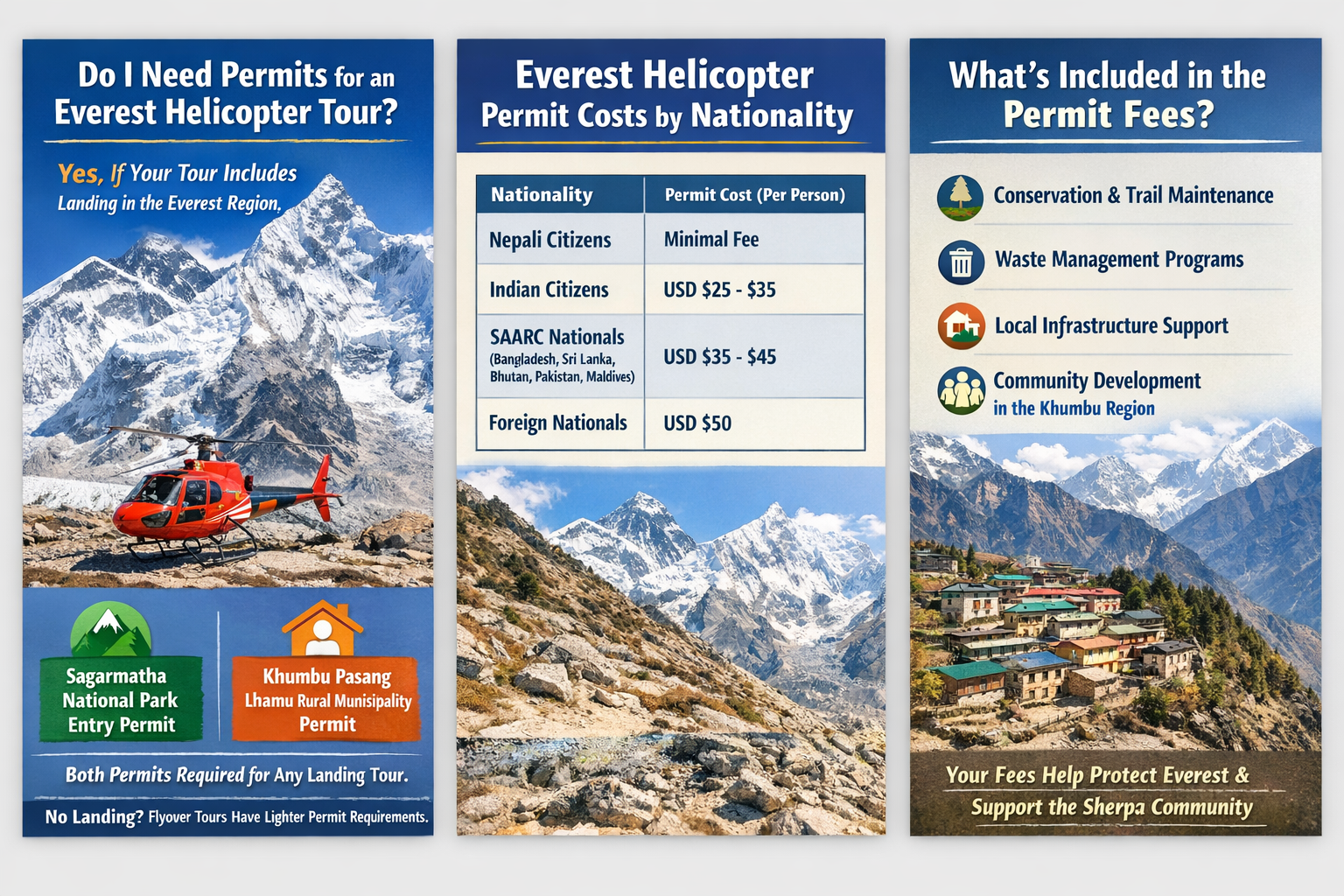
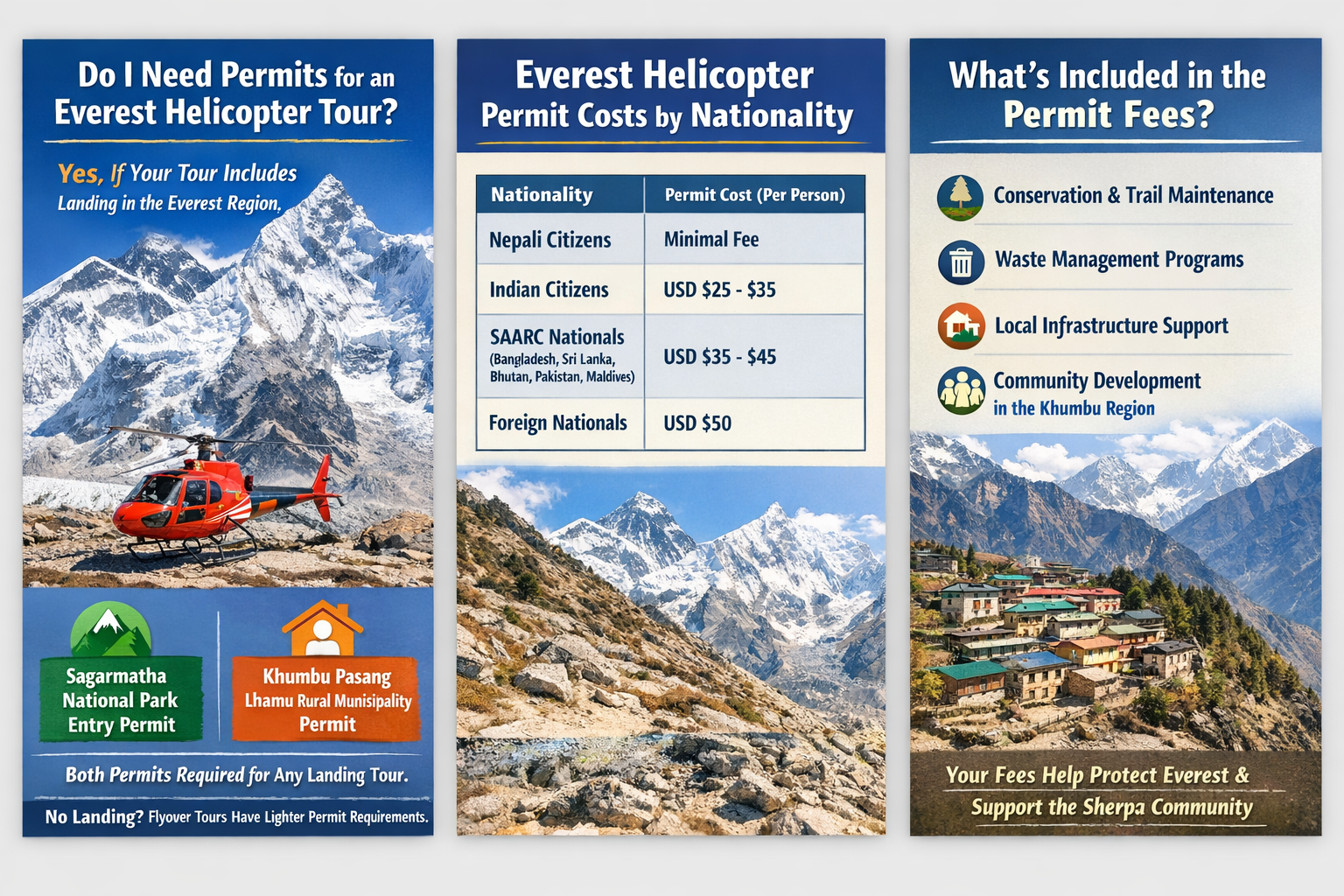
- The permit for Everest helicopter tour in Nepal is non-negotiable for any tour that includes a landing inside the Everest region
- Two permits are required, the Sagarmatha National Park Entry Permit and the Khumbu Pasang Lhamu Rural Municipality Permit
- Everest helicopter permit cost is different depending on whether you hold a Nepali, Indian, SAARC, or foreign passport
- Most tour operators bundle permits into the package price but this needs to be confirmed before money changes hands
- Flyover tours without landing have lighter permit requirements than landing tours
Do You Actually Need a Permit for the Everest Helicopter Tour?
The short answer is yes, though the specifics depend on what your tour actually involves.
Nepal runs a layered entry system for the Everest region and it applies to everyone regardless of how they get there. Trekkers who walk for two weeks through the Khumbu Valley need these permits. People who fly in by helicopter for twenty minutes need the same permits. The protected area regulations do not have a special exemption for short visits or aerial arrivals. If you land inside Sagarmatha National Park, you are entering a protected conservation zone and the entry requirements apply in full.
What a lot of people do not realize until they start reading the fine print is that the Everest region is managed through overlapping permit structures covering both the national park and the local municipality. Missing either one of them creates a compliance problem that a responsible operator will not let you walk into.
When the Full Permit Set Is Required
Any Everest helicopter tour that includes a landing at Kalapathar or anywhere else inside the national park boundary needs both permits sorted before the helicopter leaves Kathmandu. It does not matter whether you spend ten minutes on the ground or two hours. The moment the helicopter lands inside the protected area the permits become a legal requirement. This covers every standard Everest helicopter tour with Kalapathar landing that most operators are selling in 2026.
When the Rules Are Different
Aerial sightseeing tours that stay airborne for the entire flight operate under different conditions. A mountain flight that passes over Everest and returns to Kathmandu without touching down is a different product from a landing tour and the permit requirements reflect that. Some operators offer these flyover experiences at lower price points partly because of the reduced permit burden. But here is the honest reality of that choice. The Kalapathar landing is the reason people book the Everest helicopter tour in the first place. An aerial pass over Everest from inside a helicopter cabin is genuinely impressive. Standing outside on the ground at 5,545 meters with the mountain directly above you is a completely different experience. Most people who look at this properly choose the landing tour and treat the permit cost as simply part of what that experience costs.
The Two Permits You Need and What They Actually Cover
Sagarmatha National Park Entry Permit
Sagarmatha National Park was established in 1976 and covers more than 1,100 square kilometers of high Himalayan terrain. Everest is there. So is Lhotse, Cho Oyu, and the entire upper Khumbu Valley including the glacier systems and the Sherpa villages that sit within the park boundary. Every person entering this area, however they arrive, needs this permit.
The fee from this permit goes toward the conservation management of the park. Trail maintenance, waste management programs that deal with the significant rubbish problem in one of the world's most heavily visited protected areas, ranger operations, and environmental monitoring across a landscape that takes a beating from the tourism volume it receives every year. When people ask why the permit costs what it does, that is what it pays for.
For helicopter tour passengers the permit is usually arranged by the operator before departure day. Trekkers typically collect it at the entrance gate near Monjo on the trail from Lukla. Either way it needs to exist and be in order before anyone lands inside the park.
Khumbu Pasang Lhamu Rural Municipality Permit
This one surprises people who have only ever heard about the national park permit. The Khumbu Pasang Lhamu Rural Municipality Permit covers the local government area that the Everest trekking corridor passes through. It was introduced to make sure that tourism revenue reaches the Sherpa communities who actually manage the infrastructure and culture of the Khumbu Valley, rather than that money only flowing through national government channels.
Both permits together form the complete entry documentation for any Everest helicopter landing tour. One without the other is not sufficient. Both need to be confirmed before the day of the flight.
Everest Helicopter Permit Cost by Nationality
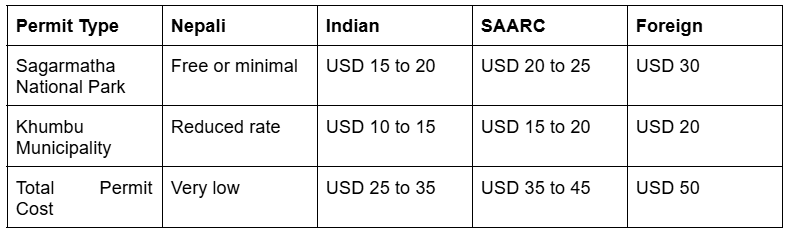
Nepal uses a tiered fee structure for protected area access that gives preferential rates to Nepali citizens, followed by Indian nationals, then other SAARC country travelers, and then international visitors from outside the region at the full foreign rate. Here is what that looks like in practice.
Permit Cost for Nepali Citizens
Nepali citizens pay either nothing or a very small domestic fee for Sagarmatha National Park entry. The municipality permit applies at a reduced domestic rate. This is one of the main reasons the total Everest helicopter tour price for Nepali travelers sits noticeably lower than what international visitors pay for the exact same experience. The permit cost component that feeds into the overall package price is dramatically lower for domestic travelers.

Permit Cost for Indian Citizens
Indian nationals travel to Nepal without a visa under the open border arrangement between the two countries. The permit fee structure for Indian visitors within Nepal's protected areas sits above the domestic Nepali rate but below the standard foreign national charge. It is part of a broader bilateral framework that reflects the longstanding relationship between the two countries and makes Everest helicopter tour access more financially viable for Indian travelers than for visitors from further afield.

Permit Cost for SAARC Nationals
Travelers from Bangladesh, Sri Lanka, Bhutan, Pakistan, and the Maldives access a permit fee structure that sits in the middle ground between Indian national rates and the full foreign charge. The SAARC pricing reflects Nepal's regional cooperation commitments across South Asian borders and makes the experience more accessible for regional visitors than it would be under standard international pricing.

Permit Cost for Foreign Nationals
International visitors from outside the SAARC region pay the full foreign national rate. These fees are what push the baseline price of Everest helicopter tour packages for international travelers above what Nepali and regional visitors pay for the same product.

Complete Permit Cost Comparison Table
What Is Actually Included in Everest Helicopter Permit Fees?
This matters more than most people stop to think about and it is worth spending a moment on.
The Sagarmatha National Park entry fee funds conservation management of one of the most ecologically fragile and heavily visited protected areas in Asia. The Khumbu Valley receives enormous tourist pressure every year, particularly during peak spring and autumn seasons when the Everest Base Camp trail is at maximum capacity. The permit revenue covers ranger operations, trail infrastructure, waste management programs dealing with years of accumulated rubbish at high altitude, and the environmental monitoring programs tracking glacier retreat and ecological change in the park.
The Khumbu Pasang Lhamu Municipality Permit revenue goes directly to the local government managing infrastructure and services across the Sherpa villages of the Khumbu corridor. Roads, schools, medical facilities, community infrastructure: this is where that money lands. The Sherpa communities who have lived in and managed this landscape for generations bear the real costs of the tourism volume that passes through their home every year. The municipality permit is one mechanism through which some of that tourism value flows back to the people who actually live there.
Understanding this helps the permit cost feel less like a tax and more like a reasonable contribution to the place you are visiting.
Everest Helicopter Tour with Landing vs Without Landing: The Permit Difference
This distinction matters practically and financially and is worth understanding clearly before you compare prices from different Kathmandu operators.
With Kalapathar Landing
A tour package that includes the Kalapathar landing at 5,545 meters requires the full permit set covering both the Sagarmatha National Park entry and the Khumbu municipality access. The landing is what triggers the full permit requirement because it constitutes physical entry into the protected area. The Kalapathar landing is also what most people are actually paying for when they book this tour. The aerial views are extraordinary but the ground-level experience of standing at 5,545 meters with Everest directly above you is the moment that makes the entire experience genuinely memorable.
The permit costs associated with the landing are factored into the overall package price by all reputable operators and should be explicitly confirmed as included when comparing quotes. Any operator quoting a significantly lower price for a landing tour than the market standard is likely either not including permits or cutting corners somewhere in the compliance process, neither of which is a situation a passenger wants to find themselves in on the day of the flight.
Without Landing (Flyover Only)
Flyover-only tours that remain airborne throughout without touching down inside the national park operate under lighter permit requirements in some cases depending on the specific flight path and altitude. These tours come at a lower price point partly because the permit cost component is reduced. The trade-off is a fundamentally different experience. Seeing Everest from the air is remarkable but it is not the same as stepping out onto the rocky ground at Kalapathar, feeling the thin cold air at 5,545 meters, and having the mountain directly above you rather than visible through a helicopter window. Most travelers who research this decision end up choosing the landing tour because the permit cost difference does not justify giving up the ground experience.
How Permit Costs Affect the Total Helicopter Tour Price
Permits form one component of the overall Everest helicopter tour price structure alongside the helicopter flight itself, aviation fuel costs, pilot fees, the breakfast stop at Hotel Everest View, and the operator's service margin. Understanding how permits sit within the overall cost helps you evaluate quotes from different operators intelligently.
For foreign nationals where permits total USD 50 per person, that amount is a meaningful but not dominant share of the overall tour price. For Nepali citizens where permit costs are minimal, the overall tour price reflects that saving directly. This is why the same physical tour experience costs meaningfully less for Nepali and Indian passengers than it does for visitors arriving from Europe or North America.
Group Sharing vs Private Charter and Permit Cost Impact
Permit costs are per-person charges regardless of whether you are traveling on a shared group helicopter or a private charter. On a shared helicopter where five or six passengers split the aircraft cost, each person pays their own permits individually. On a private charter where one party pays for the entire helicopter, the permit costs for each individual passenger in that group still apply at the same per-person rate. The aircraft cost per person changes dramatically between shared and private options. The permit cost per person stays the same regardless of how the helicopter is booked.
How to Get Permits for an Everest Helicopter Tour
Booking Through a Tour Operator
The overwhelming majority of Everest helicopter tour passengers never deal with permits directly because reputable Kathmandu-based operators handle the entire permit process as part of the booking. When you book a tour through an established operator they obtain your permits in advance, the documents are carried by the operator or the helicopter crew, and everything is in order before you arrive at the airport on the morning of your flight. This is the reason most people never think about permits until they start researching what the overall tour price actually covers.
When comparing tour packages from different operators always ask explicitly whether permits are included in the quoted price. A quote that does not include permits will always look more attractive on paper than one that does. The difference gets resolved at the airport when you are asked to pay permit fees separately before boarding. Confirming permit inclusion at the quote stage eliminates that unpleasant discovery.
Independent Permit Process
Travelers who prefer to arrange permits independently can obtain both the Sagarmatha National Park Entry Permit and the Khumbu Pasang Lhamu Rural Municipality Permit through the Nepal Tourism Board offices in Kathmandu. The process requires a passport copy and passport-sized photographs alongside the applicable fee payment in Nepali rupees or USD depending on the nationality-based fee structure. Permits are issued on the day in most cases during normal office hours.
The independent process works fine but adds administrative steps to what is already a very early morning departure experience for most helicopter tours. The operator-managed permit process is more convenient for the vast majority of travelers and is the standard approach for good reason.
Important Rules for Everest Helicopter Tour Permits
Beyond simply having the correct permits in order there are operational rules that govern how landing tours function within the Everest region and these affect the experience directly.
Weight restrictions apply to all helicopter operations in the Everest region for aviation safety reasons specific to high-altitude flying. Passengers are weighed before departure and the total load including passengers, fuel, and equipment must fall within safe operational limits for mountain helicopter flying. This is a non-negotiable aviation safety requirement and operators enforce it without exception regardless of how uncomfortable the conversation might be.
Time limits at Kalapathar apply because the landing site sits within the protected area and extended ground stops are not permitted under the operational rules governing helicopter access to this elevation. The standard landing window of 10 to 20 minutes reflects these restrictions alongside the altitude safety considerations for passengers arriving without gradual acclimatization.
Environmental regulations covering waste management, disturbance to the landscape, and conduct during the landing are part of the terms under which landing permissions are granted in this protected area. Passengers are expected to take nothing from the landing site and leave nothing behind. The conservation integrity of the Khumbu region depends on these standards being maintained consistently across all visitor types including helicopter tour passengers.
Weather and safety considerations sit above all permit and regulatory factors in terms of actual operational decision-making. Operators cancel or reschedule flights when conditions do not meet the safety standards for mountain helicopter operations regardless of permit status or passenger convenience. No permit guarantees a flight on any specific day. Flexibility on departure dates, particularly during periods of uncertain mountain weather, is a practical reality of booking this experience.
Final Thoughts: Understanding Everest Helicopter Permit Costs Before You Book
The permit system for the Everest helicopter tour is not complicated once you understand what it covers and why it exists. Two permits, both mandatory for landing tours, both serving genuine conservation and community purposes, and both priced according to a nationality-based structure that reflects Nepal's regional relationships and domestic tourism policy.
For most international travelers booking through a reputable Kathmandu operator the permits are simply part of the package price and never require separate attention. For travelers comparing quotes from multiple operators the permit inclusion question is one of the most important things to clarify before making a final booking decision.
The permit for Everest helicopter tour in Nepal is not a bureaucratic obstacle. It is the mechanism through which one of the most spectacular and ecologically sensitive landscapes on Earth is managed, protected, and kept accessible for the travelers who come from every corner of the world to experience it. The Kalapathar landing that those permits make possible is worth every dollar of the Everest helicopter permit cost and then some.
Book with a licensed operator, confirm permits are included, arrive at the airport with everything in order, and focus your energy on charging your camera battery and picking the right layers for a cold morning at 5,545 meters. The paperwork takes care of itself when the operator knows what they are doing.
Frequently Asked Questions (FAQs)
Do I need a permit for an Everest helicopter tour in Nepal?
Yes if your tour includes any landing inside the Everest region. The Sagarmatha National Park Entry Permit and the Khumbu Pasang Lhamu Rural Municipality Permit are both required for any landing tour including the standard Kalapathar landing that forms the centrepiece of most Everest helicopter tour packages. Flyover-only tours without landing have different and lighter permit requirements.
How much is the Everest helicopter permit cost?
For foreign nationals the two permits combined cost USD 50 per person, with the Sagarmatha National Park permit at USD 30 and the Khumbu municipality permit at USD 20. SAARC nationals pay a reduced combined rate of approximately USD 35 to 45. Indian citizens pay approximately USD 25 to 35 combined under the bilateral pricing structure. Nepali citizens pay minimal or no permit fees for the same access.
Are permits included in helicopter tour packages?
Most reputable Kathmandu-based operators include permits in the overall quoted package price. Always confirm this explicitly when comparing quotes because packages that exclude permits will appear cheaper on paper until the permit fees are charged separately at departure. Asking whether permits are included is one of the most important questions to clarify before committing to any booking.
Is a permit required for the Kalapathar landing specifically?
Yes. Kalapathar sits inside Sagarmatha National Park and any landing at this location requires the full permit set covering both the national park entry and the Khumbu municipality access. The Kalapathar landing is the most sought-after element of the Everest helicopter tour experience and the permits are simply part of the cost of accessing it legally.
Do Nepali citizens need permits for Everest helicopter tours?
Nepali citizens are subject to permit requirements but at a significantly reduced or waived fee structure compared to international visitors. The Sagarmatha National Park entry is either free or available at a heavily subsidized domestic rate for Nepali nationals. This is one of the main reasons why Everest helicopter tour pricing for Nepali citizens sits considerably lower than equivalent packages marketed to international travelers.