
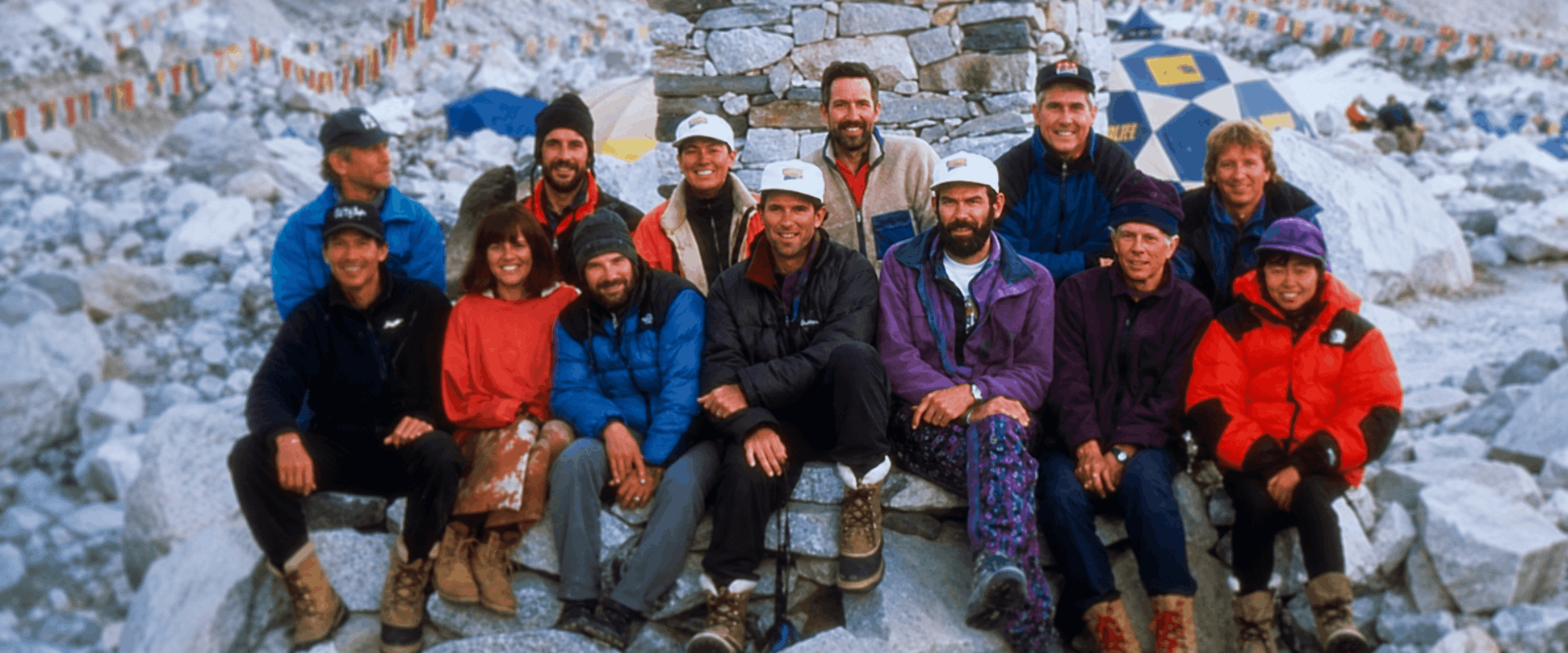
On 10 and 11 May 1996, a violent storm trapped climbers high on Mount Everest during their descent from the summit. Eight people died across the southern and northern sides of the mountain, making the event one of the most widely discussed tragedies in mountaineering history.
The disaster was not caused by a single mistake. Delayed fixed-rope preparation, bottlenecks near the summit, late turnaround decisions, exhaustion, limited oxygen, communication problems and rapidly worsening weather combined to create a crisis in the death zone.
Five climbers died on the southern route used by the Adventure Consultants and Mountain Madness expeditions. Three members of an Indo-Tibetan Border Police expedition died during the same storm on the northern side.
The tragedy later became the subject of books, documentaries, and the 2015 film Everest. It also intensified debate about commercial climbing expeditions, guides’ responsibilities and whether personal ambition can override safe decision-making at extreme altitude.
Quick facts about the 1996 Mount Everest disaster
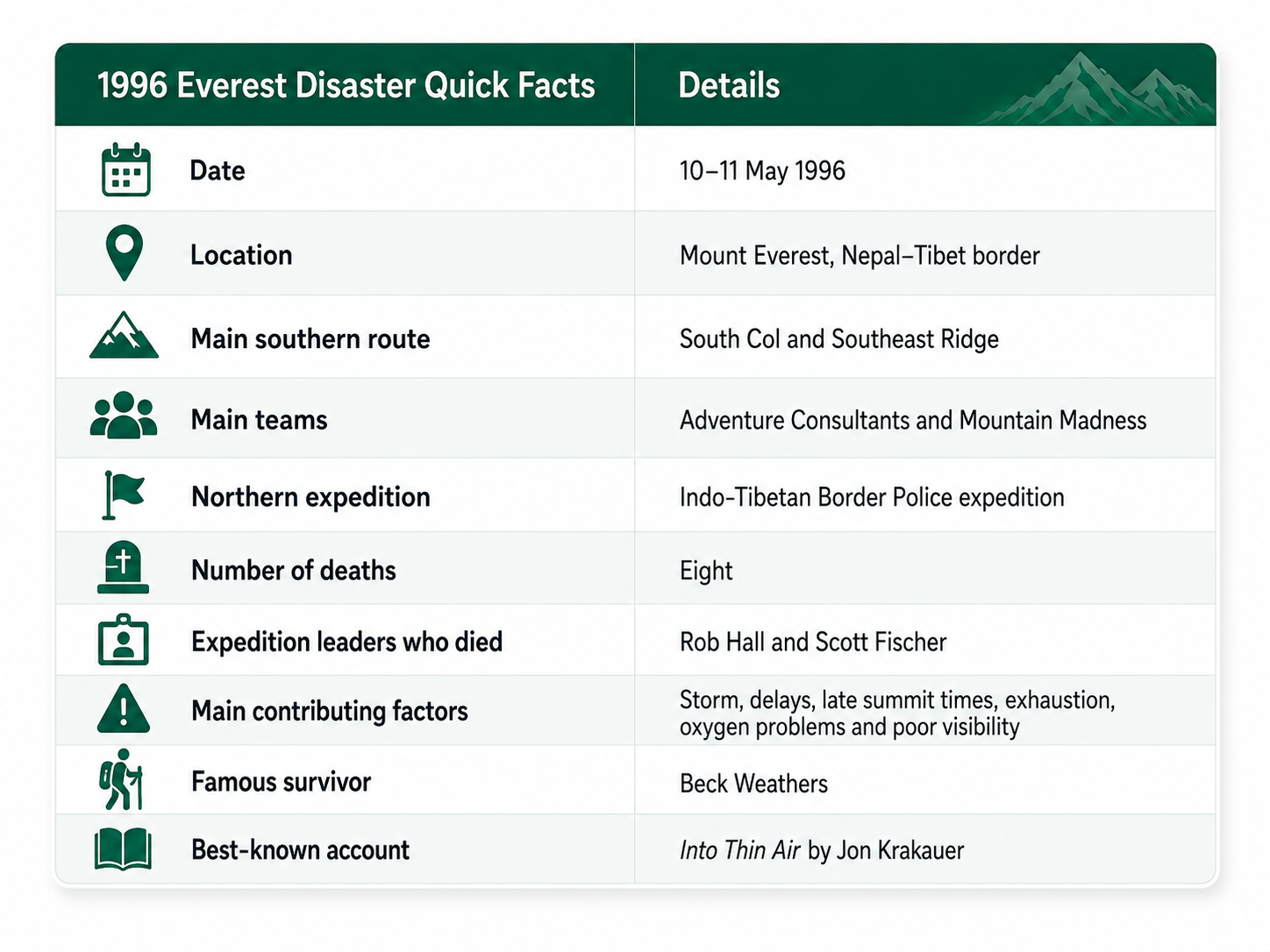
The Himalayan Database maintains detailed expedition records covering routes, camps, summit successes, deaths, accidents and rescues throughout the Nepal Himalaya, making it an important source for studying Everest’s climbing history. For current totals and broader mortality trends, see Hop Nepal’s guide to how many people have died on Mount Everest.
What Happened on Mount Everest in May 1996?
Several expeditions were operating on Everest during the spring climbing season. Among them were two commercial teams attempting the summit from Nepal:
- Adventure Consultants, led by New Zealand mountaineer Rob Hall
- Mountain Madness, led by American climber Scott Fischer
There were also independent expeditions, an IMAX filming team, a Taiwanese group and climbers attempting the mountain from Tibet. National Geographic’s account describes an unusually busy southern side, with several large expeditions sharing the same upper route and weather window.
After weeks of acclimatisation, Hall and Fischer planned their summit attempts for 10 May. Climbers left Camp IV on the South Col around midnight and began moving through the darkness towards the Balcony, South Summit, Hillary Step and Everest’s main summit.
The plan depended on reaching the top early enough to descend before darkness. However, the expedition soon began falling behind schedule.
Timeline of the 1996 Mount Everest Tragedy
Midnight: The Summit Push Begins
The Adventure Consultants and Mountain Madness teams departed Camp IV, situated at approximately 7,900 metres on the South Col. Climbers carried supplementary oxygen and expected to spend many hours ascending and returning to camp.
Moving at this altitude is extremely slow. Even simple decisions become difficult because the body receives far less oxygen than it would at sea level.
Morning: Delays at the Balcony
When climbers reached the Balcony, part of the fixed-rope system had not been prepared as expected. Guides and Sherpa team members had to organise ropes while the clients waited. This delay cost valuable time and forced climbers to use oxygen and energy while standing in the cold.
Late Morning: Bottleneck Near the Hillary Step
Another delay developed below the summit. Climbers arrived at the Hillary Step, a narrow and technically demanding section of the old Southeast Ridge route, before the necessary rope was ready.
Because many climbers reached the same point at nearly the same time, a queue developed. The resulting delay increased fatigue and forced climbers to consume oxygen that had been allocated for the original climbing schedule.
Early Afternoon: Turnaround Time Passes
Rob Hall reportedly worked with an approximate 2 pm turnaround rule. The purpose of such a deadline is simple: climbers must descend even when the summit appears close.
Some climbers reached the summit around or after the planned turnaround time, while others continued climbing well into the afternoon. Reaching the top late left them with little daylight and reduced oxygen for the descent.
The summit is only halfway through an Everest climb. The descent is often considered the most dangerous part of a summit attempt because climbers are exhausted, dehydrated and increasingly affected by cold and oxygen deprivation.
Late Afternoon: The Weather Deteriorates
During the descent, the weather worsened rapidly. High winds, falling snow and poor visibility made it difficult to see the route, fixed ropes or Camp IV.
Some climbers were trapped near the South Summit. Others became lost on the relatively open terrain of the South Col, even though they were not far from their tents. PBS describes a fast-moving storm trapping three teams high on Everest as darkness fell.
Evening: Climbers Become Separated
Rob Hall remained high on the mountain with his exhausted client, Doug Hansen. Adventure Consultants guide Andy Harris later moved upwards, apparently carrying oxygen and water, but he did not return.
Scott Fischer became incapacitated during his descent near the Balcony. Lopsang Jangbu Sherpa assisted him for part of the way before Fischer reportedly instructed him to descend.
Lower on the mountain, guides Neal Beidleman and Mike Groom tried to bring a group of clients towards Camp IV. The climbers became disoriented in the whiteout and eventually stopped together, unable to identify the direction of camp.
Night: Rescue Attempts Begin
When visibility temporarily improved, several climbers located Camp IV and informed Anatoli Boukreev where the remaining group was stranded.
Boukreev, a Mountain Madness guide, made repeated journeys into the storm and brought Charlotte Fox, Tim Madsen and Sandy Hill Pittman back to camp. His decision to descend ahead of clients earlier in the day became controversial, but his rescue efforts during the night saved lives. Accounts by Krakauer, Boukreev and other survivors differ regarding several decisions made during the climb.
Eight climbers who died in the 1996 Mount Everest disaster
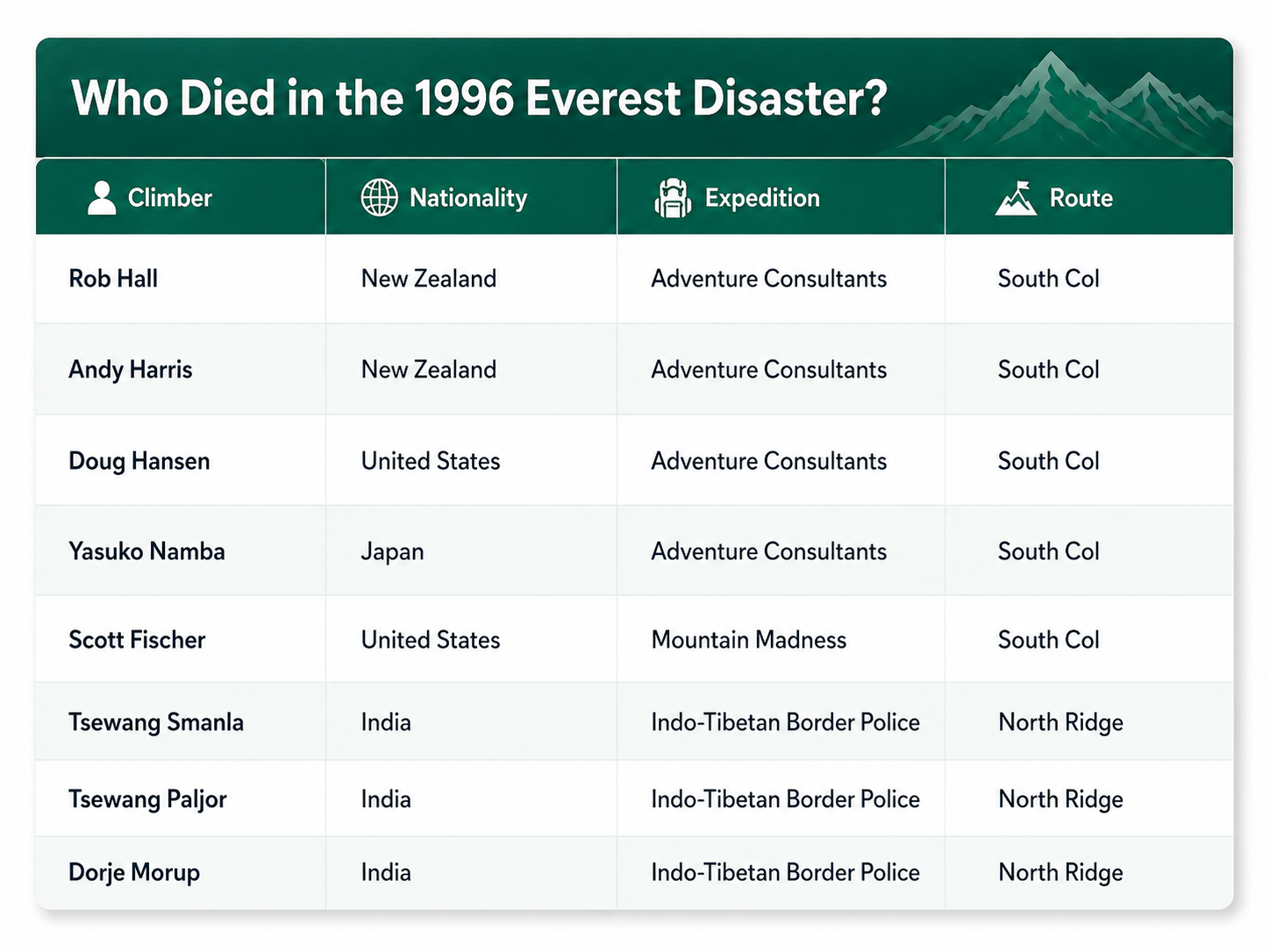
Rob Hall
Rob Hall was an experienced New Zealand guide and the leader of Adventure Consultants. He had successfully guided Everest expeditions before 1996 and was known for organised, carefully managed climbs.
Hall remained with Doug Hansen after Hansen became too weak to descend effectively. Both men were trapped above the Hillary Step as the weather deteriorated. Hall survived through the night but died high on the mountain on 11 May.
Scott Fischer
Scott Fischer was an accomplished American mountaineer and the founder of Mountain Madness. He had previously climbed Everest and was respected for his strength, enthusiasm, and extensive high-altitude experience.
During the 1996 summit attempt, Fischer appeared unusually exhausted and became increasingly weak during the descent. He collapsed above Camp IV and died despite later efforts to reach him. Mountain Madness records that he died during the severe storm while leading the expedition.
Doug Hansen
Doug Hansen was an American client who had previously attempted Everest with Rob Hall in 1995. He returned in 1996, hoping to reach the summit.
Hansen reached the top late but was unable to descend safely. Hall stayed with him, and both were eventually lost near the South Summit area. The exact circumstances of Hansen’s final moments remain uncertain because his body was never conclusively located.
Yasuko Namba
Japanese climber Yasuko Namba reached the summit of Everest on 10 May, completing the Seven Summits challenge. During the descent, she became exhausted and was stranded with other climbers near the South Col. She was found in a severely hypothermic condition and died from exposure.
Andy Harris
Andy Harris was a guide working for Adventure Consultants. During the storm, he apparently climbed back towards Hall and Hansen with water and oxygen. His final movements are uncertain. Harris disappeared near the South Summit, and his body was never found.
Expeditions Involved in the 1996 Everest Disaster
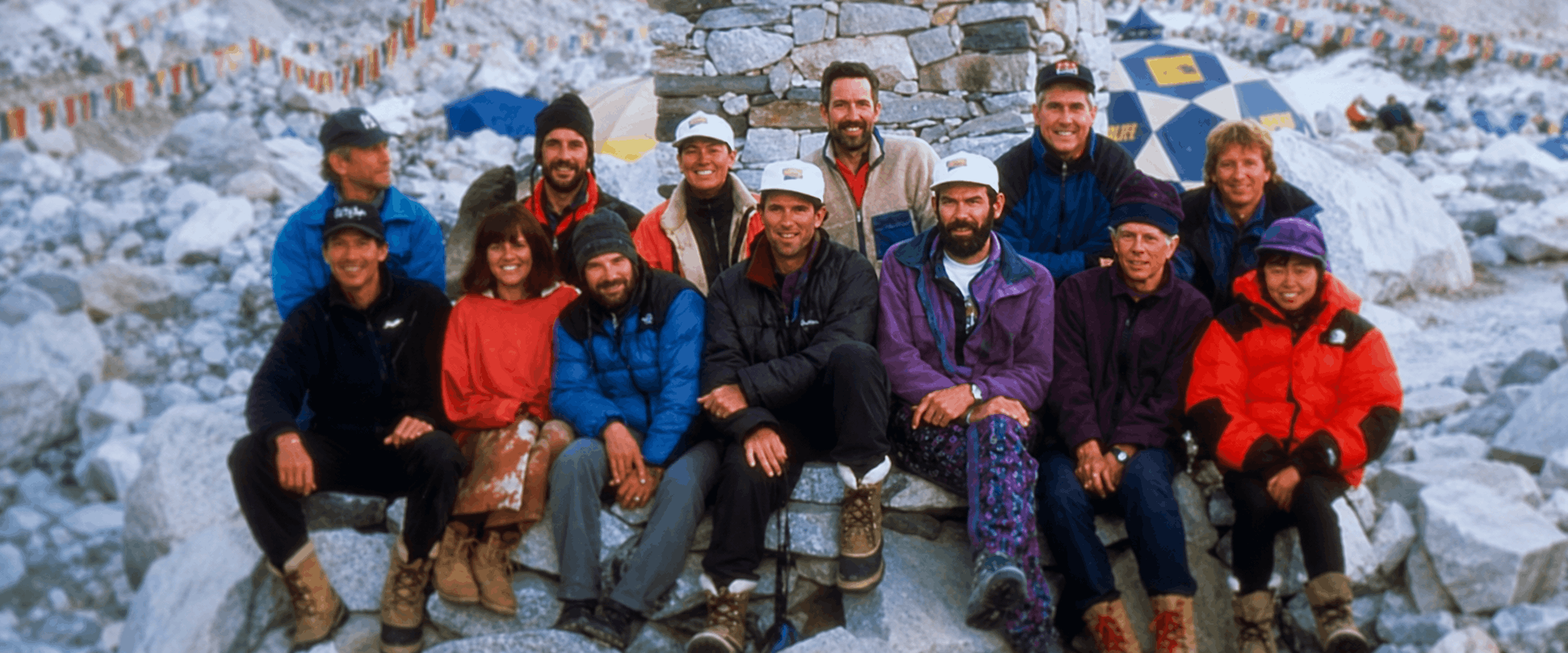
The Three Indian Climbers on the North Side
Tsewang Smanla, Tsewang Paljor and Dorje Morup were members of an Indo-Tibetan Border Police expedition attempting to climb Everest from Tibet.
They reached the upper section of the Northeast Ridge but were caught in the same storm system. All three died during their descent. Their story received less international attention than the events on the Nepal side, but they are part of the eight fatalities associated with the disaster.
Was “Green Boots” One of the 1996 Victims?
For decades, the body known as “Green Boots” was widely believed to be Tsewang Paljor. In 2026, the Indo-Tibetan Border Police publicly identified the remains as Dorje Morup and began planning a possible recovery. Because the earlier identification remains widely repeated and the recovery had not been completed at the time of review, the identity should still be presented with appropriate context.
What Caused the 1996 Mount Everest Disaster?
The tragedy is often described as a storm disaster, but weather alone does not explain why so many climbers were exposed high on the mountain so late in the day.
Delays in Fixing the Ropes
Ropes had not been installed at important sections before the summit teams arrived. Guides and Sherpa climbers had to complete the work while clients waited. These delays disrupted the schedule before the teams had even reached the upper ridge.
Bottlenecks on the Summit Route
Multiple groups were using the same narrow climbing line. Congestion developed at the Balcony and Hillary Step, where climbers could not easily overtake one another. Every minute spent waiting above 8,000 metres increases exposure, fatigue and oxygen consumption. This type of congestion remains relevant today; Hop Nepal’s guide to Mount Everest traffic jams explains why summit queues can become dangerous.
Failure to Enforce the Turnaround Time
The 2 pm turnaround time was not consistently enforced. Some climbers were still ascending or reaching the summit after the deadline.
Turning around close to the summit can be emotionally difficult, especially after weeks of preparation and significant financial investment. However, continuing upward reduces the time available for a safe descent.
Rapidly Worsening Weather
A powerful storm brought snow, winds and near-zero visibility. Trails disappeared, fixed ropes became difficult to locate and climbers struggled to recognise landmarks.
The weather transformed a delayed descent into a survival emergency. National Geographic identifies the fast-moving storm, misused turnaround times and leadership problems as central elements of the tragedy.
Exhaustion and Hypoxia
Above 8,000 metres, the human body cannot properly acclimatise. Prolonged exposure gradually weakens physical strength and mental performance. By the time the storm arrived, several climbers had been moving for many hours. Exhaustion, dehydration, cold and low oxygen affected coordination and judgement.
Oxygen-Management Problems
The expedition’s oxygen calculations were based on an expected climbing schedule. Delays meant some climbers used more oxygen than planned before beginning their descent. There was also confusion about the condition and availability of oxygen bottles at the South Summit. Without sufficient supplementary oxygen, climbers became slower and more vulnerable to altitude-related illness.
Communication Limitations
Not every climber carried a radio. Messages had to pass between guides, expedition leaders and Base Camp, sometimes through multiple people. During the storm, poor visibility and strong winds also made direct communication difficult.
Leadership and Commercial Pressure
Both Hall and Fischer were highly experienced mountaineers. Nevertheless, the disaster raised questions about whether commercial guides felt pressure to place paying clients on the summit.
Journalists were also present on the teams, increasing public interest in whether the expeditions succeeded. However, blaming commercialisation alone oversimplifies the event. Natural hazards, individual health, equipment, group coordination and decisions made under severe hypoxia all played a role.
11 May: The Aftermath and Final Rescue Efforts
By the morning of 11 May, the scale of the disaster was becoming clear. Rob Hall remained stranded near the South Summit and continued communicating by radio with climbers and Base Camp. He was eventually connected with his pregnant wife, Jan Arnold, in New Zealand. Scott Fischer remained incapacitated above the South Col, while Beck Weathers, who had been considered beyond rescue, unexpectedly regained consciousness and walked back into Camp IV with severe frostbite. Hall’s final known radio communication took place later that day.
Beck Weathers: The Most Famous Survivor
Beck Weathers was an American client on the Adventure Consultants team. During the ascent, impaired vision prevented him from continuing towards the summit. He waited for Hall as instructed, but the descending team reached him much later than expected. Weathers then became trapped with other climbers during the storm.
After spending hours exposed to extreme cold, he was believed to be beyond rescue. Unexpectedly, he regained consciousness and made his way back to Camp IV. He suffered devastating frostbite and later underwent extensive medical treatment. His survival was documented in his memoir Left for Dead and depicted in the film Everest.
The Anatoli Boukreev Controversy
Anatoli Boukreev was one of the strongest climbers on the Mountain Madness team. He reached the summit without supplementary oxygen and descended to Camp IV ahead of several clients. Jon Krakauer later questioned whether a commercial guide should have descended separately and climbed without bottled oxygen. Boukreev and his supporters argued that he had discussed the descent with Scott Fischer and returned to camp so that he could prepare for possible rescue operations.
What is certain is that Boukreev repeatedly entered the storm that night and brought several stranded climbers back to Camp IV. The disagreement demonstrates why the 1996 disaster remains controversial: participants experienced different parts of the emergency, many were affected by exhaustion and hypoxia, and no single account provides a complete view.
Books and Films About the 1996 Everest Disaster
Into Thin Air
Jon Krakauer joined Rob Hall’s expedition as a journalist for Outside. His book Into Thin Air became the most famous account of the tragedy.
The book provides a detailed first-person narrative but has also prompted disagreement about responsibility and the actions of other climbers.
The Climb
Anatoli Boukreev and G. Weston DeWalt presented a different interpretation in The Climb. It responds to criticism of Boukreev and describes the Mountain Madness expedition from another perspective. Reading both books helps readers understand why the event remains disputed.
Left for Dead
Beck Weathers described his survival, injuries, and recovery in Left for Dead. The book focuses not only on Everest but also on how the experience affected his family and personal life.
Everest Film
The 2015 film Everest dramatised the experiences of Rob Hall, Scott Fischer, Beck Weathers and other climbers. Although based on real events, some scenes and conversations were altered for storytelling. National Geographic noted that the film largely followed Krakauer’s account while also changing or simplifying certain events.
Storm Over Everest
PBS FRONTLINE’s Storm Over Everest includes interviews, expedition footage and recollections from survivors. It remains one of the most useful documentary introductions to the disaster.
Final Verdict
The 1996 Mount Everest disaster was not simply the result of an unexpected storm. The tragedy developed through a chain of connected problems: delayed ropes, crowded climbing sections, late summit arrivals, depleted oxygen, physical exhaustion, communication limitations and decisions made under intense pressure.
The storm became the final and most destructive element, trapping climbers when they were already vulnerable in the death zone.
The event also showed that experience does not make anyone invincible on Everest. Rob Hall and Scott Fischer were highly accomplished expedition leaders, yet neither survived. At the same time, the rescue efforts of guides, Sherpa climbers and exhausted team members demonstrated extraordinary courage.
Three decades later, the disaster continues to shape conversations about commercial climbing, personal responsibility, client preparation and the limits of rescue at extreme altitude. Its most important lesson remains simple: on Mount Everest, reaching the summit must never become more important than returning safely. Readers exploring the mountain beyond this tragedy can also review how many people have climbed Mount Everest and how Mount Everest was formed .
Frequently Asked Questions
1. How many people died in the 1996 Mount Everest disaster?
Eight climbers died during the storm-related events of 10 and 11 May 1996. Five died on the southern route from Nepal, while three members of an Indian expedition died on the northern route from Tibet.
2. Did anyone survive the 1996 Everest storm?
Yes. Most members of the affected expeditions survived. Well-known survivors included Beck Weathers, Jon Krakauer, Anatoli Boukreev, Neal Beidleman, Mike Groom, Charlotte Fox, Sandy Hill Pittman and Lene Gammelgaard.
3. Why did climbers continue after the turnaround time?
There was no single reason. Rope delays, queues, determination to reach the summit, guide-client relationships and the difficulty of abandoning a major personal goal all influenced decisions.
4. Was the storm predicted?
The extent to which expedition leaders received or correctly interpreted warnings remains debated. What is clear is that conditions deteriorated rapidly while climbers were still descending high on the mountain.
5. Is the film Everest based on a true story?
Yes, the film is based on the May 1996 tragedy, although parts of the timeline and some interactions were changed or simplified.
6. Was 1996 the deadliest Everest disaster?
The May 1996 event was once widely described as Everest’s most notorious modern climbing tragedy, but later disasters produced higher single-event death tolls. Its enduring fame comes largely from the presence of commercial expeditions, journalists, survivor accounts and extensive media coverage.
7. Did Anatoli Boukreev save climbers?
Yes. After returning to Camp IV, Boukreev made repeated rescue attempts and brought several stranded climbers back to the tents. His earlier decision to descend ahead of clients remains debated.
8. Did Beck Weathers reach the summit?
No. Vision problems forced him to stop below the summit. He was caught in the storm during the descent and later survived after being presumed dead.
9. How many people died on Mount Everest during the entire 1996 season?
Twelve people died on Mount Everest during the full 1996 climbing season. Eight of those deaths were associated with the storm-related events of 10 and 11 May, while four other fatalities occurred elsewhere in the season.
10. What was the 2 pm rule during the 1996 Everest disaster?
The 2 pm rule was a planned turnaround deadline. Climbers were expected to begin descending by approximately 2 pm, even if the summit was close, so they would retain enough daylight, energy and supplementary oxygen to return to Camp IV.
11. Who was to blame for the 1996 Mount Everest disaster?
No single person or decision fully explains the disaster. Delayed rope preparation, bottlenecks, late summit arrivals, oxygen-management problems, exhaustion, communication limitations and the storm all contributed. Survivor accounts differ on several decisions, so assigning responsibility to one person oversimplifies the event.
12. Was Rob Hall’s body ever recovered from Mount Everest?
No. Rob Hall’s body remained high on Everest near the South Summit. A recovery from that altitude would have exposed rescuers to extreme risk, and his remains were not brought down.
13. What happened to Adventure Consultants after the 1996 disaster?
Adventure Consultants continued operating after the tragedy. New Zealand guide Guy Cotter took over the company following Rob Hall’s death and continued developing its expedition and guiding programmes.