
Have you ever wondered how Mount Everest was formed?
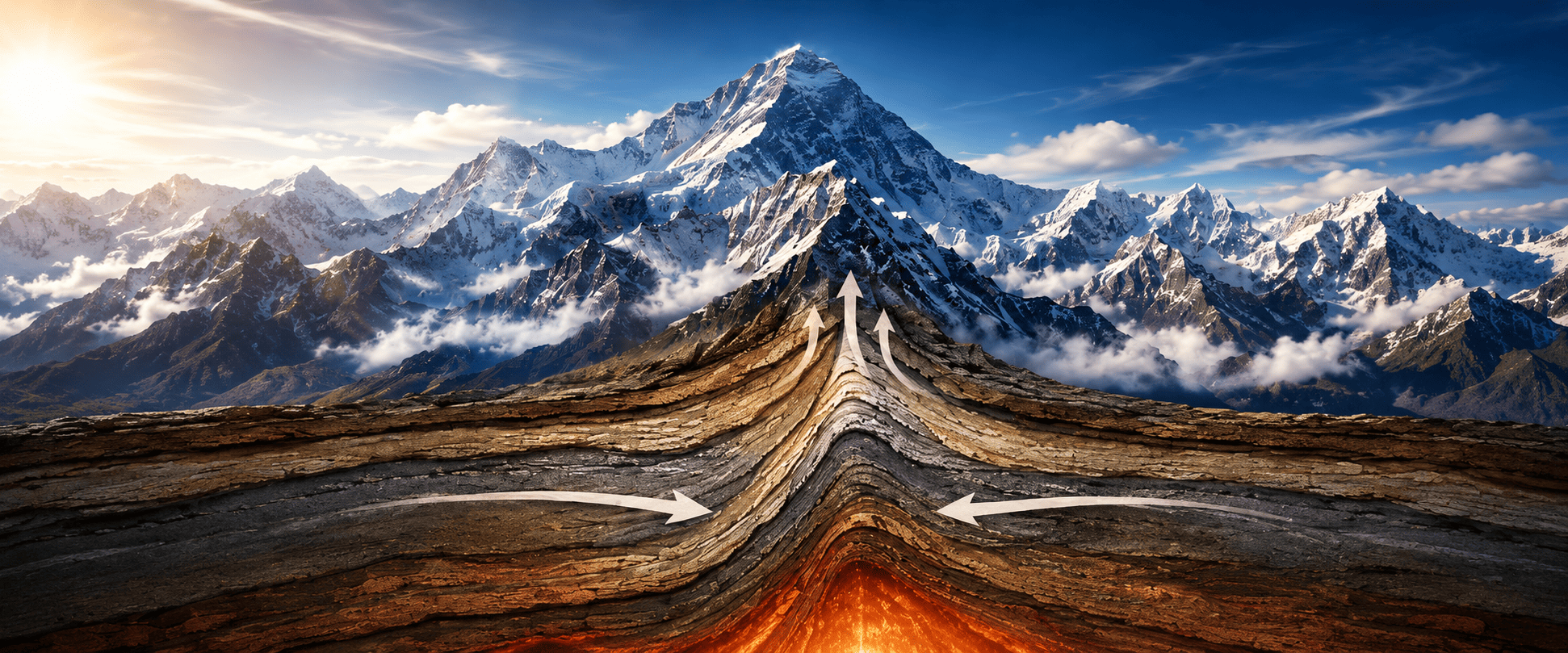
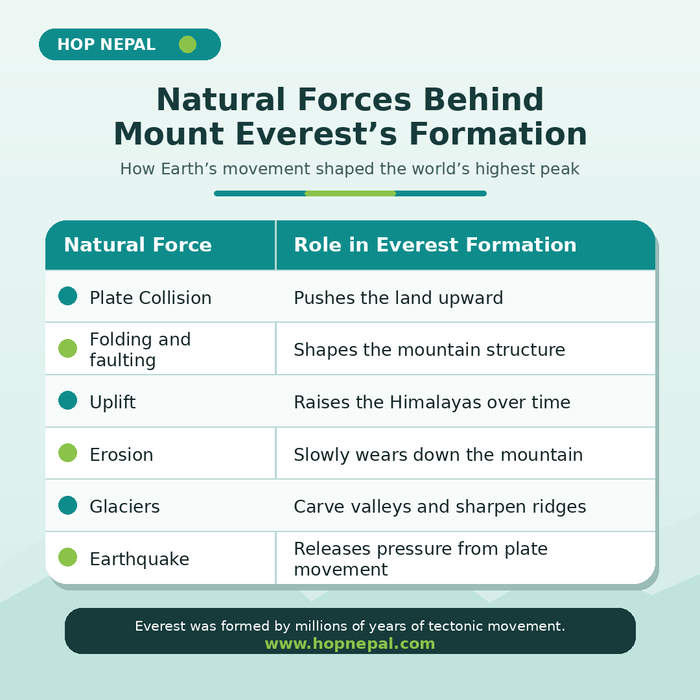
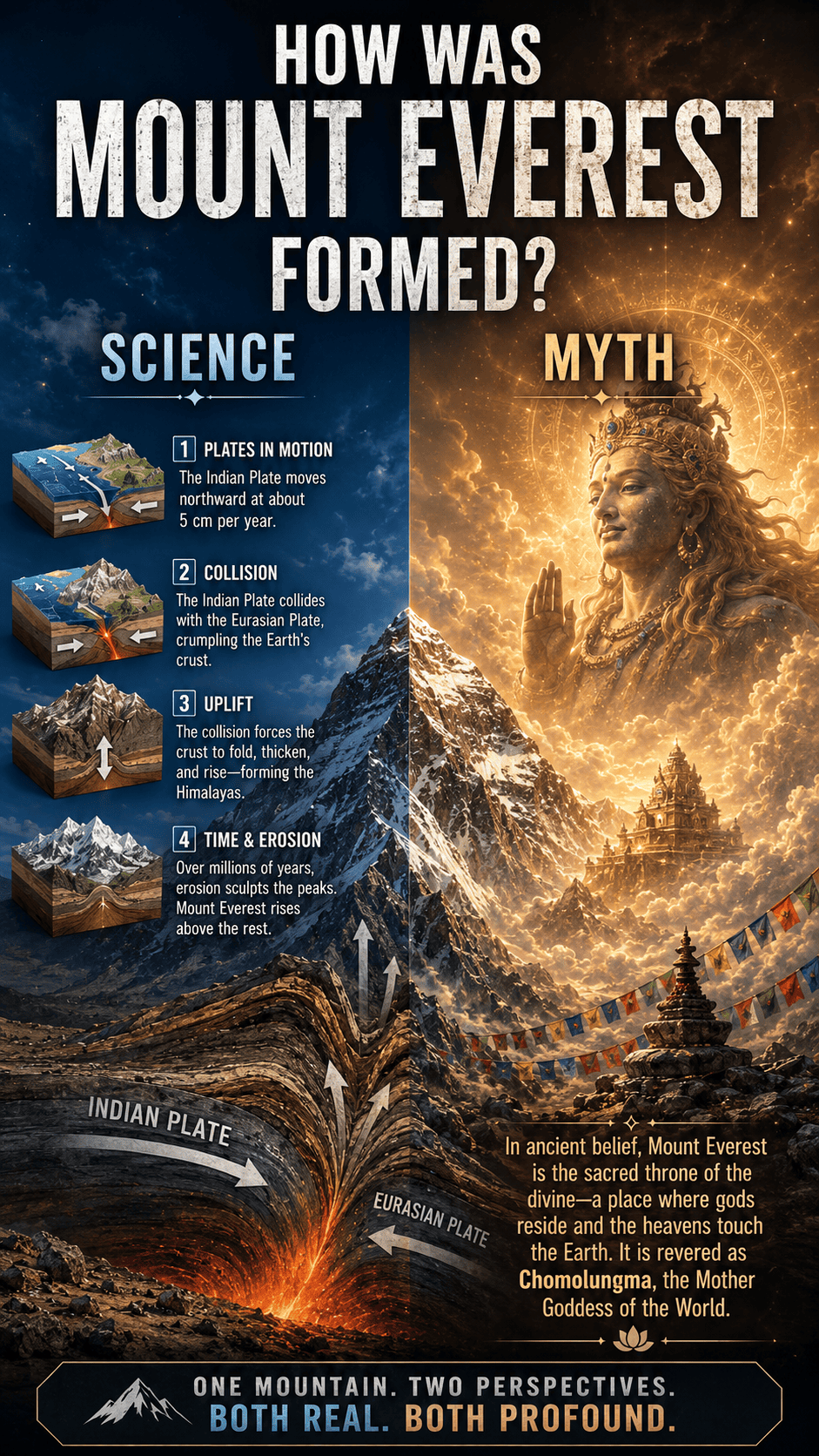
Every year, thousands of trekkers visit the Everest region, but very few know how Mount Everest was formed. This is a mystery as well as science. The Himalayas, including Mount Everest, began forming around 50 million years ago. Mount Everest and the Himalayas were formed by the slow, continuous collision of the Indian and Eurasian tectonic plates. Even today, this geological activity continues to push the mountain upward by roughly 5cm each year.
The plates did not crash just once. The crashing and pushing continued for millions of years. This slow movement caused the land to rise higher and higher over time, eventually creating Mount Everest and other mountain ranges.
The Collision Between the Indian Plate and Eurasian Plate
Mount Everest and the Himalayas were formed because of the collision between the Indian plate and Eurasian plate. This dynamic geological process remains active even today, increasing the mountain’s height by approximately 5cm each year.
The process can be imagined like pushing two thick carpets towards each other. When they meet, they do not disappear. Instead, they wrinkle and rise upward. In the same way, the Earth’s crust wrinkled and raised to form the Himalayas.
Why is Mount Everest Still Growing?
Did you know Mount Everest is not just a static giant; it’s actively growing by about 5cm yearly? This is due to the ongoing activity between the Indian and Eurasian Plates. This does not mean that Mount Everest grows smoothly solely due to tectonic activity. Earthquakes, snow cover, glacier movement, landslides, and erosion can all affect the measured height of a mountain.
The official height of Mount Everest was updated to 8,848.86 meters from sea level after a joint Nepal-China measurement announced in 2020.
Why did Mount Everest Become So Tall?
Mount Everest became so tall because of continuous tectonic pressure between the Indian and Eurasian plates. The Indian Plate continues to push upward, creating uplift across the Himalayas.
What can Everest teach us about Earth’s History?
Mount Everest plays an important role in Earth’s history and is also a key subject in understanding geological history. It teaches us that the Earth is not fixed. The planet is alive with movements, and Everest is one of the clearest examples of how powerful and fascinating Earth’s history can be.
Everest connects us to Earth's formation and the beings within it through its own formation. Everest teaches us that the rocks we see today at the top of the world were once part of an ancient sea. This shows that Earth is not steady but dynamic, and that its surface can change dramatically over millions of years.
What Kind of Rocks are Found on Mount Everest?
Mount Everest is made of different layers of rocks. Some rocks were originally formed as sediments in ancient seas, while others were altered by heat, pressure, and tectonic activity. It has a mind-blowing diversity of rock types. Mount Everest is composed of metamorphic rock, especially gneiss and schist.
Other rocks, like marine limestone and dolomite, can be found on Mount Everest. These stones are 450+ million years old and contain trilobites and crinoids.
This makes Everest one of the most interesting geological places on Earth. It is a mountain made from rocks that tell the story of ancient oceans and continental collision.
How Long Does it Take to Form Mount Everest?
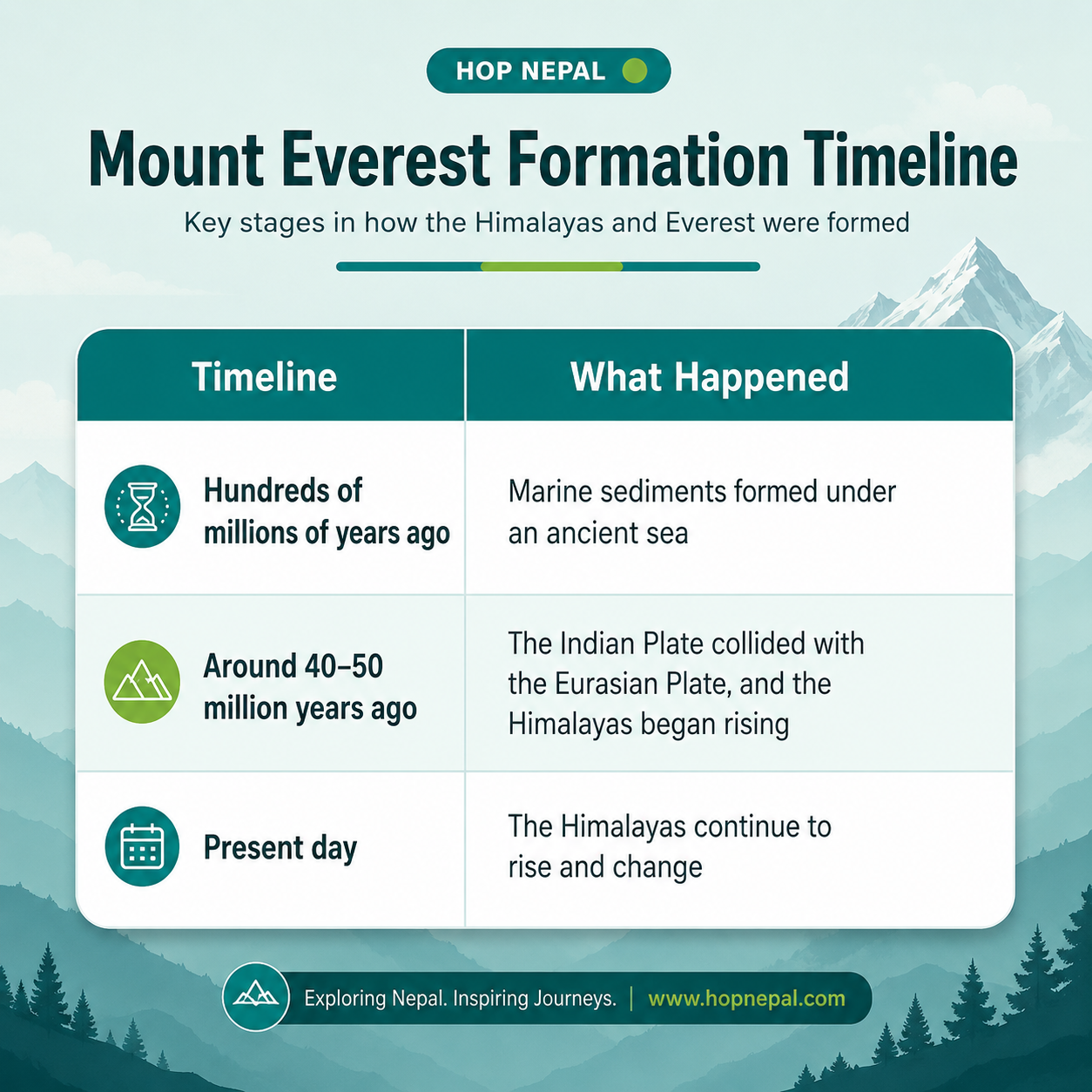
Mount Everest took approximately 40-50 million years to form. Everest was created by the collision of the Indian and Eurasian tectonic plates, which continues today as India ploughs northward, pushing the mountain upward by about 5cm each year.
According to USGS, this collision marked the beginning of rapid uplift of the Himalayas.
Interesting Facts about Mount Everest’s Formation
Previously, Mount Everest was just a giant rock under the sea; it formed millions of years ago due to the collision of two tectonic plates. The formation of Mount Everest is very interesting and holds an important role in Earth’s history.
Mount Everest was Formed by Plate Collision
Before it became an ultimate bucket-list destination for global travellers, Mount Everest was underwater for roughly 40-50 million years. Mount Everest formed when the Indian Plate collided with the Eurasian Plate, pushing the rock upward.
Mount Everest Contains Rocks from an Ancient Ocean
Some rocks around and in Mount Everest were once under an ancient sea. Marine limestone and fossil evidence show that these rocks formed underwater before being uplifted and becoming mountains.
Mount Everest’s Height Can Change
Mount Everest's height can change due to tectonic activity, snow cover, glacial movement, and landslides. The Nepal-China joint measurement proves that Mount Everest can change. They jointly announced the current height of Mount Everest is 8,848.86 meters above sea level.
Mount Everest Is Young In Geological Time
Mount Everest is a geological teenager. It is roughly around 40-50 million years old, which is considered a “young fold mountain”. Compared to other older ranges like the Appalachians, which are around 500 million years old, Mount Everest is young in Geological Time.
Mount Everest Formation - Science VS Myth
Conclusion
Mount Everest was formed by the collision of the Indian Plate and the Eurasian Plate. This extremely powerful geological process began around 40-50 million years ago and slowly created the Himalayas, including the giant Mount Everest. One of the most interesting things is that some rocks that were once underwater are still found at the summit of Mount Everest.
Everest teaches us that Earth does not remain still; it is always changing. Mount Everest was once a rock that lay beneath the sea and was not even a mountain; this shows that Earth's dynamics are changeable.
While planning your trip to Mount Everest, remember Hop Nepal, which will make it more beautiful, easier, and more comfortable, with local guides. Hop Nepal will help you with planning the trip, its execution and safe return.
FAQs
Why are there Marine Fossils on Mount Everest?
Marine fossils are found on Everest because some rocks near the summit were formed from ancient sediments and later uplifted by tectonic forces.
Is Mount Everest Still Growing?
Yes, Mount Everest is still growing. It is affected by the ongoing collision between the Indian Plate and the Eurasian Plate. However, its height can be affected by snow, glaciers, landslides and earthquakes.
Was Mount Everest Once Under Water?
Yes, Mount Everest was once underwater. Roughly around 40-50 million years old, Mount Everest was just a rock under the sea before the collision between the Indian and Eurasian plates.
What is the Age of Mount Everest?
Mount Everest was created millions of years ago. Mount Everest is considered a young mountain because of its age. Mount Everest is around 40-40 million years old.
Why is Mount Everest Considered as a Teenage Mountain?
Mount Everest is considered a teenage mountain because it is just 40-50 million years old. In geological terms, this age is considered young compared to other ranges, such as the Appalachians.