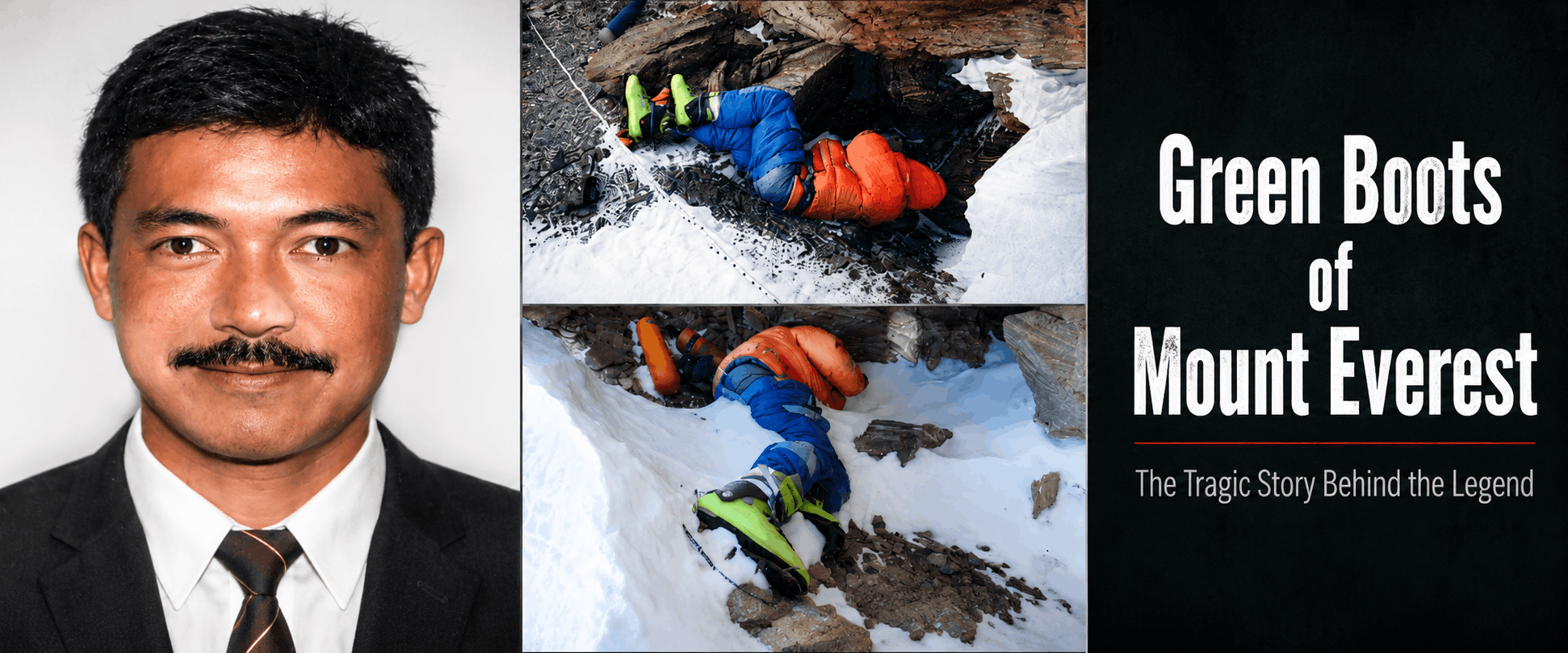
For many years, Green Boots was believed to be Tsewang Paljor because he was part of the same 1996 Indo-Tibetan Border Police expedition and was known to have worn green climbing boots. However, recent reports have challenged that long-held belief, with Indian authorities now identifying Green Boots as Dorje Morup, another member of the same Indo-Tibetan Border Police expedition. The recent identification was not based only on old assumptions or visual details. Indian authorities later connected the body to Dorje Morup through official recovery documents and a verification process linked to DNA testing.
Mount Everest is known for its beauty, height and adventure, but it also carries many sad stories. One of the most famous and emotional stories is the legend of “Green Boots,” a name given to a climber who died high on Mount Everest and became known because of the bright green boots he was wearing.
For many years, Green Boots was a familiar landmark for climbers on the northern side of Everest. His story is not just about mystery. It is also a reminder of how dangerous Mount Everest can be, especially in the death zone where oxygen is low, weather changes quickly and survival becomes extremely difficult.
Today, the story of Green Boots is remembered with curiosity, sadness and respect. Behind the nickname was a real person, a climber with a dream, a family and a final journey on the world’s highest mountain.
Who Was Green Boots on Everest?
Green Boots is the nickname given to a climber who died on Mount Everest during the 1996 climbing season. He is known as “Green Boots” because of the bright green mountaineering boots he wears.
Many climbers and writers believe Green Boots was Tsewang Paljor, an Indian climber and member of the Indo-Tibetan Border Police expedition. However, according to a DNA test conducted in 2026, “Green Boots” was Dorje Morup.
Dorje Morup was part of an Indian team attempting to climb Everest from the northern side. During the climb, the team was caught in dangerous weather. Several climbers did not return, and Green Boots became one of the most recognized reminders of that tragic event.
Green Boots and the Calamitous Everest Expedition 1996
The story of Green Boots is closely connected to the tragic 1996 Everest climbing season. In that year, several climbers lost their lives on Mount Everest after severe weather struck high on the mountain. Among them were three members of the Indo-Tibetan Border Police expedition from India: Tsewang Smanla, Dorje Morup and Tsewang Paljor.
Was Green Boots Really Tsewang Paljor or Dorje Morup?
For many years, Green Boots was widely believed to be Tsewang Paljor, an Indian climber from the Indo-Tibetan Border Police expedition who died during the 1996 Mount Everest disaster. This belief became common in Everest stories because Paljor was also part of the same tragic summit push and was reported to have worn green climbing boots.
However, recent reports have changed the long-standing understanding of this famous Everest mystery. Indian authorities now identify Green Boots as Dorje Morup, another member of the same Indo-Tibetan Border Police team. Dorje Morup, Tsewang Paljor and Tsewang Smanla were all part of the 1996 North Side expedition and disappeared during a severe storm near the summit.
On 10 May 1996, six members of the ITBP team moved higher from the North Side of Everest. As the weather worsened, three climbers turned back, while Dorje Morup, Tsewang Paljor and Tsewang Smanla continued towards the top. Reports from the expedition say the climbers later radioed that they had reached the summit, but the storm made their descent extremely dangerous.
As conditions became worse, the three men struggled to return safely. Teammates and other climbers later reported signs of movement and lights high on the mountain, but Dorje Morup and his companions never made it back to high camp. Their deaths became part of the wider 1996 Everest tragedy, one of the most remembered disasters in mountaineering history.
Today, Green Boots is understood not only as a landmark on the North Side of Everest's route, but also as the resting place of Dorje Morup. His story reminds every climber that Everest is not only about reaching the summit. The real success is returning safely, respecting the mountain and understanding how quickly conditions can turn in the death zone.
Deputy Team Leader and Expedition Leader
The 1996 Indo-Tibetan Border Police expedition was led by Commandant Mohinder Singh, with senior team members supporting the climb from the North Side of Mount Everest. The expedition was a proud moment for India because the team aimed to make a historic ascent from the northern route of Everest.
Before the summit push, the team had been instructed to follow a strict turnaround time, often known as the 2 0’clock rule. This rule means climbers should turn back if they cannot reach the summit by a certain time, even if they are very close.
During the climb, some team members, including Harbhajan Singh, turned back due to frostbite and unsafe conditions. Harbhajan Singh reportedly signalled the remaining climbers not to continue higher, but Tsewang Smanla, Dorje Morup and Tsewang Paljor pushed on towards the summit. Their teammates later saw faint headlamps near the second step area, but the climbers never returned to their high camp.
The report says that Harbhajan Singh sought help from a Japanese expedition on the North side, but the rescue situation was complicated by extreme altitude, poor weather, communication difficulties, and the danger of moving in the death zone.
Why Did Green Boots Become Famous?
Green Boots became famous because of his location, visibility, and the powerful story associated with him. For climbers on the northern route of Everest, he was once a landmark in one of the mountain's most dangerous sections. But the fame of Green Boots also raises an important question: how should we speak about people who died on Everest?
Green Boots should not be treated as a strange Everest fact or scary mountain story. He was a climber who lost his life while following a dream. His story reminds us that Everest is not only a place of achievement but also one where decisions, weather, altitude, and timing can become matters of life and death.
The Controversy Around the Name “Green Boots”
The story ofGreen Boots on Mount Everest remains controversial even today. For many years, the body became a well-known landmark for climbers on the Northeast Ridge route of Everest. Most people believe Green Boots was Tsewang Paljor, an Indian climber from the Indo-Tibetan Border Police expedition of 1996. However, some accounts have also suggested that the body belonged to his teammate Dorje Morup.
The name” Green Boots” came from the bright green mountaineering boots found on the body. The climber was discovered lying in a small cave-like shelter high on Everest, at around 8,500 meters. Because of the striking colour of the boots, climbers started calling the body "Green Boots".
The controversy around Green Boots is not only about identity. It is also about how Everest treats those who never return. Whether the climber was Tsewang Paljor, Dorje Morup or another mountaineer, the story represents courage, sacrifice and the harsh reality of high-altitude climbing.
Green Boots is believed to have died at a young age, around 28 years old. He was young, brave, and full of ambition. His story should not be remembered only as the body of a famous climber on Everest, but as the story of a climber who followed his dream in one of the most dangerous places on Earth.
Are Green Boots Still on Mount Everest?
Green Boots were visible on Everest’s northern route for many years. However, reports suggest that the body was moved or hidden from its original visible position around 2014. Some later accounts suggest that it may have been covered, shifted from the main route or no longer clearly visible to climbers passing that area.
Because of the extremely high location and limited access, the exact current position is not always clear. The safest way to explain it is that Green Boots is no longer as visible as it once was on the main climbing route.
Even if the body is no longer clearly seen, the story of Green Boots remains one of the most famous and emotional stories connected to Mount Everest.
What Lessons from the Story of Green Boots?
The story of Green Boots teaches important lessons about Mount Everest and high–altitude climbing.
- Everest must always be respected. It may be beautiful and inspiring, but it is also one of the most dangerous environments on Earth.
- Climbers need to know when to continue and when to turn back. A late summit push, changing weather or slow movement can increase risk.
- Teamwork and responsibility are very important. In extreme conditions, one decision can affect the entire team.
- The story reminds us that every climber has a human story. Behind every name, photo or Everest landmark, there is a real person with dreams, courage, and loved ones waiting at home.
Final Thoughts
The story of Green Boots of Mount Everest is one of the most emotional stories connected to the world’s highest mountain. Many people first hear about Green Boots as a famous Everest landmark, but the story's real meaning goes much deeper.
Green Boots reminds us that Everest is not only about adventure, records and success. It is also about danger, preparation, respect, human limits and the cost of climbing in extreme conditions.
If you are planning a journey to the Everest region, proper preparation is very important. Hop Nepal can help you plan the 12-Days Everest Base Camp Trek, 14-Days Everest Base Camp Trek, Everest Helicopter Tour, permits, transport and complete travel support for a safe and well-planned experience in Nepal.
You can also contact Hop Nepal for Everest region trip planning, trekking guidance and travel support.
FAQs About Green Boots on Mount Everest
Can Everest Base Camp Trekkers See Green Boots?
No. Everest Base Camp trekkers cannot see Green Boots because the body was located high on the northern route of Everest, far above the normal trekking route.
Why are Bodies Left on Mount Everest?
Bodies are sometimes left on Mount Everest because recovery at extreme altitudes is very dangerous, expensive, and physically difficult due to low oxygen levels, harsh weather, and steep terrain.
Is Green Boots Still on Mount Everest?
The exact current position of Green Boots is not completely clear. For many years, the body was visible on Everest’s northern route, but reports suggest it was later moved, covered or hidden from its original visible position. The safest way to explain it is that Green Boots is no longer clearly visible on the main climbing route like before.
Was Green Boots a real person?
Yes. Green Boots was the nickname given to a climber who died on Everest. According to Indian authorities, “Green Boots” is Dorje Morup, an Indian climber from the 1996 Indo-Tibetan Border Police expedition.