
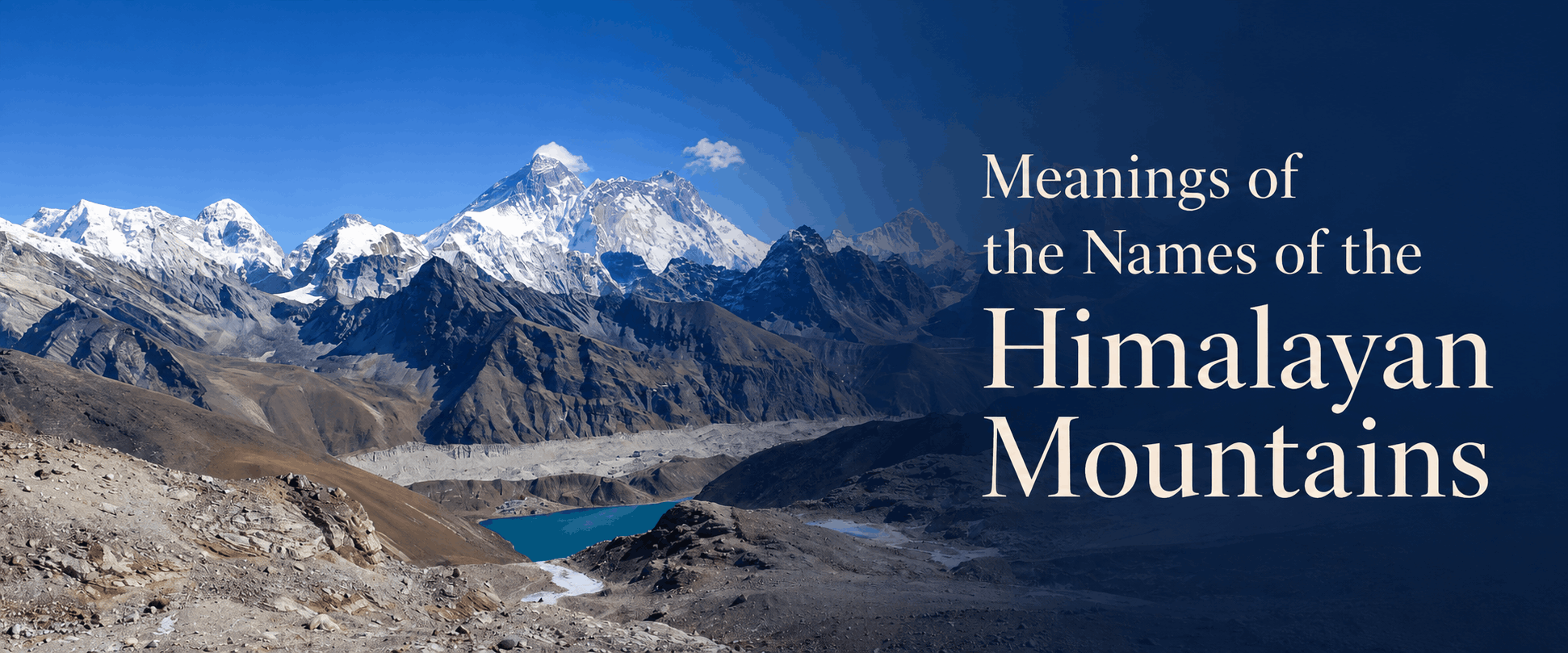
Himalayan Mountain Names and Meanings
The Himalayas contain some of the highest, most beautiful and most culturally significant mountains on Earth. Travellers often recognise names such as Everest, Annapurna, Manaslu and Kanchenjunga, but fewer people know what these mountain names actually mean.
Many Himalayan mountain names come from Sanskrit, Nepali, Tibetan, Sherpa, Balti and other regional languages. Some describe the mountain’s physical appearance, while others connect the peak with gods, goddesses, spiritual beliefs or local legends. A few internationally recognised names were introduced by foreign surveyors and explorers.
Learning the meanings of Himalayan mountain names helps travellers see these peaks as more than geographical landmarks. Each name carries part of the history, identity and worldview of the communities living beneath the mountains.
What Does the Word “Himalaya” Mean?
The word Himalaya comes from Sanskrit. It combines hima, meaning snow or frost, with alaya, meaning dwelling, home, or abode. Himalaya can therefore be translated as “the abode of snow” or “home of snow.” In Nepali, himal (हिमाल) commonly refers to the Himalayas, snow peaks or a high snow-covered mountain. This is why the word appears in many Nepali mountain and regional names, including Mardi Himal, Ganesh Himal and the Mahalangur Himal.
The name appropriately describes the vast snow-covered mountain system stretching across South Asia. However, the Himalayas are not simply a wall of rock and ice. They are also home to diverse languages, religious traditions and mountain communities whose cultures have shaped the names of individual peaks.
Not all 14 mountains above 8,000 metres belong to the Himalaya range in the narrow geographical sense. K2, Broad Peak and the Gasherbrum mountains, for example, belong to the neighbouring Karakoram range. Nevertheless, they are often discussed together as the world’s fourteen eight-thousanders. K2 is officially recognised as part of the Karakoram.
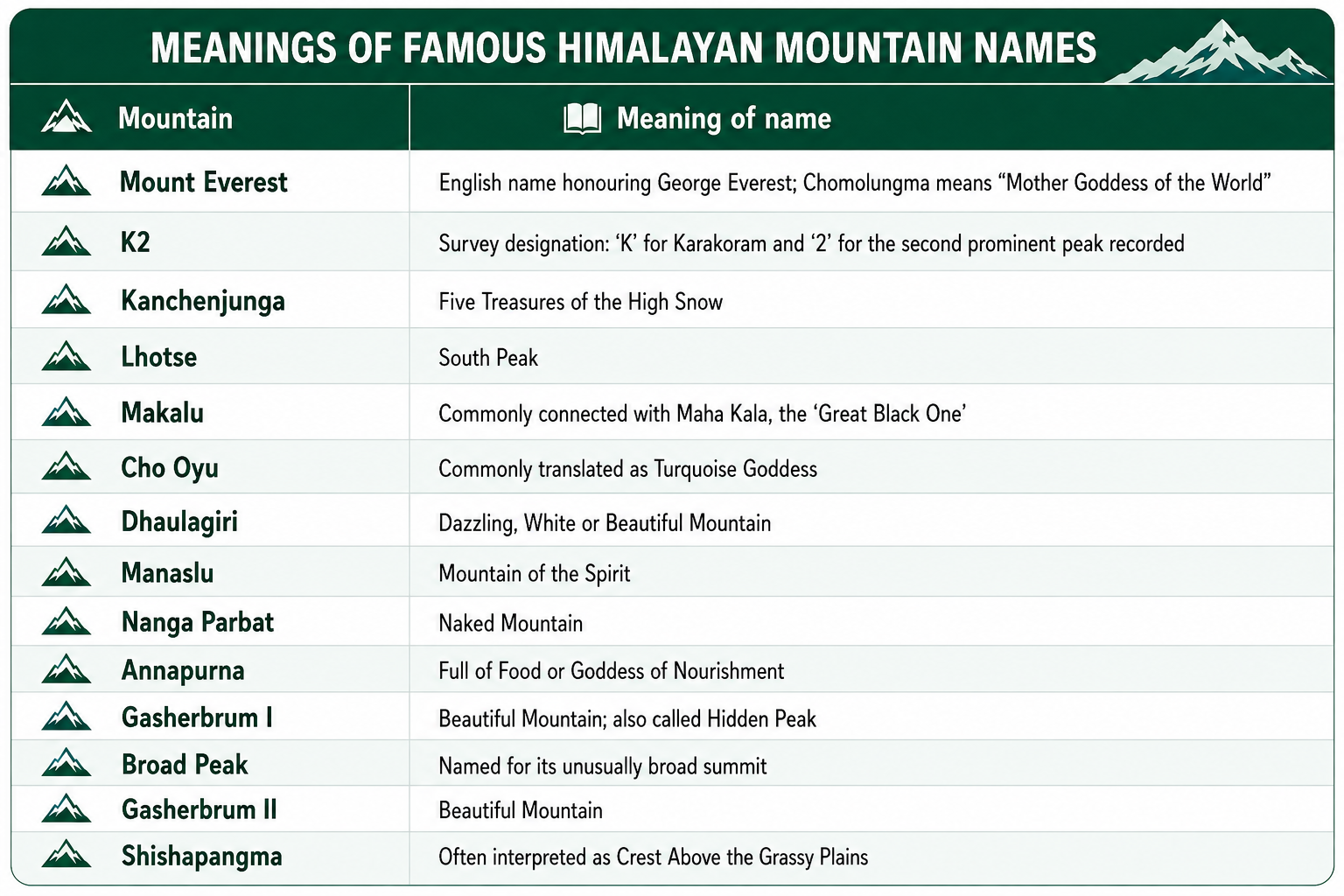
Quick Guide to Famous Mountain Names and Their Meanings
Mountain List and Their Names
- Mount Everest: Sagarmatha and Chomolungma
- K2: A Survey Number That Became a Permanent Name
- Kanchenjunga: Five Treasures of the High Snow
- Lhotse: The South Peak
- Makalu: The Great Black One
- Cho Oyu: The Turquoise Goddess
- Dhaulagiri: The Dazzling White Mountain
- Manaslu: Mountain of the Spirit
- Nanga Parbat: The Naked Mountain
- Annapurna: The Goddess of Food and Nourishment
- Gasherbrum I: Beautiful Mountain and Hidden Peak
- Broad Peak: Named After Its Wide Summit
- Gasherbrum II: Another Beautiful Mountain
- Shishapangma: Crest Above the Grassy Plains
- Aama Dablam: Mother’s Necklace
- Machhapuchhre: Fishtail Mountain
- Gaurishankar: Gauri and Shankar
1. Mount Everest: Sagarmatha and Chomolungma
The internationally recognised name Mount Everest honours Sir George Everest, a former Surveyor General of India. British surveyors adopted the name during the nineteenth century after identifying the peak as the world’s highest mountain.
However, communities around the mountain had their own names long before it became known internationally as Everest.
What Does Chomolungma Mean?
The Tibetan name Chomolungma, sometimes written as Qomolangma, is commonly translated as:
- Mother Goddess of the World
- Goddess Mother of the Earth
- Goddess Mother of the Valley
These interpretations reflect the sacred position of the mountain in Tibetan and Himalayan traditions. National Geographic translates Chomolungma as “Mother Goddess of the World.”
What Does Sagarmatha Mean?
In Nepal, Mount Everest is officially known as Sagarmatha. The name is commonly interpreted as “Forehead of the Sky,” “Head of the Sky”, or “Peak of Heaven.” The name joins ideas of the sky or heavenly realm with the head, forehead or summit. It represents Everest as a peak touching the highest part of the heavens.
Sagarmatha is also the name used for Sagarmatha National Park, the UNESCO-listed protected area covering much of Nepal’s Everest region. Travellers can experience this landscape on the classic Everest Base Camp Trek.
2. K2: A Survey Number That Became a Permanent Name
Unlike many Himalayan and Karakoram peaks, K2 does not have a widely accepted ancient local name.
In 1856, British surveyor Thomas Montgomerie observed and sketched prominent mountains in the Karakoram. He labelled them K1 and K2, with the letter K standing for Karakoram. K2 was simply the second prominent peak recorded in that survey.
K1 was later identified by its local name, Masherbrum. No widely established local name was found for K2, so the survey code remained.
The name Chogori, sometimes interpreted as “Big Mountain,” has also been used. However, evidence that this was a traditional and widely used local name is limited. K2 remains one of the rare cases in which a temporary mapping label became the mountain’s permanent international name.
3. Kanchenjunga: Five Treasures of the High Snow
Kanchenjunga, also written as Kanchanjunga or Khangchendzonga, is generally translated as “Five Treasures of the High Snow” or “Five Treasures of the Great Snow.”
The name comes from Tibetan words associated with snow, greatness, treasure and the number five. It refers to the mountain’s five summits and to sacred treasures believed to be hidden within the mountain.
Different traditions describe these treasures in slightly different ways. They may include precious metals, gems, grain, medicine, sacred texts or other resources needed to protect and sustain humanity.
Kanchenjunga rises along the border between eastern Nepal and the Indian state of Sikkim. For communities living around the mountain, it is not simply a collection of high summits. It is a sacred landscape associated with protection, abundance and spiritual power. Travellers interested in this sacred landscape can also explore the Kanchenjunga Conservation Area or consider the Kanchenjunga Base Camp Trek.
4. Lhotse: The South Peak
The meaning of Lhotse is relatively direct. In Tibetan, the name means “South Peak.” The mountain received this name because it stands immediately south of Mount Everest and is closely connected to it through the Everest massif. The two mountains are separated by the South Col, and climbers following the standard routes initially travel through some of the same terrain.
The name is formed from Tibetan words generally understood as:
- Lho: south
- Tse: peak or summit
Although Lhotse is one of the highest mountains in the world, its identity has often been overshadowed by neighbouring Everest. Its name clearly expresses this geographical relationship.
5. Makalu Mountain: Meaning, Location and the Great Black One
Where Is Makalu Mountain Located?
Makalu is located in the Mahalangur Himal of the Himalayas on the Nepal–China border, southeast of Mount Everest. At 8,485 metres, it is the fifth-highest mountain in the world.
The Mahalangur mountain range is one of the most spectacular sections of the Himalayas because it contains four of the world's six highest mountains: Everest, Lhotse, Makalu and Cho Oyu. On the Nepal side, Makalu rises above the remote landscapes protected by Makalu Barun National Park.
The origin of the name Makalu is not completely certain. The most commonly accepted explanation connects it with the Sanskrit term Maha Kala.
Maha means great, while Kala means black, time or death depending on its context. Maha Kala is also a title associated with a powerful form of the Hindu god Shiva. Makalu is therefore frequently interpreted as “The Great Black One.”
The name may refer to the mountain’s dark rock, powerful appearance or spiritual association with Shiva.
Makalu is especially recognisable because of its steep four-sided pyramid shape. Its name suits a mountain that appears dark, isolated and imposing when seen from the surrounding valleys. The surrounding Himalayan environment is protected within Makalu Barun National Park.
Because the exact linguistic development of the name remains uncertain, it is better to describe the Maha Kala explanation as a widely accepted interpretation rather than an unquestioned fact.
6. Cho Oyu: The Turquoise Goddess
Cho Oyu is widely translated from Tibetan as “Turquoise Goddess.” Thus, the poetic meaning may refer to the blue-green or turquoise colour the mountain can appear to display under particular atmospheric and lighting conditions.
However, the precise origin of the name is debated. Other interpretations recorded over time include:
- Mighty Head
- God’s Head
- Bald God
“Turquoise Goddess” remains the best-known and most commonly used English meaning, but responsible writing should acknowledge that Tibetan mountain names can have regional pronunciations and multiple interpretations.
Cho Oyu stands west of Everest near the Nepal-Tibet border. Its elegant name reflects the tendency of Himalayan communities to view mountains not merely as physical objects but as living or divine presences.
7. Dhaulagiri: The Dazzling White Mountain
The name Dhaulagiri comes from Sanskrit.
- Dhawala or Dhavala: dazzling, white, bright or beautiful
- Giri: mountain
Dhaulagiri can therefore be translated as “White Mountain,” “Dazzling Mountain” or “Beautiful White Mountain.” The name describes the mountain’s enormous snow-covered slopes, which appear exceptionally bright when illuminated by the sun.
Dhaulagiri rises west of the Kali Gandaki Valley in Nepal. Its bright white massif creates a dramatic contrast with the deep valleys and darker landscapes below it. Among Nepal’s mountain names, Dhaulagiri is one of the clearest examples of a name inspired by the mountain’s visible appearance.
8. Manaslu: Mountain of the Spirit
The name Manaslu is derived from the Sanskrit word Manasa, which can mean spirit, soul, intellect or mind. Manaslu is generally translated as “Mountain of the Spirit.” Nepal Tourism Board also presents this as the recognised meaning of the mountain’s name.
The meaning feels especially appropriate in the Manaslu region, where trekking trails pass Buddhist monasteries, mani walls, prayer wheels, chortens and villages influenced by Tibetan culture. Much of this cultural landscape lies within the Manaslu Conservation Area.
Manaslu is also known locally by other names, including Kutang in some historic and regional contexts. The name Manaslu, however, has become the most recognised internationally. For travellers completing the Manaslu Circuit Trek, understanding the name provides a deeper appreciation of the spiritual landscape surrounding the mountain.
9. Nanga Parbat: The Naked Mountain
The name Nanga Parbat comes from Sanskrit-derived words:
- Nagna: naked or bare
- Parvata: mountain
Together, they mean “Naked Mountain.” The name is often connected with the mountain’s immense exposed faces and its comparatively bare appearance from certain directions. The mountain is also known locally as Diamer or Deo Mir. This name has been interpreted as “Mountain of God,” “Sacred Mountain” or “Heavenly Mountain.”
Nanga Parbat stands at the western end of the traditional Himalayan range in present-day Pakistan-administered Gilgit-Baltistan. Its two names create contrasting images: one describes a bare physical mountain, while the other presents it as a divine or sacred place.
10. Annapurna: The Goddess of Food and Nourishment
The name Annapurna comes from Sanskrit:
- Anna: food or grain
- Purna: full, complete or abundant
Annapurna can therefore be understood as “Full of Food,” “Filled with Nourishment” or “She Who Provides Food.”
The mountain range is named after Annapurna, the Hindu goddess of food, nourishment and abundance. She represents the life-supporting power of food and the importance of ensuring that people are fed.
The name is particularly meaningful because water flowing from the Annapurna Himalayas supports valleys, farms and communities below. The mountains are therefore connected symbolically and physically with fertility, sustenance and life.
For trekkers travelling through the Annapurna region, the name adds a cultural dimension to landscapes that might otherwise be appreciated only for their beauty. The Annapurna Conservation Area and the Annapurna Circuit Trek provide two useful starting points for learning more about the region.
11. Gasherbrum I: Beautiful Mountain and Hidden Peak
The name Gasherbrum is frequently said to mean “Shining Wall.” However, this is a common misconception.
According to the American Alpine Club, Gasherbrum comes from the Balti words:
- Rgasha: beautiful
- Brum: mountain
The more accurate translation is therefore “Beautiful Mountain.” The term “Shining Wall” specifically became associated with the spectacular west face of Gasherbrum IV rather than being the literal translation of Gasherbrum.
Gasherbrum I is also known as Hidden Peak. Explorer William Martin Conway used this name because the mountain remains concealed behind other peaks during much of the approach through the Baltoro region.
12. Broad Peak: Named After Its Wide Summit
Broad Peak received its English name because of its unusually long and wide summit ridge. Its summit area extends for more than a kilometre, giving the mountain a broad appearance rather than a single sharply pointed top. The mountain was initially designated K3 during early surveying. It was later named Broad Peak by explorer William Martin Conway.
The name is sometimes translated into Balti as Falcha Kangri or a similar spelling. However, sources disagree about how widely this translated name has traditionally been used by local communities.
Broad Peak demonstrates how some mountain names are based on a straightforward observation of physical shape rather than mythology or religion.
13. Gasherbrum II: Another Beautiful Mountain
Like Gasherbrum I, the name Gasherbrum II belongs to the Gasherbrum group in Karakoram. The correct meaning of Gasherbrum is “Beautiful Mountain,” formed from Balti words meaning beautiful and mountain.
Gasherbrum II was given a numerical designation to distinguish it from the other major peaks within the massif. The numbering reflects the mapping and classification of the mountain group rather than a separate spiritual meaning.
The repeated use of Gasherbrum shows how one regional name can describe an entire massif before individual summits receive numbers or secondary names.
14. Shishapangma: Crest Above the Grassy Plains
Shishapangma is commonly interpreted as “Crest Above the Grassy Plains.” Geologist Toni Hagen explained the name through Tibetan words referring to a mountain crest or range rising above a grassy plain or meadow.
However, another Tibetan interpretation connects the name with a local story about livestock killed during heavy snowfall and the food that remained available to nearby residents. This demonstrates why translating Himalayan place names is not always simple.
Shishapangma is also known as Gosainthan, a name that can be translated as “Place of the Saint” or “Abode of God.” Rather than presenting one translation as completely certain, it is more accurate to recognise that Shishapangma has multiple linguistic and cultural interpretations.
Meanings of Other Famous Mountain Names in Nepal
Nepal has many recognisable mountains below 8,000 metres whose names are equally meaningful.
Aama Dablam: Mother’s Necklace
Aama Dablam means “Mother’s Necklace” in the Sherpa language. The long ridges on either side of the mountain are compared to a mother’s arms protecting her child. The hanging glacier beneath the summit resembles a Dablam, a traditional pendant worn by Sherpa women.
- Ama: mother
- Dablam: a traditional pendant or necklace
This combination of physical shape and cultural symbolism has made Ama Dablam one of the most beautifully named mountains in Nepal.
Machhapuchhre: Fishtail Mountain
The Nepali name Machhapuchhre means “Fish Tail.”
- Machha: fish
- Puchhar or Puchhre: tail
The name refers to the mountain’s distinctive double summit, which resembles the opened tail of a fish when viewed from certain directions. Machhapuchhre is one of the most recognisable mountains visible from Pokhara and the Annapurna trekking region.
Gaurishankar: Gauri and Shankar
The name Gaurishankar combines two sacred Hindu names:
- Gauri: a form of the goddess Parvati
- Shankar: a name for Lord Shiva
The mountain has two prominent summits associated symbolically with Gauri and Shankar. Its name can therefore be understood as representing the goddess and her divine consort. The name reflects the mountain’s sacred importance to communities in the Rolwaling region of Nepal.
Why Do Himalayan Mountains Have Different Names?
A single Himalayan mountain may have several names because it can be seen and approached from different countries, valleys, and cultural regions.
The same peak may have:
- A Nepali name
- A Tibetan name
- A Sherpa or local Indigenous name
- A Sanskrit-derived religious name
- A survey number
- An English or European name
Mount Everest is the clearest example. The same mountain is known internationally as Everest, in Nepal as Sagarmatha and in Tibetan tradition as Chomolungma. These names are not simply alternative labels. Each one reflects a different relationship with the mountain.
A survey name may focus on mapping and measurement. A local name may describe shape, colour or location. A sacred name may represent a god, goddess, protector or source of life.
Why Understanding Mountain Names Matters to Travellers
A Himalayan trek is not only a journey through high-altitude scenery. It is also a journey through places shaped by language, religion, oral tradition and local identity.
Knowing that Manaslu means Mountain of the Spirit changes how a traveller may view the monasteries and prayer flags along the trail. Understanding Annapurna as a goddess of nourishment adds meaning to the farming communities and fertile valleys below the range.
Similarly, recognising Chomolungma as Mother Goddess of the World encourages travellers to see Everest through the beliefs of local communities rather than only as a summit to be conquered. Responsible Himalayan travel begins with respecting these local names, stories and cultural interpretations.
Final Thoughts
The meaning of Himalayan mountain names reveals stories that are often hidden behind their famous snow-covered summits.
Some names describe shape, colour or direction. Others honour gods, goddesses, protectors and sources of nourishment. A few, such as K2 and Everest, show how surveying and international exploration introduced names that later became globally recognised.
From the Mother Goddess of the World to the Mountain of the Spirit, the Five Treasures of the High Snow and the Mother’s Necklace, these names remind us that Himalayan peaks are more than climbing objectives.
They are cultural landmarks, sacred places and enduring symbols of the communities that have lived beneath them for generations. Travelling with local knowledge allows visitors to experience not only the Himalayan landscape but also the histories and meanings held within it. Hop Nepal helps travellers explore Nepal’s mountain regions through carefully planned trekking, tour, accommodation and transportation services.
Frequently Asked Questions
1. Why do Himalayan mountains have more than one name?
Many Himalayan mountains lie between different countries, cultural regions and language communities. As a result, the same peak may have a Nepali, Tibetan, Sanskrit, Sherpa or internationally recognised English name. Mount Everest, for example, is also called Sagarmatha in Nepal and Chomolungma in Tibetan.
2. Which mountain name means Turquoise Goddess?
Cho Oyu is commonly translated as “Turquoise Goddess.” The name is believed to come from Tibetan, although other interpretations have also been recorded.
3. What is the meaning of Shishapangma?
Shishapangma is commonly interpreted as “Crest Above the Grassy Plains.” However, different translations and local stories are associated with the name, so its exact meaning is sometimes debated.
4. Are Himalayan mountain names based on religion?
Many Himalayan mountain names have religious or spiritual meanings, but not all of them do. Annapurna, Gaurishankar, Chomolungma and Manaslu have strong spiritual associations, while names such as Lhotse, Broad Peak and Machhapuchhre describe location or physical appearance.
5. Which Himalayan mountains are named after gods or goddesses?
Mountains with names connected to gods, goddesses or spiritual figures include Annapurna, Gaurishankar, Chomolungma and Makalu. These names show the important place mountains hold in Hindu, Buddhist and local Himalayan beliefs.
6. Which mountain name is connected with food and abundance?
Annapurna is connected with food, nourishment and abundance. The Sanskrit words anna and purna can be understood as food and fullness, making Annapurna a symbol of nourishment and prosperity.
7. Are Himalayan mountain name translations always exact?
No. Mountain names may have different pronunciations, spellings and interpretations depending on the language and community. Some meanings are widely accepted, while others are based on local legends, historical records or debated linguistic explanations.
8. Do mountain names describe their appearance?
Many of them do. Dhaulagiri describes a white or dazzling mountain, Machhapuchhre refers to a fish-tail shape, Broad Peak describes a wide summit, and Nanga Parbat refers to a bare or naked mountain.
9. What is the most spiritually meaningful mountain name in Nepal?
There is no single answer because meanings vary between communities. Annapurna represents nourishment, Manaslu represents the spirit, Gaurishankar represents Shiva and Parvati, and Chomolungma represents Everest as the Mother Goddess of the World.
10. How can learning mountain names improve a Himalayan trek?
Understanding mountain names allows trekkers to connect landscapes with local stories, religions and communities. It transforms a trek from a purely scenic journey into a more meaningful cultural experience.
11. How do you spell Himalayan?
Himalayan is spelled H-I-M-A-L-A-Y-A-N. “Himalaya” refers to the mountain system, “Himalayas” is the common plural form used for the range, and “Himalayan” is the adjective used in phrases such as Himalayan mountains, Himalayan culture and Himalayan trekking.