
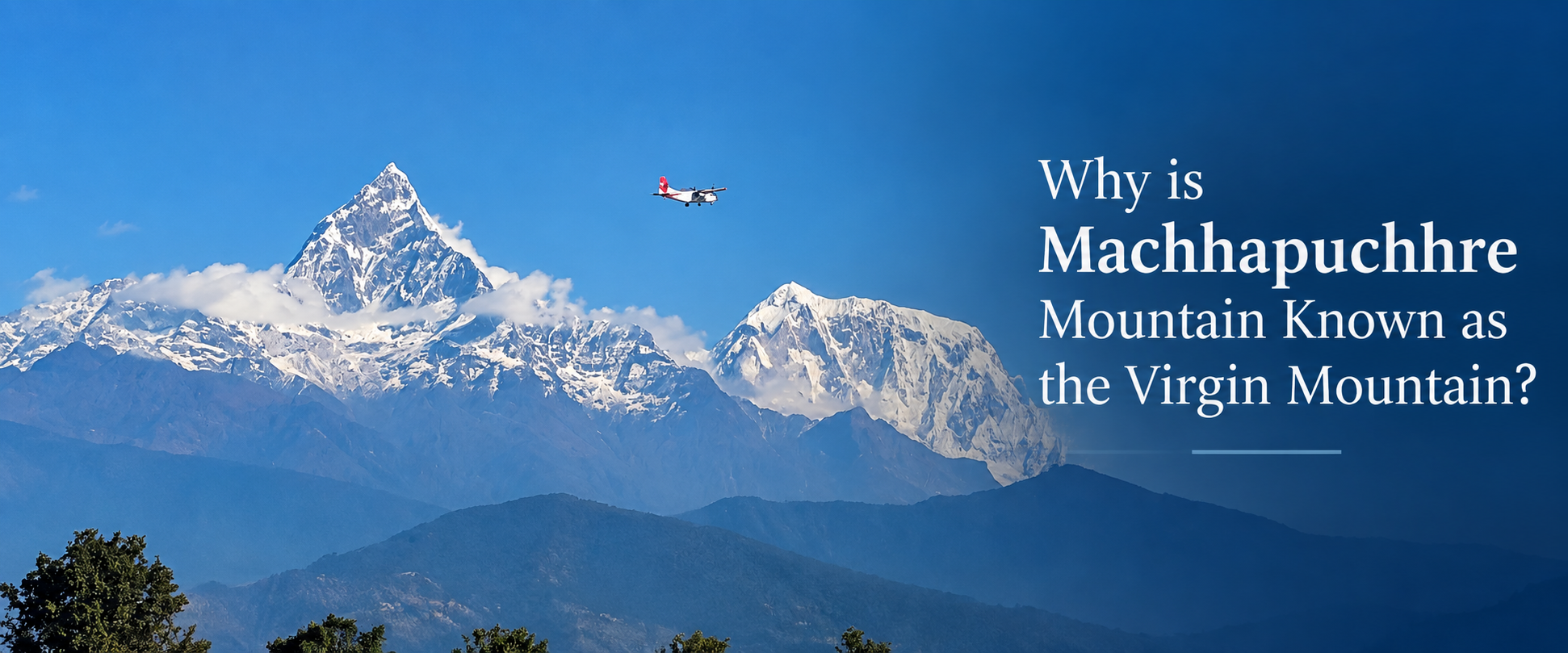
Machhapuchare Mountain, Nepal's virgin mountain, stands at 6,993 meters as the world's most famous unclimbed peak. Visible from Pokhara's lakeside, this sacred fishtail mountain has remained untouched since 1964. The reason there is so much history surrounding Machhapuchare is not merely related to government restrictions and prohibitions on mountaineering. It is instead a story intertwined with strong reverence, respect, and the understanding that there are places beyond humanity's needs.
Foreigners from the restaurants lining Pokhara’s lakeside watch in amazement at the uniquely shaped mountain. There is, in fact, an allure to its particular attractiveness. And then, of course, the same dilemma that many climbers have faced over the years, wondering how a mountain so attractive, so accessible, can remain out of reach. The answer speaks volumes about how the government of Nepal strikes an excellent balance between tourism and heritage.
Where Is Machhapuchare Mountain Located?
Machhapuchare is situated within the Annapurna Range of the Himalayas, in the Kaski District of Nepal. This mountain is only 25 kilometres from Pokhara, the city that is home to it. Machhapuchare is the symbol of Pokhara because the mountain towers over the entire region from every vantage point. This mountain also towers over the Pokhara region from the north.
Geographically, Machhapuchare is the southernmost point of the Annapurna Mountain range. The mountain appears to be a little distant from the Annapurna Mountain range; thus, it may look particularly striking when observed from the city of Pokhara. The Mountain’s location offers a remarkable view from Pokhara. The mountain’s location is ideal; therefore, it is perfectly visible from the city.
Machhapuchare is situated at a geographical point of approximately 28°30'N latitude and 83°57' East longitude. From Pokhara, one gets a view, to a certain extent, of 6,200 meters and beyond, and this is a sight to behold. The direct line-of-sight distance from Pokhara to the summit is about 25-28 kilometres. Treks to Machhapuchare Base Camp are much longer.
Trekkers reach the foot of the mountain via the Annapurna Base Camp (ABC) trekking trails. The trail takes the trekkers through a Gurung village, bamboo forests, and an alpine meadow to Machhapuchare Base Camp at 3,700 meters and finally to ABC at 4,130 meters. At Machhapuchare Base Camp, the mountain peaks are above them.
Machhapuchare Height and Physical Features
Machhapuchare stands at 6,993 meters above sea level, making it a prominent Himalayan peak. What the mountain lacks in height, it certainly makes up for in steepness. The peaks tower directly out of the valleys, with a sheer 1,000-metre climb over a few horizontal kilometres to the summit. This translates to slopes of either 35-45 degrees, with vertical ascents in certain areas.
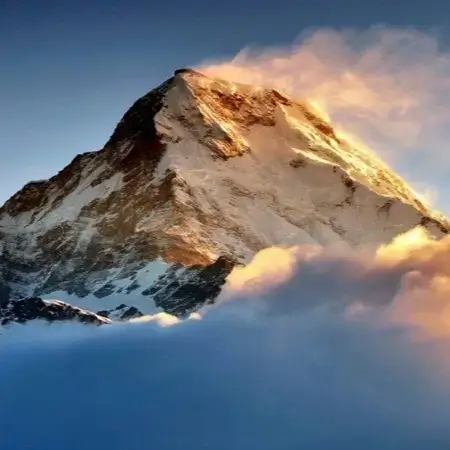
One of the most distinctive features of the Machhapuchare is that it has a double summit, which creates the ‘fishtail’ appearance, which gives the peak its name ‘Machhapuchare’, which translates to ‘fish tail’ in Nepali. From Pokhara, the twin peaks resemble a fish’s tail fin rising from the Himalayan massif. From other viewpoints, including the trekking trail, the mountain appears as a single sharp summit.
The summit consists of two separate peaks, separated by a narrow saddle. The higher southern summit reaches 6,993 meters, while the slightly lower northern summit stands at approximately 6,940 meters. The double-peaked configuration, combined with the mountain’s isolation from surrounding peaks, creates a unique profile that makes Machhapuchare one of the most photographed mountains in Nepal.
Geologically, Machhapuchare consists primarily of the metamorphic rock overlaid with permanent ice and snow above 5,500 meters. It has nearly vertical rock and ice cliffs that demand highly technical climbing capabilities. The north and east sides are a little less formidable but still provide a challenge due to hanging glaciers, steep terrain prone to avalanches, and unpredictable weather.
The normal snowline usually lies between 5,000 and 5,500 meters, depending on the season and orientation. Above it is a permanent mass of snow and ice, with the top portion always covered by a layer of rime ice that glitters in sunlight.
Machhapuchare From Pokhara: A Perfect Viewpoint
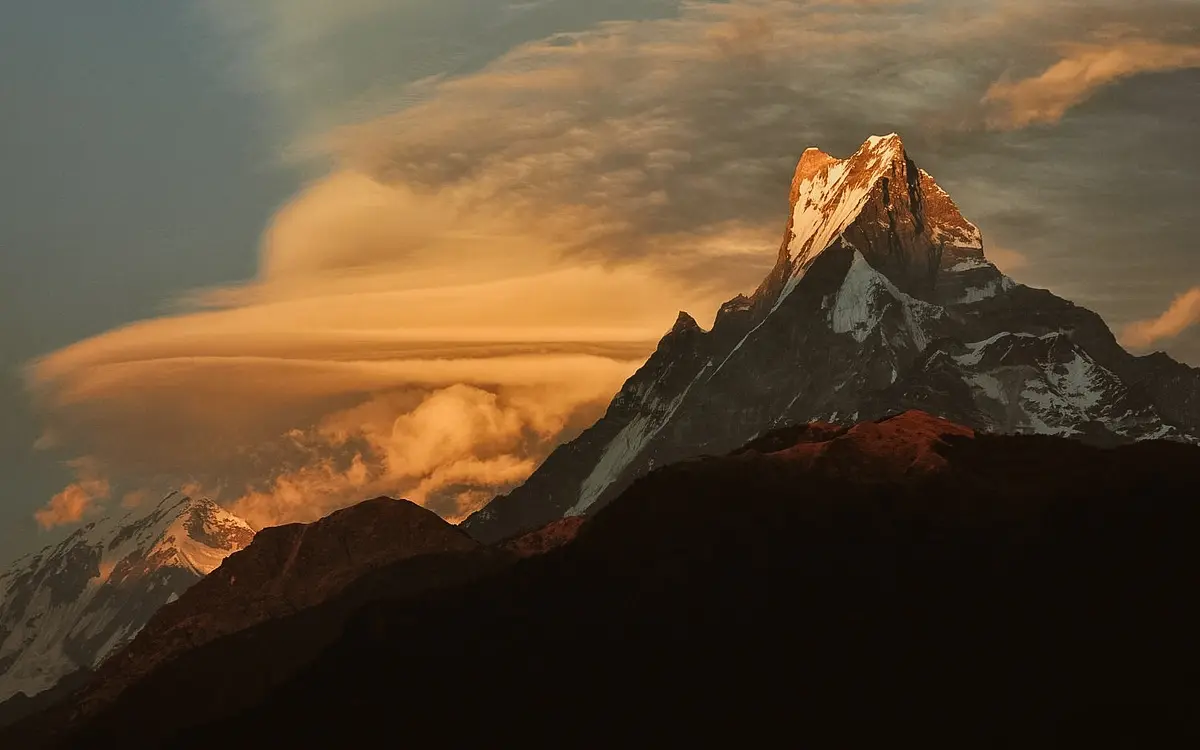
The Machhapuchre mountain range offers an awe-inspiring view of another giant in the Himalayas. The ranges of this mountain are easily visible around, particularly during October and November, or March and April, which are periods of clear skies.
Best Viewing Locations in Pokhara
- Lakeside Phewa: The entire area around Phewa Lake offers wonderful views of Machhapuchre, particularly early mornings, when the peak is visible with complete clarity before clouds cover it by afternoon. The top-floor restaurants allow unobstructed views. The picturesque reflection of Machhapuchre, mirrored by Phewa Lake on a calm morning, is one of the most photographed views of Nepal.
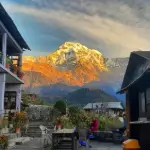
- Sarangkot: It is a hilltop viewpoint at 1,600 meters that offers panoramic vistas of the entire Annapurna range with Machhapuchare as the stunning centrepiece. The sunrise view from Sarangkot is really beautiful; watching first light paint the fishtail peaks golden-orange while the Pokhara valley still sleeps in shadow draws hundreds of visitors daily. The mountain appears so close from here that you feel you could almost touch it.
- World Peace Pagoda: The Peace Pagoda provides a different perspective of Machhapuchare. This view combines the white Buddhist stupa in the foreground with the white mountain peak in the background, creating a photographic composition beloved by visitors. The location also offers quieter contemplation than more touristy viewpoints.
- Pokhara Airport Area: Even the airport runway provides an impressive view of Machhapuchare. Pokhara Airport and the Annapurna Range: Arriving at Pokhara Airport, with the Annapurna peaks in the background, is possibly the prettiest approach to an airport.
Viewing Conditions and Timing
The best time to observe is early morning (6:00 to 9:00 AM), when views are clearer before cloud cover forms around the peaks. During the monsoon, there is a chance of cloud cover that totally obscures the peaks for several days, though there are sometimes cloudless mornings when views can be spectacular. In winter, there are often cloudless skies and chilly weather. The spring season, in March or April, is characterised by partly cloudy skies and mild weather.
The climate and lighting make a huge difference to how the mountain appears. Sunset might illuminate the mountain in the background, creating an impressive silhouette. On nights when the full moon is present, your eyes might catch a glimpse of the mountain peak glowing in silver light, helping you understand why the mountain has always been sacred to people. Sunrises might illuminate the mountain ranges in gold and pink lights. Direct noon sun might create pure white contrasts.
Why is Machhapuchare Sacred?
Machhapuchare is also said to have divine status, dating back long before the modern state of Nepal itself. This is because some mountains in this range were believed to be the residences of gods (Shiva and Parvati) in Hindu mythology.
Hindu Religious Significance
The earthly abode of Lord Shiva, one of the principal deities of Hinduism, is considered to be Machhapuchare. According to locals, these mountains are Siva's celestial abode, home to him with his consort, Parvati. That association really makes the mountain deeply sacred to Hindu devotees, who consider the peak itself a deity rather than merely a geographic feature.
Its fishtail is also responsible for this sutra status. In Hindu iconography, fish are associated with several gods and their roles in the world. There are also explanations linking Machhapuchare’s appearance to Matsya, Vishnu’s fish incarnation, although the link to Siva is more prominent.
Cultural and Community Beliefs
In the Gurung communities living in the shadow of the Himalayas, the importance of Machhapuchare extends beyond Hindu mythology. In fact, these indigenous communities consider the peak to be a “guardian deity” that shields them from harm. In the past, shamans conducted rituals to appease this deity and ensure good harvests, easy journeys, and the well-being of their families.
The slopes of this mountain are believed to be inhabited by spirits and gods that one is not supposed to interfere with. Climbing Machhapuchare would be seen not only as Religious Blasphemy but also as courting disaster in the community, since the god of this mountain may cause droughts, plagues, and catastrophes.
These beliefs are not merely historical myths; they are still manifest in contemporary Gurung religious tradition. Even among younger generations, who may not adhere to all traditional practices, the mountain's sacred nature is well known. Thus, to climb Machhapuchare is to commit an outrageous act, as if to vandalise a temple or degrade an icon's portrait.
Religious Practices and Observances
While direct worship of Machhapuchare as a distinct deity is less common than general reverence for Himalayan peaks, the mountain figures into regional religious practices. Pilgrims trekking to Muktinath and other sacred sites in the Annapurna region pass near Machhapuchare, often offering prayers of respect along the way. The mountain's visibility from Pokhara means many residents see it daily, and some offer morning prayers in acknowledgement of the divine presence.
Why Is Machhapuchare Unclimbed?
The short answer as to why Machhapuchare is an unclimbed mountain is that the government of Nepal imposed a ban on all attempts to climb the mountain in 1964, out of respect for the mountain's cultural and religious heritage. But the story is far from simple.
The 1957 Expedition
Machhapuchare's climbing history began and essentially ended with a single British expedition in 1957. Led by Jimmy Roberts, the team included accomplished climbers Wilfrid Noyce and A.D.M. Cox. They approached via the north ridge, establishing camps up to about 5,800 meters before attempting the summit.
In May 1957, Noyce and Cox reached approximately 6,940 meters, just 50-60 meters below the summit and likely at or very near the northern (lower) summit. At this point, with the main summit tantalisingly close, they made a remarkable decision: they turned back. Various accounts cite different reasons: some cite deteriorating weather, others mention technical difficulties on the final summit ridge, and some sources suggest Roberts had promised local authorities they wouldn't actually stand on the very summit out of cultural respect.
This is the only expedition to have come thus far up Machhapuchare. The group's pictures clearly depict the difficulties encountered when climbing the mountain's upper slopes.
The 1964 Ban
Following the 1957 expedition and growing awareness of the mountain's sacred significance, the Nepalese government declared Machhapuchare off-limits to climbing in 1964. This decision came during a period when Nepal was developing its mountaineering tourism regulations and considering how to balance economic benefits from climbing permits with cultural preservation.
The ban was absolute; there were no exceptions, no special permits, and no discussion allowed. Unlike some “closed peaks,” where the ban may have been repealed under special circumstances, Machhapuchare's ban was presented as final on religious grounds. The government recognised values that transcended economic considerations, prioritising the protection of religious tradition over economic gain.
Modern Protection
Machhapuchare has remained an unclimbed peak to date, thanks to a legal ban and a strong cultural tradition. The mountain is located in the Annapurna Conservation Area, which imposes additional regulations to prevent its ascent. Climbing Machhapuchare would require permits, which would never be issued.
Apart from the legal issues, the attempt to climb Machhapuchare would cause immense public outcry and debates in the surrounding regions and the country as a whole. It is common knowledge that Machhapuchare is a sacred mountain. Climbers would not only face legal repercussions for climbing the mountain but would also invite public opprobrium.
However, this cultural protection may ultimately have more power than any law. Laws can be amended, but they do not evolve as rapidly as those rooted in deep religious respect and cultural heritage. The virgin status of Machhapuchare is not simply that it is protected by law, but that there is an unspoken agreement to leave this mountain as it is.
Machhapuchare: The Virgin Mountain of Nepal
In mountaineering, the 'virgin peak' refers to a peak that has never been successfully climbed. In this regard, Machhapuchare Peak has a special status among virgin peaks, as it is unlike the difficult-to-reach or inaccessible peaks that remain unclimbed. Machhapuchare is unclimbed by choice. It is virgin, not difficult.
Which Mountain Is Known as Virgin Mountain?
Even with a number of virgin peaks remaining around the world, Machhapuchare is probably the best-known and the most protected. The ease of access to this peak and its moderate altitude make it a potentially attractive target for climbers. Nevertheless, it is hard to imagine someone attempting to scale this virgin peak in the near future.
The virgin status of the mountain holds a symbolic significance that transcends mountain climbing. In a world that has already reached both poles, climbed the highest mountains, explored the deepest oceans, and even set foot on the moon, Machhapuchare is a symbol of our restraint. The mountain is a reminder that sometimes we should not succeed in reaching a given location, not out of a lack of capability, but out of our own desire to keep those places untouched.
Thus, the case of Machhapuchare is quite distinct from other peaks that have been banned or restricted for mountaineering. Peaks that lie within restricted military areas, are banned due to environmental issues, or are temporarily banned due to avalanche risks belong to a totally distinct group. The case of Machhapuchare is distinct in that the mountain is banned due to its cultural and spiritual significance.
About Machhapuchre Mountain: Facts & Myths
Local Legends
The Gurung and Magar populations surrounding the peak have detailed oral traditions about this peak. This one revolves around a heavenly conflict between Shiva, whose trishul (trident) marked the peak's dual summits. Another local lore holds that this peak marks the entrance to the worlds of heaven and hell, with the top marking a border humans cannot cross.
In other stories, supernatural protectors may be shielding high-order spirits or deities, thereby repelling invaders through storms, avalanches, and/or mysterious disappearances. Such folk tales may be deemed irrational by modern notions of reason, yet they convey essential beliefs that perpetuate a certain mindset regarding the mountain.
Mountaineering Mystique
Within climbing circles, Machhapuchare enjoys a unique status: to the climber who plots a route up any accessible peak, the one mountain that is permanently off-limits is oddly fascinating. Some climbers honour the ban fully and consider it appropriate deference to local culture. Others secretly nurse summit ambitions they know can never be fulfilled, which makes Machhapuchare some kind of forbidden fruit in the world of climbers.
This mystique is furthered by its modest height relative to the Himalayas and its distance from trekking routes. In contrast to remote 8,000-meter giants that demand major expeditions, Machhapuchare seems tantalisingly accessible: you can trek into its base camp in a few days, see potential routes clearly, and dream of the climb. Yet you cannot try it. The result is a unique psychological dynamic in which accessibility and prohibition together create an almost mythical aura.
Scientific Interest
Machhapuchare, aside from its cultural and climbing attributes, is significant to geologists and climatologists studying Himalayan glaciology and tectonics. The ice formations and avalanches, along with the area's geology, are significant to research on the formation of the Himalayan Mountain ranges. Studies are ongoing using satellite images and research within the allowed boundaries.
Can You Trek Near Machhapuchare?
Although climbing is not allowed on this mountain, trekking in the vicinity of Machhapuchare is not merely tolerated; it is encouraged and is one of the most sought-after trekking adventures in Nepal. The Annapurna Base Camp Trek includes Machhapuchare Base Camp as one of its main stops.
Machhapuchare Base Camp Trek
The trek to MBC usually takes 4 to 7 days from Pokhara. This trek goes through cultivated land, a Gurung settlement such as Ghandruk or Chhomrong, and finally through a bamboo forest with thick rhododendron growth, leading to an alpine basin beneath Machapuchare’s southern face.
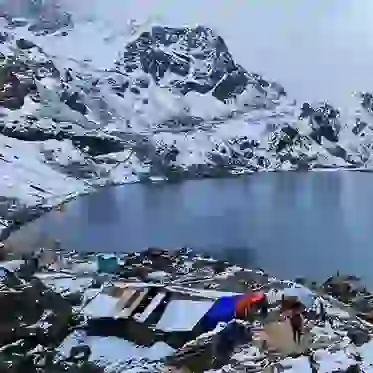
Machhapuchre Base Camp is located at 3,700 meters and is nestled within a natural bowl formed by majestic peaks. From here, the fishtail peak towers directly above you. The view here is dramatically different from what it was from Pokhara; you are looking directly up at the southern face of the peak, appreciating its sheer mass and the challenge of climbing it.
Trekking can continue from MBC to Annapurna Base Camp, which lies only a few hours ahead. ABC offers a stunning panorama of the entire Annapurna Sanctuary, though some consider the singular perspective of Machhapuchare from MBC to be more breathtaking. The dawn experience at MBC, witnessing the first rays of sunlight on the fishtail mountain while the valley lies in darkness, is an unforgettable experience in trekking.
Trekking Regulations
The trek in the Annapurna Conservation Area requires trekking permits, such as the ACAP permit and TIMS card, which can be obtained in either Pokhara or Kathmandu. The trekking routes are well-developed, with tea houses offering accommodation and meals, so trekking independently is possible without the need for full-blown camping. Guide services and porter support can be hired, but are not required for experienced trekking enthusiasts accustomed to high-altitude terrain.
The key to this challenge is to follow this important guideline: while you can hike to the base camp, you cannot proceed beyond the designated camps to reach the top. There is no ambiguity about where you can/cannot go from MBC, as clearly marked signs show the areas where trekking is allowed but not climbing.
Responsible Trekking
Visiting Machhapuchare Base Camp is not just a matter of legal formalities like permits. The place also requires respect in how trekkers conduct themselves, in consideration of its holiness. The mountain is revered, and the trekkers need to demonstrate this in their behaviour in the camp.
It means being considerate of others, which includes not playing loud music, not getting drunk, and not being at the location solely for a photo opportunity without any cultural sensitivity. While it is a surreal sight to enjoy, bear in mind that many people consider this place sacred. All it really takes is a little awareness and respect.
Conclusion: Respecting Nepal's Sacred Peak
The significance of Machhapuchare extends beyond mountaineering, representing something much deeper about the human condition and our relationship with nature. At a time when technology gives us access to just about everywhere on the planet, this mountain reminds us of the value of some places remaining untouched. The virgin peak of this mountain is not just unclimbable; rather, it symbolises that we value some things over the potential of conquest.
In the case of tourists viewing the fish-tail peak from the lakeside cafes in Pokhara, in the case of trekkers standing in awe at Machhapuchare Base Camp, and in the case of climbers who may have dreamed of routes they would never take, this mountain has something to give them in a way no other does.
The appeal of the mountain also stems from its inaccessibility. The fact that no man has ever set foot, or indeed left footprints, upon the shiny summit is an attraction rather than a deterrent. By choosing to respect local culture and traditions, Nepal is proving that tourism and tradition can coexist when mutual respect is upheld.
As you plan your visit to Pokhara or an Annapurna trek, approach Machhapuchare with this understanding. You are not just viewing a mountain but an area of sanctity, a cultural symbol, a statement about what we choose to preserve. May that knowledge deepen your appreciation. The Fishtail Mountain asks nothing of us except respect; in return, it offers beauty which goes beyond mere scenery, touching the realm of the sacred.
Frequently Asked Questions (FAQs)
Q. Why can't climbers reach the summit?
A. In response to the sacred significance of Machhapuchare being regarded as a residence of Lord Shiva, the Nepalese government made it mandatory for climbers to refrain from summiting the mountain in the year 1964. This is a strict, irreversible policy of the Nepalese government, and no climber can reach the summit, regardless of whether they hold a mountaineering license.
Q. Is Machhapuchare visible from Pokhara?
A. Yes, Machhapuchare is visible from Pokhara on most days, located only 25 kilometres away. This fishtail peak with twin summits is a dominant feature of Pokhara's northern skyline. The best views are to be had between 6:00 AM and 9:00 AM, before clouds build up, preferably during post-monsoon (October/November) or pre-monsoon (March/April) seasons, when the skies are usually clearer. Sarangkot, Lakeside, and World Peace Pagoda are viewing points.
Q. What makes it different from other Himalayan peaks?
However, the uniqueness of A. Machhapuchare exists in its state of permanent virginity, which it has chosen to maintain and not disturb, unlike hundreds of other Himalayan peaks that have permits for ascent. A. Machhapuchare is also one of the peaks explicitly reserved for religious reasons, being one of the sacred peaks of this region. Being relatively close to Pokhara and featuring the distinctive "fishtail" peak, it is one of the most iconic peaks in this region of Nepal, despite remaining unclimbed.
Q. Is Machhapuchare part of the Annapurna range?
A. Yes, Machhapuchare forms the southernmost significant peak of the Annapurna Himalaya massif. While geographically connected to the Annapurna range, it stands somewhat isolated from the main Annapurna peaks, contributing to its distinctive appearance. The mountain sits within the Annapurna Conservation Area and is often viewed together with Annapurna I, Annapurna South, and other peaks of the range from Pokhara and along trekking routes.