
Nepal does not run short of festivals. But every now and then, you stumble upon one that stops you in your tracks. Not because it is loud or lavish, but because it is so quietly, deeply intelligent that you wonder how the modern world missed it entirely.
Sithi Nakha is that festival.
Every year, just before the monsoon descends on the Kathmandu Valley, the Newar community does something that no environmental agency, government campaign, or municipal authority has managed to achieve with the same level of consistency: they clean their water.
All of it. Together. On a single day. And they have been doing it for thousands of years.
What is the Sithi Nakha Festival in Nepal?
Sithi Nakha is a traditional Newar water festival observed on the sixth day of the bright fortnight of Jestha, the Nepali month that falls between May and June. The name itself comes from Sanskrit. "Sithi" derives from "Shashthi," meaning the sixth, and "Nakha" simply means festival. So translated directly, it is the Festival of the Sixth Day. But that plain translation does nothing to capture what the day actually holds.
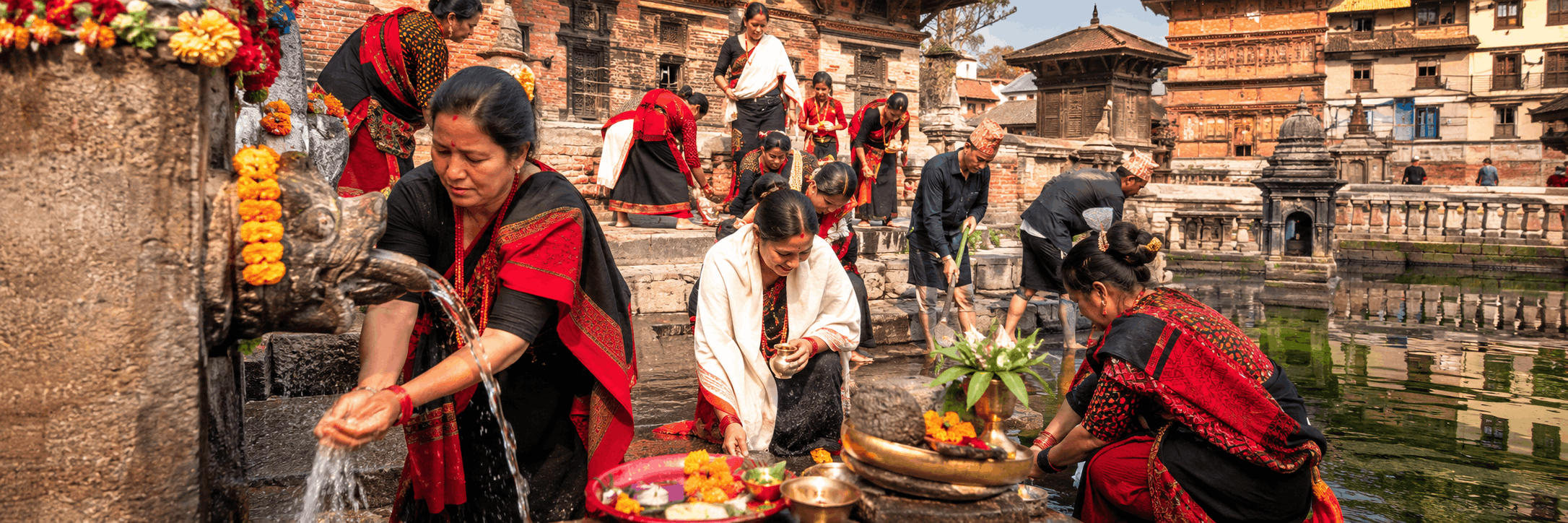
On this day, Newar communities across the Kathmandu Valley gather to clean their local water sources, including the ancient stone water spouts called hitis, the community ponds known as pukhus, and the dug wells called tuns. Prayers are offered. Traditional food is cooked. Family deities are honoured. And one of the world's oldest systems of community-led water conservation is passed down to another generation.
It is also celebrated as Kumar Shashthi, the birthday of Kumar Kartikeya, the warrior son of Lord Shiva and Goddess Parvati. In Newar culture, Kumar is revered as Chhetrapal, the protector deity of the neighbourhood. Outside each Newar household, a small mandal called a pikhalakhu is drawn in the shape of an eight-petalled lotus and worshipped as Kumar's symbol. The religious and the ecological sit side by side on this day, as they always have in the Newar tradition.
Significance of Sithi Nakha Festival in Newar Culture
To understand why this festival matters, you have to understand what the Kathmandu Valley looks like in late May. The preceding months are the driest of the year. Water levels in wells and ponds drop to their lowest point. The community water sources, some of which were built over a thousand years ago, are at their most accessible for cleaning and maintenance. Then the monsoon arrives, and everything refills.
The timing is not a coincidence. It is genius.
According to Newar belief, the Nagas, the serpent deities who guard water sources, leave the wells during the dry season to perform their own ancestral Dewali worship. Their absence is precisely why the wells can be cleaned with lime without disturbing the water guardians. Once the cleaning is done and the Nagas return with the monsoon rains, the water sources are fresh, functional, and ready for the heavy-use season ahead.
Beyond mythology, the environmental logic is airtight. Cleaning accumulated mud, silt, and sediment from the bottom of wells and ponds just before the monsoon prevents waterborne diseases from spreading when rains arrive and contaminate surface runoff. Dr Purushottam Lochan Shrestha, a culture expert, notes that Sithi Nakha is significant for two distinct reasons: religious devotion to Kumar and its perfect timing before the rice planting season. Both purposes, the spiritual and the agricultural, arrive at the same practical outcome: a community that is healthy, hydrated, and prepared.
Sithi Nakha also frequently falls close to World Environment Day on June 5, a coincidence that feels less like chance and more like an ancient civilisation was simply ahead of its time.
Traditional Newar Practices During Sithi Nakha
The morning of Sithi Nakha begins early. While some family members head out to clean the water sources, others stay home to prepare the food that gives the day much of its warmth.
The cleaning itself is physical and communal. Community members enter the wells and ponds directly, scooping out mud, removing sediment, and scrubbing stone spouts that might have accumulated algae and debris over the dry months. After the cleaning is complete, the water sources are flushed and then closed for a few days to allow the water level to stabilise before reopening for daily use. It is a system that works. The same stone spouts that Licchavi-era kings commissioned over a thousand years ago still run in parts of the old city because communities have maintained them every year, on this very day.
At home, the kitchen is its own ceremony. Six varieties of wo, the savoury lentil pancakes made from black masur lentils and mugi, are prepared along with chatamari, the thin rice-flour crepes that Kathmandu's food culture has since made famous. Bara, chhoila (spiced grilled meat), cooked buffalo, mhuchhyamadhi (bread from roasted wheat flour), malpuwa, and papad round out a spread that is as nutritionally deliberate as it is delicious.
The food is not arbitrary. As the monsoon approaches, the body becomes vulnerable to bacteria and infection. These protein-rich, iron-heavy dishes are understood by the Newar nutritional tradition as immunity builders. Science, centuries later, tends to agree. The offerings are shared as prasad at the pikhalakhu altar, blessed and then enjoyed with family.
Farmers observe the day differently. They avoid working the soil entirely. Cow dung and farm manure are carried to fields early in the morning, completing the last agricultural task before a day of rest and ritual. It is also the final day to complete the month-long Dewali period, during which Newar families of related ancestry gather to honour their family deity, the Digu Deya, through elaborate feasts and ancestral worship. Newly married daughters-in-law are formally welcomed into the family fold during Dewali, making Sithi Nakha the closing note of a deeply significant family cycle.
Newar Lifestyle and Cultural Traditions
Sithi Nakha does not exist in isolation. It is one thread in a textile of Newar cultural life so dense and intricate that no single festival can fully represent it.
The Newars are the indigenous people of the Kathmandu Valley and the original architects of its UNESCO World Heritage Sites. The Durbar Squares of Kathmandu, Bhaktapur, and Patan, the chaityas (Buddhist shrines), the stone temples and sunken courtyards, all of it was built by Newar artisans and maintained by Newar communities for centuries. Their festivals are not ornamental. They are the calendar the city runs on.
Community is the organising principle of Newar life. Every neighbourhood has its own guthi, a social institution unique to the Newar community that coordinates everything from festivals and funerals to irrigation and infrastructure. The guthi is why water sources get cleaned. The guthi is why temples get maintained. The guthi is why traditions survive.
Newar ancestral worship connects the living to the dead across generations through prescribed rituals, feast days, and pilgrimage cycles. Urban Kathmandu has changed enormously in the past fifty years, but inside the old city's courtyards and narrow lanes, you can still hear the Dhime drums, still smell the mustard oil lamps, still see the pikhalakhu drawn fresh outside doorways on Sithi Nakha morning.
Where to Experience Sithi Nakha in Kathmandu Valley
The most vivid celebrations happen in the old city neighbourhoods of Bhaktapur, Patan (Lalitpur), and Kathmandu's historic core around Ason and Indra Chowk.
Bhaktapur is particularly immersive. The city's ancient stone spouts and ponds are still in active community use, and the cleaning rituals are public and participatory. Taumadhi Tole and Dattatreya Square come alive with morning prayer and activity. The pace is unhurried, the rituals are genuine, and the absence of tourist infrastructure actually adds to the experience.
In Patan, the sunken hiti water spouts near Patan Durbar Square and Mangal Bazar are worth visiting. Some of these stone spouts date back to the 5th-century Licchavi period and still carry water. Watching a community tend to infrastructure that old with the same care their ancestors showed is something that stays with you.
In Kathmandu's core, areas like Kilagal, Asan, and Nhu Guthi lanes host quiet but genuine celebrations where outsiders are generally welcomed with curiosity rather than spectacle.
Local Clean-Water Ceremonies and Community Benefits
What makes Sithi Nakha remarkable in the modern context is that it accomplishes, through culture, what policy often cannot. It creates a shared obligation to public infrastructure. Nobody needs to be told to clean the well. The calendar says it is time. The community shows up.
This social accountability embedded in ritual is something urban planners and environmental scientists increasingly recognise as one of the most sustainable forms of resource management. Kathmandu's ancient water infrastructure, the hiti system, is a testament to that. Several hits that fell into disuse during rapid urban development in the 20th century have been restored by community groups who cite Sithi Nakha as the cultural anchor that kept the practice alive in collective memory.
Today, Newar community organisations and cultural NGOs are working to document these water sources, map the hiti network, and advocate for their legal protection. Sithi Nakha sits at the centre of that effort, not as a museum piece, but as a living reason to keep going.
Conclusion
The Sithi Nakha festival is many things at once. It is a birthday celebration for a Hindu deity. It is a preparation ritual for the monsoon. It is a community health measure, an agricultural checkpoint, a family reunion, and one of the oldest environmental campaigns in human history. It is, above all, proof that the Newar people of the Kathmandu Valley built not just beautiful cities but a way of life within those cities designed to last.
If you are in Nepal in late May or early June, this cultural experience deserves a place on your itinerary. Not as a spectator at a performance, but as a witness to something real, something that has survived a thousand years not because it was protected behind glass, but because ordinary families show up every year and do the work.
Hop Nepal has been helping travellers find their way into Nepal's living culture since 2017. From heritage walks in Bhaktapur's ancient lanes to curated Kathmandu Valley cultural experiences, the team can put you in the right place at the right time.
Explore cultural tours and heritage experiences at Hop Nepal .
Frequently Asked Questions
What is the Sithi Nakha festival in Nepal?
Sithi Nakha is a traditional Newar festival observed on the sixth day of the bright fortnight of Jestha (May/June). It is dedicated to the Hindu deity Kumar Kartikeya and centres on the ritual cleaning of community water sources including wells, stone spouts (hitis), and ponds (pukhus) before the monsoon season begins. It is one of the most environmentally significant cultural festivals in Nepal.
How do Newar people celebrate Sithi Nakha?
Celebrations begin in the morning with community members physically cleaning local water sources by removing sediment and silt. At home, families prepare traditional Newar dishes, including wo (lentil pancakes), chatamari (rice-flour crepes), chhoila, bara, and malpuwa. A small mandal called a pikhalakhu is drawn outside homes and worshipped as the symbol of Kumar. The day also marks the conclusion of the month-long Dewali ancestral worship period.
Why is cleaning water sources important during Sithi Nakha?
Late May is when the Kathmandu Valley is at its driest and water levels are at their lowest, making it the ideal time to clean the interiors of wells and ponds. Cleaning before the monsoon prevents the accumulated silt and organic matter at the bottom of water sources from mixing with monsoon runoff and causing waterborne diseases. The practice is thousands of years old and remains ecologically relevant today.
When is Sithi Nakha celebrated in Kathmandu Valley?
Sithi Nakha falls on the sixth day (Shashthi) of the bright fortnight (Shukla Paksha) in the Nepali month of Jestha, which corresponds to May or June in the Gregorian calendar. The exact date varies each year according to the lunar Bikram Sambat calendar followed by the Newar community.
What other Newar cultural festivals should I know about?
The Newar festival calendar is remarkably rich. Indra Jatra in September is a massive street festival honouring the rain god Indra. Bisket Jatra in Bhaktapur marks the Newar New Year with chariot processions and is one of the most dramatic festivals in the valley. Gai Jatra honours those who have passed in the last year through a procession involving cows. Mha Puja, observed on the day after Tihar, is a deeply personal self-purification ritual unique to the Newar community. Each of these festivals is a living heritage experience that reveals a different dimension of Newar identity.
Is Sithi Nakha only celebrated in Kathmandu?
While the most visible celebrations happen in the old cities of Bhaktapur, Patan, and Kathmandu, Sithi Nakha is observed by Newar communities wherever they are settled across Nepal. The Kathmandu Valley, however, is where the ancient water infrastructure (hitis and pukhus) still exists and where the cleaning rituals are most visibly and authentically practised.
Can tourists participate in or witness Sithi Nakha?
Yes. Sithi Nakha is a community festival, not a ticketed event, and visitors who approach with respect and genuine curiosity are generally welcomed warmly. Bhaktapur and Patan are the most accessible places to witness the water-cleansing rituals and morning prayers. Hiring a local cultural guide is recommended both for a deeper context and for navigating the old city lanes where most of the activity takes place.