Quick Answer: How Fit Do You Need to Be for Trekking in Nepal?
Most people asking this question are hoping the answer is "not very." The honest answer is somewhere more nuanced than that.
You need a moderate level of fitness to trek in Nepal. Not athlete-level fitness. Not zero fitness either. Somewhere in the middle that most people with genuine preparation can reach within six to eight weeks of consistent training. Here is what that moderate fitness actually looks like in practical terms:
- Walking 10 to 15 kilometres per day on varied terrain carrying a daypack
- Handling 500 to 1,000 meters of elevation gain in a single trekking day
- Sustaining five to seven hours of continuous moderate physical effort
- Doing all of the above on consecutive days without complete physical collapse
Beginners with good preparation can complete popular treks like Annapurna Base Camp and Langtang Valley. Everest Base Camp demands higher endurance and a longer preparation runway. Advanced routes like the Manaslu Circuit and the three-pass treks require genuine athletic fitness and prior high-altitude experience.
Which category you fall into right now determines what preparation you need before booking a flight to Kathmandu.
What Actually Determines Trekking Difficulty in Nepal
Before getting into fitness levels and benchmarks, it helps to understand what makes Nepal trekking difficult in the first place. Most people focus entirely on physical fitness as the deciding factor. Fitness matters enormously, but it is one of three distinct challenges that Nepal trekking presents simultaneously.
Altitude: The Factor That Overrides Everything Else
Oxygen levels drop measurably above 3,000 meters, and the effect on your body is something that no amount of gym training fully prepares you for because you cannot replicate it at sea level. At 4,000 meters, your body is working with roughly 60 per cent of the oxygen available at sea level. At 5,000 meters, that drops further. Physical effort that feels moderate at home feels considerably harder at altitude because your cardiovascular system has to work harder to deliver less oxygen to muscles that need more than the thin air can provide.
This is why genuinely fit people sometimes struggle on Nepal treks while less conventionally athletic people with good acclimatisation habits do fine. Altitude does not respect gym numbers. It responds to how well your body adapts to reduced oxygen over time.
Daily Walking Hours Across Multiple Consecutive Days
Five to seven hours of walking per day sounds manageable until you are on day nine of a twelve-day trek, carrying the accumulated fatigue of every previous day. Nepal trekking is not about peak fitness. It is about sustained moderate fitness across an extended period without the recovery time that normal training schedules build in between sessions.
The cumulative demand of back-to-back trekking days is what catches most underprepared trekkers off guard. Training for single long days without also training for consecutive days of effort leaves a significant gap between preparation and trail reality.
Terrain and Elevation Gain
Nepal trails are not smooth paths with gentle gradients. The stone staircases that define sections of the Annapurna approach around Ulleri, the rocky glacier moraine above Lobuche on the Everest trail, the steep exposed ridgeline sections on higher altitude routes: all of these demand dynamic leg strength, ankle stability, and the specific kind of muscular endurance that flat-surface cardio training does not build in the same way.
Fitness Levels for Trekking in Nepal: Beginner to Advanced
Beginner Level Fitness
A beginner trekker in the Nepal context is someone who exercises occasionally, has no prior multi-day hiking experience, and has never been at significant altitude. This is not a disqualifying profile for trekking in Nepal. It is simply the starting point that requires the most preparation time.
Beginner-suitable treks include the Annapurna Base Camp trek, reaching 4,130 meters, the Langtang Valley trek, reaching around 3,870 meters at Kyanjin Gompa, and the Ghorepani Poon Hill circuit, which is genuinely accessible to people with basic fitness. These treks do not require technical skills, and the trail infrastructure of teahouses, clear paths, and regular checkpoints makes them manageable for prepared first-timers.
The critical word is prepared. A beginner who trains specifically for six to eight weeks before the trek will have a fundamentally different experience from one who shows up relying on general good health to carry them through.
Intermediate Level Fitness
An intermediate trekker exercises regularly, has some hiking experience, and already has a reasonable cardiovascular base. This person is well-positioned for the Everest Base Camp trek, the Mardi Himal trek, and similar routes that push into higher altitude territory with longer daily demands.
The Everest Base Camp trail reaches 5,364 meters at Base Camp and 5,644 meters at Kalapathar. It runs twelve to fourteen days with daily walking of six to seven hours. The combination of higher altitude, longer duration, and more demanding terrain makes it unsuitable for true beginners and well-suited for intermediates who add specific trekking preparation on top of their existing fitness base.
Advanced Level Fitness
Advanced trekkers have prior high-altitude experience, strong endurance built through extended training, and the physical and mental resilience to undertake extended remote trekking in genuinely challenging conditions. This level suits routes such as the Manaslu Circuit, the three-pass trek combining Cho La, Renjo La, and Kongma La, the Dolpo region, and other technically demanding or very high-altitude routes.
These treks are not appropriate starting points regardless of how fit someone is at sea level. Prior altitude experience and a proven track record of successfully completing moderate Himalayan treks are prerequisites beyond fitness alone.
Fitness Requirements for Nepal's Most Popular Treks
Everest Base Camp Trek
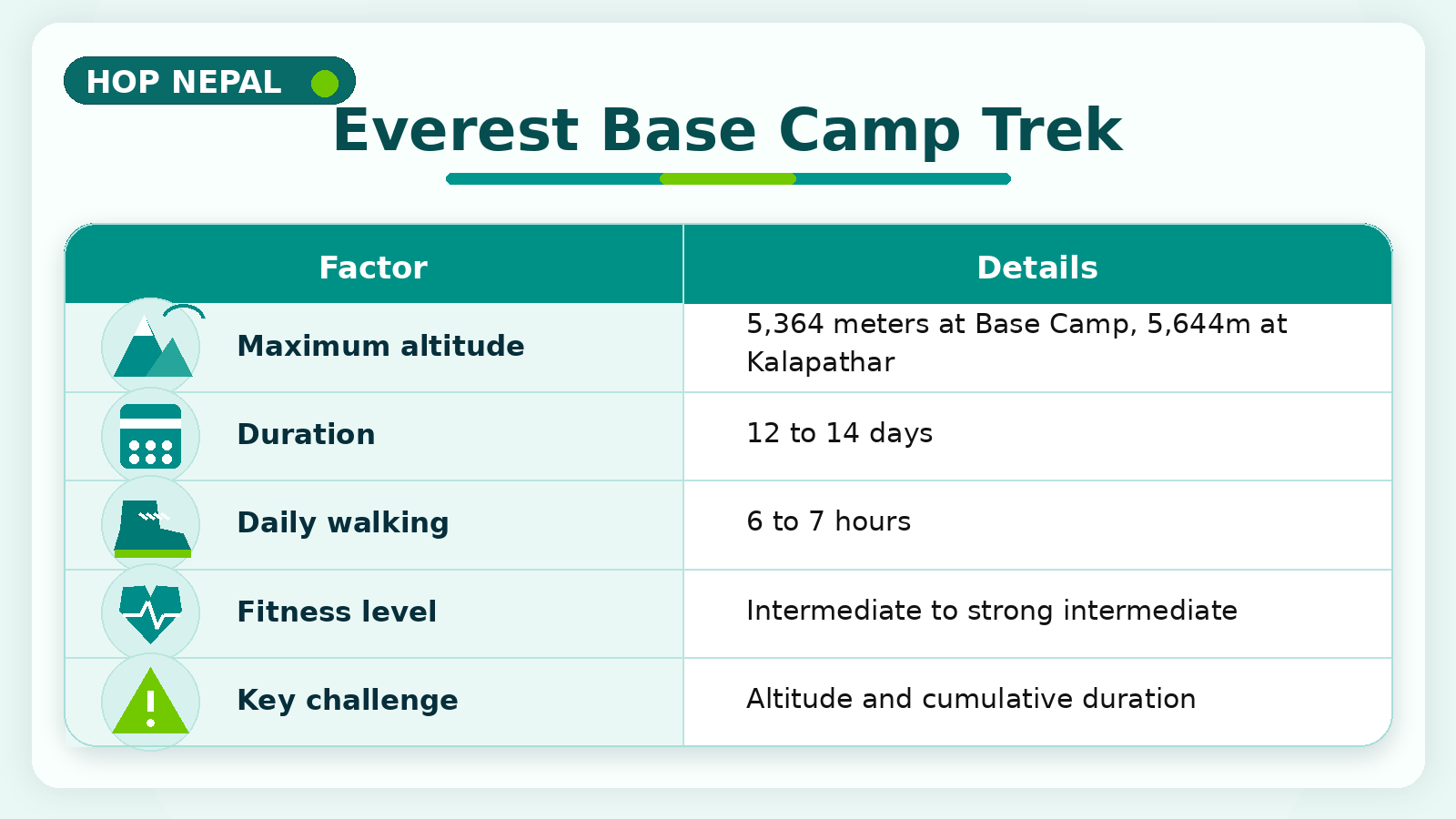
The Everest Base Camp trek is the most researched and most attempted major Himalayan trek in the world. It is achievable for well-prepared intermediate trekkers and challenging enough that underprepared people turn back at a meaningful rate. The altitude is the primary difficulty. The walk itself is not technically demanding, but the oxygen deficit above 4,500 meters makes sustained effort genuinely hard in ways that cannot be fully anticipated without experiencing it.
Annapurna Base Camp Trek
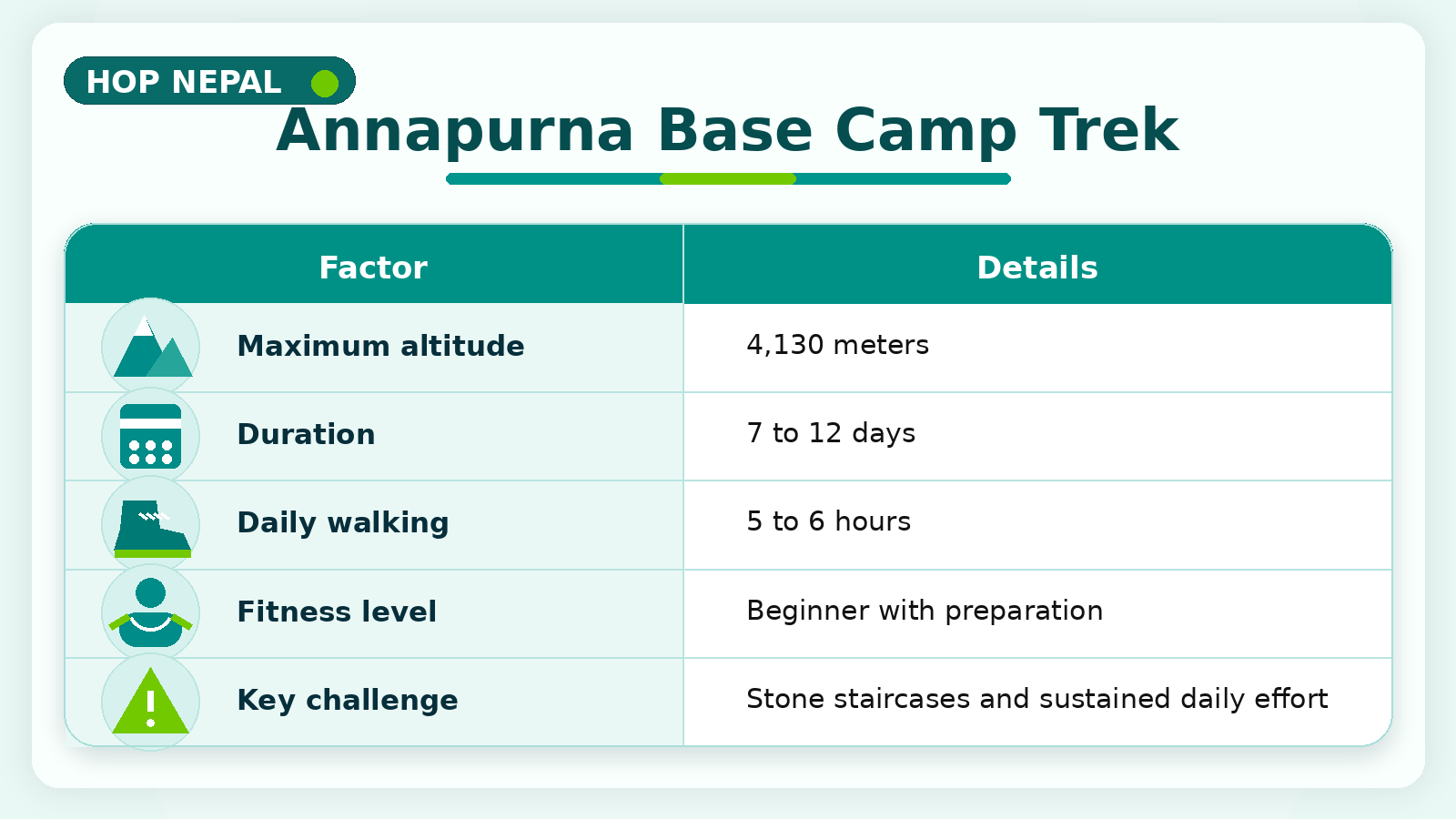
The ABC trek is the more accessible of the two most popular Nepal trekking destinations. The lower maximum altitude reduces the risk of altitude sickness compared to EBC, and the shorter duration results in less accumulated fatigue. The stone staircase sections around Ulleri on the approach are the specific terrain challenge that most surprises unprepared trekkers and the section that stair climbing training most directly prepares you for.
Langtang Valley Trek
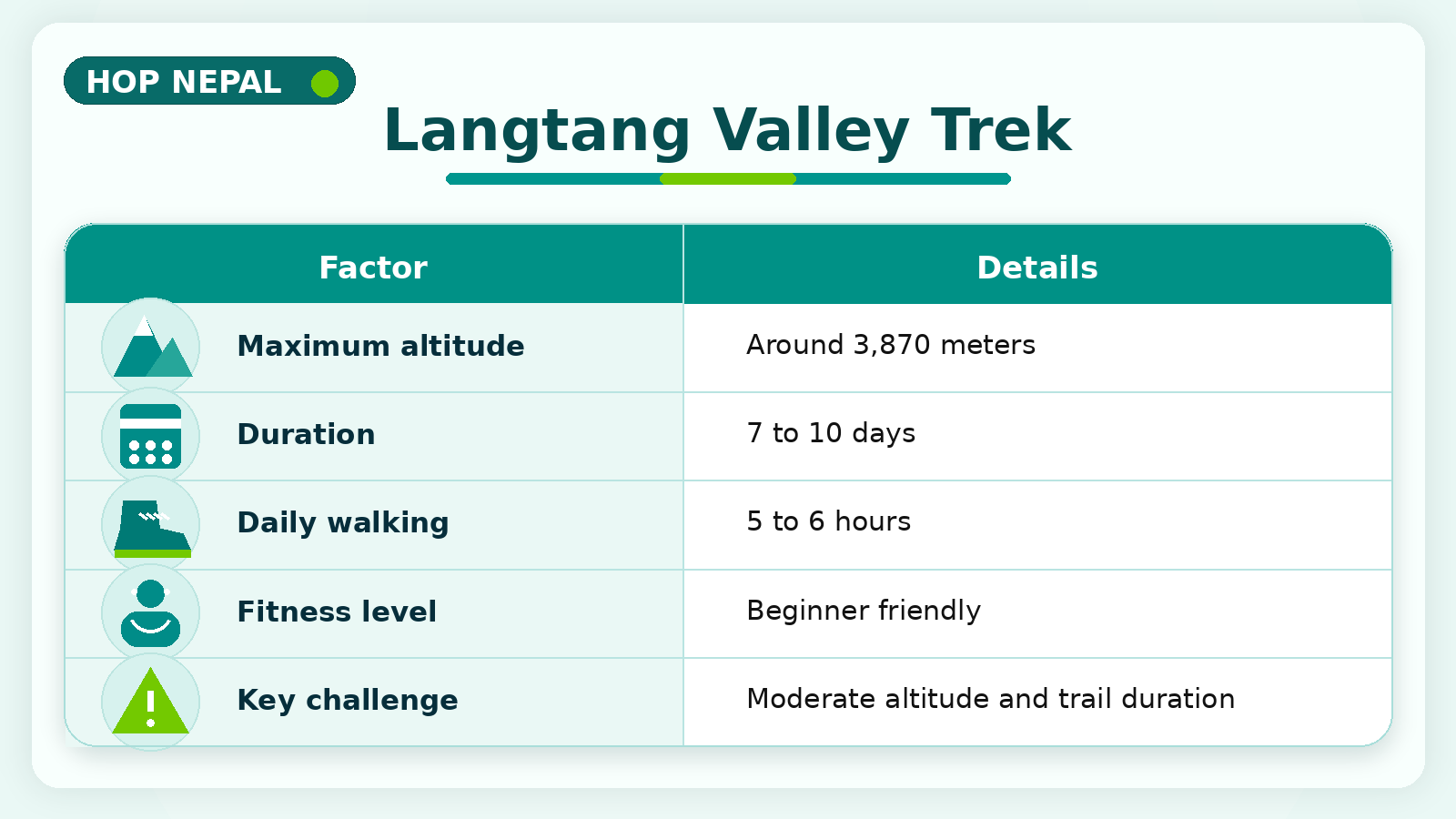
Langtang is genuinely beginner-friendly in a way that EBC and ABC are not quite. The maximum altitude is lower, the daily walking demands are slightly less intense, and the proximity to Kathmandu means logistics are simpler than the fly-in routes to Lukla. For a first Nepal trekking experience aimed at understanding what high-altitude trekking actually feels like before committing to a more demanding route, Langtang is an excellent choice.
How Fit Do You Need to Be: The Honest Benchmarks
These are the practical fitness benchmarks that give you a realistic picture of where you need to be before departing for Nepal. They are not aspirational targets. They are the minimum functional standards that the trails actually demand.
You should be able to walk uphill continuously for one to two hours without needing to stop and recover. Not without getting tired, but without the fatigue being so severe that continuing requires a genuine rest break rather than just a pace reduction. You should be able to climb the equivalent of ten to fifteen floors of stairs without stopping and feel like you have capacity remaining rather than hitting your ceiling. You should be able to carry a pack of five to eight kilograms comfortably across a full day of walking without the load creating significant joint pain or postural breakdown. You should be able to maintain a steady walking pace for five to six hours on a day when you are not feeling your absolute best, because not every day on a trek starts with full recovery and fresh legs.
If these benchmarks feel significantly beyond your current capacity, that is useful, actionable information about how much preparation time you need before departure, rather than a reason to abandon the plan.
Key Fitness Components for Nepal Trekking
Cardiovascular Endurance
Cardio endurance is the foundation of trekking fitness, and the component most people intuitively understand as preparation. Running builds it. Cycling builds it. Hiking is most specifically designed for trekking purposes because it replicates the movement patterns, joint loading, and terrain variability of the actual trail.
The specific cardio quality that matters for Nepal trekking is sustained moderate-intensity endurance rather than high-intensity peak performance. You are not sprinting. You are walking uphill for hours at a pace that lets you breathe and hold a conversation, yet remains consistently demanding rather than comfortable. Training that builds this quality looks like long moderate-intensity sessions rather than short intense ones.
Leg Strength
Leg strength is the component most people underinvest in when preparing for trekking. The quads need to power uphill sections and control the descent on the way back down. The hamstrings and glutes drive hip extension through sustained walking hours. The calves handle the constant demands of pushing off over uneven terrain during long trekking days. The ankles need the stability to manage rocky paths without rolling on every other step.
Squats in their various forms build quad strength directly. Lunges build single-leg strength and hip flexor endurance. Step-ups onto a raised platform simulate the stone staircase movement pattern, the most distinctive terrain feature of the ABC trail approach. Romanian deadlifts build hamstring and glute strength that protects the lower back and drives sustainable hiking mechanics.
Core Stability
Core strength for trekking is not about abdominal appearance. It is about the stabilising muscles that maintain your posture and protect your spine across multiple consecutive days of carrying a pack on uneven ground. Trekkers with weak core stability show it in their posture by the end of long trekking days and pay for it in lower back fatigue that accumulates across the duration of the trek.
Planks and their progressions build the anterior stability that matters most. Single-leg balance work on an unstable surface builds ankle and hip stability, preventing micro-ankle rolls on rocky terrain that cause most trail injuries. Dead bug exercises build the deep stabilising core engagement that protects the lumbar spine under load.
Altitude Fitness vs Physical Fitness: The Critical Distinction
This is the section that separates genuinely useful trekking preparation content from the generic fitness advice that fills most of the search results on this topic.
Physical fitness and altitude fitness are related, but they are not the same thing. Some of the fittest people who attempt Nepal trekking struggle significantly above 4,500 meters, while less conventionally athletic trekkers who understand acclimatisation and pace management do well. This is not a paradox. It is the consequence of treating Nepal trekking as primarily a fitness challenge rather than an altitude challenge that also requires fitness.
Your body adapts to altitude over time. It produces more red blood cells, your breathing patterns adjust, and your cardiovascular system becomes more efficient at extracting oxygen from thinner air. This adaptation takes days, and it cannot be rushed by determination, fitness, or any supplement. The acclimatisation schedule built into responsible Nepal trekking itineraries exists because the mountain demands time, not performance.
How to Prepare Specifically for Altitude
Slow ascent is the most important single principle of altitude preparation. Never increase your sleeping altitude by more than 300 to 500 meters per day above 3,000 meters regardless of how you feel. The day you feel best is often the day before altitude sickness symptoms appear and the confidence of feeling strong is one of the most common reasons trekkers push too fast and pay for it.
Hydration at altitude requires more conscious management than at sea level because cold temperatures suppress thirst signals and altitude increases the rate at which your body loses fluid through increased respiration. Three to four litres per day is the target. Drink before you feel thirsty because by the time thirst registers at altitude, you are already mildly dehydrated.
Rest days in the acclimatisation schedule are not optional regardless of how good you feel or how tight your return flight schedule is. The Namche Bazaar rest day on the EBC trail and the Machapuchare Base Camp acclimatisation day on the ABC route are the days that determine whether you make it to your destination or turn back below it.
Can Beginners Trek in Nepal?
Yes, and this deserves a clearer answer than most content on this topic provides. Beginners can trek in Nepal. Thousands of first-time trekkers complete Nepal trails every year and come back having had experiences that they describe as life-changing. The qualification is that beginner success on Nepal trails almost always comes with specific preparation rather than just enthusiasm.
Choose a moderate route that matches your current fitness level. Annapurna Base Camp and Langtang Valley are the standard recommendation for first-time Nepal trekkers with a genuine preparation program behind them. Hire a licensed guide rather than trekking independently. A good guide manages your daily pace, recognises altitude symptoms early, and makes informed decisions about rest days in ways that are genuinely difficult to replicate without their specific local and altitude knowledge.
Take the acclimatisation days seriously even when you feel strong enough to push on. The trekkers who turn back prematurely are disproportionately the ones who rushed the acclimatisation schedule because they felt fine at the time.
Common Mistakes That Make Nepal Trekking Harder Than It Should Be
Overestimating current fitness is the most common mistake and the one with the most predictable consequences. General good health and occasional exercise are not the same as specific trekking fitness, and the trail is brutally honest about the difference. Train specifically for what the trail demands rather than assuming what you currently do is sufficient.
Ignoring altitude as a factor distinct from fitness is the second most common mistake. Trekkers who treat the altitude as just another hill to climb rather than a genuinely different physiological environment consistently struggle above 4,000 meters in ways they did not anticipate from their sea-level training.
Carrying too much weight is something most first-time trekkers do, and the consequences compound across every day of the trek. Pack ruthlessly. Every kilogram in your pack is a kilogram your legs carry up every staircase on every day of the trail. Porters exist for excellent practical reasons, and using one is not an admission of weakness.
Skipping training because the departure date still feels distant is how most preparation gaps happen. Six weeks sounds like a long time, but it is only two weeks, and the training program that was supposed to start has not started yet.
Real-Life Scenarios: Where Do You Actually Fit?
The Office Worker with Basic Fitness
Someone who walks occasionally, takes the stairs sometimes, and does no regular structured exercise. This person can complete the Annapurna Base Camp trek with a genuine eight-week training program that starts from scratch with light cardio and builds progressively toward loaded hikes by the final two weeks. The Langtang Valley trek is a more appropriate first choice. EBC is not realistic on a six to eight-week preparation from this starting point.
The Gym-Goer with No Hiking Experience
Someone who trains at the gym three to four times per week, has good cardiovascular fitness, and reasonable strength but has never done multi-day hiking. This person often overestimates their readiness for trekking. Gym fitness transfers partially, but the specific demands of loaded hiking on uneven terrain across consecutive days are genuinely different from gym training. Six weeks of adding specific hiking and stair-climbing training alongside existing gym work yields good results for the EBC or ABC trail.
The Experienced Hiker
Someone who regularly hikes on weekends, has done multi-day trail experiences, and has a genuine cardiovascular and leg strength base. This person is well-positioned for Everest Base Camp with a focused four- to six-week altitude-specific preparation program. The fitness foundation is there. The specific additions are longer, more strenuous hikes at greater frequency and education on altitude management that the fitness base alone does not provide.
Tips That Make Nepal Trekking More Manageable
Hire a guide or porter rather than treating it as an optional extra. A licensed guide manages the daily logistics, pace, and altitude decisions that significantly affect your success rate and overall experience. A porter removes the pack weight that compounds physically across every day of the trail.
Trek at a steady pace that feels slightly too slow rather than the pace that feels natural. The natural pace at sea level is faster than the sustainable pace at altitude and the difference becomes apparent over multiple consecutive days.
Choose the right season rather than arriving in monsoon or deep winter. Spring from March through May and autumn from late September through November offer the most manageable trail conditions and the clearest mountain views, making the effort worthwhile.
Stay genuinely hydrated rather than drinking when you feel thirsty. The cold at altitude suppresses thirst, and dehydration contributes to fatigue and altitude symptoms in ways that are both preventable and consistently underestimated.
Final Verdict: Are You Fit Enough for Nepal Trekking?
Here is the straightforward conclusion after everything covered above.
You do not need to be an athlete to trek in Nepal. You need to be prepared, and those are genuinely different things. An athlete who shows up without specific preparation and without understanding altitude will struggle. A moderately fit person who trains specifically for eight weeks, hires a good guide, and respects the acclimatisation process will complete the same trail successfully.
The decision that determines most outcomes on Nepal trekking trails is not made on the mountain. It is made in the months before departure when the choice is between preparing specifically and consistently or hoping that general fitness will be enough. The trail is not judgemental about where you started. It is very honest about whether you prepared.
If you can commit to walking five to seven hours consistently by the end of a proper training program, Nepal trekking is within your reach regardless of where you are starting from today.
Frequently Asked Questions
How fit do you need to be for trekking in Nepal?
You need moderate fitness: the ability to walk 5 to 7 hours daily on steep terrain, handle 500 to 1,000 meters of elevation gain, and carry a daypack over consecutive trekking days. Beginners can reach this standard with six to eight weeks of specific preparation. No technical climbing skills are required for the most popular Nepal trekking routes.
Can beginners do the Everest Base Camp trek?
Beginners with a strong specific preparation program of eight or more weeks can attempt EBC, but it is not the recommended first Nepal trek. Annapurna Base Camp and Langtang Valley are better entry points that build experience and altitude familiarity, making an EBC attempt safer and more enjoyable as a subsequent trek.
Is gym training enough for trekking in Nepal?
No, on its own. Gym training builds useful cardiovascular and strength foundations but does not replicate the specific demands of loaded hiking on uneven terrain across consecutive days at altitude. Specific outdoor hiking training with a loaded pack on varied terrain is essential preparation alongside or instead of gym-only training.
What is the hardest part of trekking in Nepal?
For most trekkers, the hardest part is the cumulative fatigue of consecutive days at altitude rather than any single difficult moment. The combination of sustained physical effort, reduced oxygen, disrupted sleep, and limited recovery time over a twelve- to fourteen-day trek demands a specific kind of endurance that single-day training efforts do not fully prepare you for.
How do I prepare for altitude in Nepal?
Follow the acclimatisation schedule built into your itinerary rather than rushing it. Ascend slowly above 3,000 meters. Drink three to four litres of water daily. Take scheduled rest days even when you feel well enough to continue. Tell your guide about any symptoms honestly rather than pushing through warning signs that deserve attention.