


Choosing between a direct flight and a connecting flight is something which every traveller faces when booking airfare. Should you pay $200-500 extra for the convenience of a nonstop flight that saves 4-8 hours? Or should you choose the budget-friendly connecting flight and accept longer travel time, airport navigation, and potential delays?
The decision isn't always easy. Taking the direct flight to your destination is convenient and time-saving, getting you there quickly and easily. The only disadvantage is that such a flight may be quite expensive. The connecting flight may be cheaper, but the downside is that it takes much longer, so several hassles associated with flight delays are possible.
The global data states that roughly over 60% of passengers prefer direct flight over connecting flights whereas 40% of passengers prefer connecting flights to reach their destinations. The reasons may differ. Some passengers may be on a tight budget, whereas some may prefer to experience layovers in different cities or countries.
This all-inclusive guide will cover all the perspectives of the controversy between direct vs connecting flights. We will discuss the differences in cost through real-life examples, real travel times, and added delays, taking into account safety issues based on aviation statistics, and a framework to assist a traveler in making the right decision based on their travel plans.
QUICK COMPARISON:
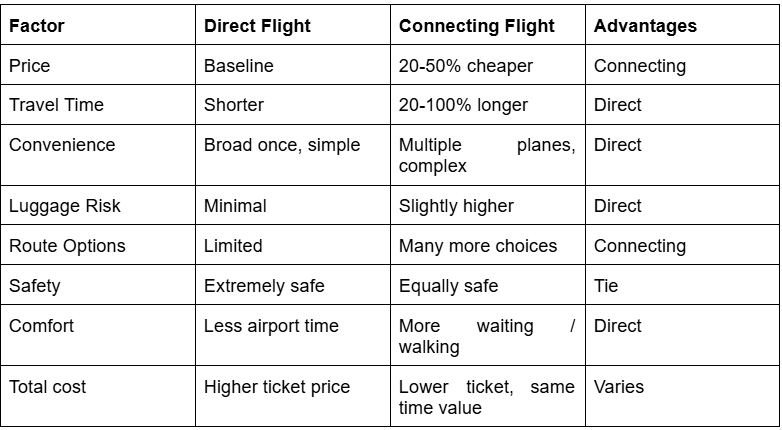
Quick Decision Guide:
- Choose a direct flight if you are attending time-sensitive events, travelling with kids, on business travel, or taking short trips
- Choose a Connecting Flight if budget is your priority, you have a flexible schedule, you have longer trips, or you want to explore layover cities.
What Is the Difference Between a Direct Vs Connecting Flight?
Knowing the nature of the difference between these two types of flights is crucial before you choose which one is a better option for you.
Direct Flight
A direct flight, also known as a nonstop flight, uses a single flight number from your departure point to your destination and involves no stops. You board the aircraft from your departure point, stay in the aircraft the entire time, and alight the aircraft only when you have arrived at your destination. This is as straightforward as air travel gets: one takeoff, one landing, and not a single stop. A nonstop flight is the exact modern terminology for the above.
Connecting Flight
A connecting flight, also known as a transit flight, means you'll need to change planes either halfway to or from your destination. A connecting flight means you'll have at least two legs to your flight, and each will have its own flight number. You'll arrive at a connecting airport, disembark from the plane you are currently on, proceed through the airport, and then board another plane to take you to your final destination. The time you have between flights is called a layover or connection time, and it can range from 45 minutes to several hours.
Key Differences
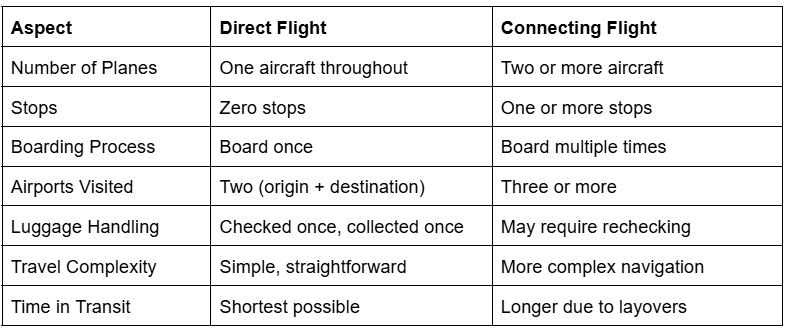
The most obvious difference for a passenger concerns the travel experience. Direct travel involves no worries about commuting through an unfamiliar airport, finding departure gates under time pressure, or encountering problems with possible connections. A passenger settles once and then waits for arrival. But with a connection, there are different transitions before a flight, especially when it is worldwide and involves customs and immigration checks at connecting airports.
Direct Flight vs. Connecting Flight: Which Is Cheaper?
The cost analysis of direct vs connecting flights often determines which flights are the best options for travelers and what they should choose.
Connecting Flights vs. Direct Flights Cost Comparison
Are connecting flights cheaper than direct flights? The straightforward answer is a strong "yes." Normally, connecting flights are 20-50% cheaper than direct flights for the same route. However, keep in mind that the above range can vary widely depending on traffic on the route and other market dynamics.
Then comes, for instance, a flight path like a direct trip from Chicago to Rome, which charges $1,537 (NPR 204,000) for a non-stop flight, compared to a connection via another city (one-stop itinerary) that may cost $1,089 (NPR 145,000) on the same route. It is therefore cheaper by $448 (NPR 59,600) per person, or about 29% cheaper than a direct flight, which will amount to $1,792 (NPR 238,400) in total savings for a family of four.
International flights can be even more dramatic when it comes to price differences. A one-way journey from London to Singapore can cost $900-$1,300 (NPR 119,700-172,900), but with a connection at Dubai, Doha, or Bangkok, it can cost $600-$850 (NPR 79,800-113,100). This works out to a savings of $300-$450 (NPR 39,900-59,850) per person, or 30%-40%. Such savings can quickly mount when traveling in a group.
Why Airlines Price Connecting Flights Lower
An airline uses connecting flights to fill aircraft on other routes. For example, if there is a direct flight from Kathmandu to London, it might not be viable to operate daily, but having Dubai as a connecting hub provides enough traffic on the Kathmandu-Dubai and Dubai-London routes. The discount given is for the inconvenience, while it helps the airline increase its revenue.
Major carriers' hub-and-spoke networks function in the same profitable way. Air carriers focus their operations on hub airports, where they have many gateways and lots of connections. Passengers, aware that they will have to travel long distances via the hub, agree to pay less to reach their destinations, and the carriers can move their passengers efficiently through their entire network.
Another way air transportation costs are reduced is through the availability of connecting flights. A number of different carriers often compete on the same routes with different connections. This means that if four different airlines each provide service between New York and Bangkok with different connecting cities, the flight cost will be reduced.
When do direct flights cost significantly more?
There are certain instances that generate a large direct flight premium:
- Limited Competition Routes: When only one or two carriers fly directly, they can offset fuel costs by charging high rates. Niche routes involving smaller cities display a 50-100% premium over a direct flight.
- High-Demand Dates: Flights over holidays, the summer holiday, or the peak business period are subject to a premium rate. An otherwise $300 direct flight can go up to $600-800 during the week of Thanksgiving, although connecting flights would be a budget buy.
- Last-Minute Booking: The direct flight will likely cost 50-100% more due to last-minute booking, while the connecting flight will not increase much.
- Business Travel Times: Flight times on Monday mornings and Friday evenings are highly preferred for business travel, with a premium rate for convenient direct travel options; connector flights are relatively affordable throughout the week.
Budget vs Convenience Trade-Off
The basic question now becomes: Does the additional price warrant a direct flight? This answer, in the end, depends solely on your needs and requirements.
Budget-conscious travelers, families, or students would consider compensation for the extra travel time if they, or others they know, could save $200-400 per person. The amount saved could pay for several days of hotel stays, lots of food, or experiences in their destinations. If their vacation budget is $2,000, saving $600 would increase their activity budget by 30%.
For busy professionals traveling on business or people short on vacation days, the calculation is reversed. To realize the value of saving 4-6 hours of travel time at the cost of $150, your time is worth $50-100+ per hour. Enjoying the opportunity to reach your destination 5 hours earlier can be the difference between making a meeting or flubbing a wedding.
Travel Time: Direct Flight vs Connecting Flight
Comparing the travel time of direct flights to that of connecting flights involves more than just flight time; the real story lies in the total door-to-door journey time.
Time Saving from Direct Flight
In direct flights, the travel time is the quickest. This is because the in-flight time between, say, New York and Los Angeles is 5.5-6 hours. Once the aircraft lands, the individual collects his/her luggage and then goes to the next location without a single stop.
The direct flights from other international countries assured ultimate efficiency. For example, when flying direct from London to Singapore, it takes a minimum of 13-14 hours, but this was the only time it was possible. You basically get on the plane, relax, set your sleeping cycle, and stick with it.
Layover Waiting Time and Total Journey Duration
Flight times increase significantly when a connection is required. The 6 hours it takes to get to Los Angeles when flying direct can take 8-11 hours with a connection in Chicago or Denver, including 2-4 hours of waiting to make the flights and another 30-60 minutes of flight time because the route is slightly longer. The total number of your working days would increase by 2-5 hours, or by almost a whole workday.
International routes display more dramatic differences. For example, the time needed to get to Singapore via Dubai or Doha, with a layover included, is 3 to 6 hours, plus 1 to 2 hours for the indirect flight, for a total of 17 to 22 hours. This is almost an entire day added to the direct travel time.
Effect on Long-Haul vs Short-Haul Travel
Short Haul Flights (Under 3 Hours): On shorter flights, the effect of connections disproportionately increases waiting times. A 2-hour direct flight becomes a 5-7 hour flight with a connecting flight, almost tripling the travel time. On shorter flights, the most advisable option is a direct flight unless there are significant economic advantages with the connecting flight.
Long Haul Flights (Over 6 Hours Direct): In the case of long-haul flights, the connection time is relatively short. For example, on a 12-hour direct flight, the arrival time would be 15 to 18 hours, whereas on a connecting flight, it would be 15 to 18 hours. It takes 25-50% longer than on a direct flight. In fact, some travelers find it beneficial to have long layovers on flights to stretch their legs and use proper toilets.
Hidden Time Costs of Connections
Aside from the layover duration, there are many other hidden time elements associated with flight connections:
- Delays Cascade Through Connections: When your direct flight is delayed 2 hours, you arrive 2 hours late. When the first leg of a connection is delayed by 2 hours, you might miss your connection entirely, potentially adding 3-12 hours (or more) to your wait for the next available flight.
- Navigation Time: The time required to navigate between linked airports is 20-45 minutes, not including possible hold-ups such as locating your gate, security screenings (for some international connections), or train transportation between terminals.
- Security Buffer Time: Smart travelers always factor in buffer time for tight connections by arriving early "just in case." This mental buffer stretches your layover even longer than scheduled.
- Baggage Claim Delays: In connections where you must retrieve and re-check your baggage (which tends to happen on US customs flights), you'll spend another 30 to 60 minutes in baggage claim and re-clearing customs.
Is a Direct Flight Worth the Extra Cost?
Whether it is worth paying extra for a direct flight is a matter of assessing your own circumstances and weighing the financial difference.
When Direct Flights Are Worth Paying More
- Time-Critical Events: If you are flying to attend weddings, cruises, business meetings, or any other event with a strict schedule, it’s well worth paying a premium for a reliable direct flight. Not being able to make your sister’s wedding or your cruise because of a connection failure doesn’t justify saving $200. In such situations, having a direct flight gives you priceless peace of mind, which costs far less than flying direct.
- Business Travel: For business travel, direct flights would almost always be the better option if the cost difference isn't too steep. You could compute the value of your time (annual salary divided by 2,000 working hours, or 200 hours per year, assuming 40 hours of billable time per week), and then the cost of the time difference associated with the connection in the form of lost billable hours. For example, if your rate is $150 an hour, 6 lost billable hours would cost $600 to $900.
- Traveling with Young Children: Parents with young children always say the money spent on direct flights is well worth it. Traveling with young children, in addition to dealing with the risk of flight cancellations, means dealing with travel stress in other forms, as airport travel, using the lavatory facilities, traveling with strollers or car seats, and coping with possible melt-downs are beyond the value of the approximately $50 savings experienced in flying with a connection.
- Short Trips: For weekend vacations or trips lasting 3-4 days, the extra day of travel to save $150 means you're giving up 25-33% of your holiday time. In short trips, the cost difference in favor of direct flights can't be ignored, as it adds to the actual time spent at the destination.
- Mobility or Health Issues: Mobility-impaired individuals, older people, or those with health problems can greatly benefit from the convenience of nonstop flights.
Trying to handle large airports, making connections in transit, and traveling long distances may be physically tiring or pose health risks for some travelers.
When Connecting Flights Are the Better Choice
- Budget-Conscious Travel When budget is the most important factor and travel flexibility exists, connecting flights are often the best option and offer the greatest savings. A price cut of $300-500 can go a long way and cover various days or activities while traveling to a foreign nation.
- Longer Vacations. For two-week or month-long vacations, spending an extra day traveling to save dollars makes sense. If your overall trip length is 20 to 30 days, spending an extra day traveling is only 3 to 5% of your holiday time.
- Flexible Schedules Passengers with loose deadlines or time-sensitive commitments can easily select their connection flights. Even if their arrival is late by one day, they could consider the risks of possible connection flight delays in terms of cost savings.
- Layover City Introduction. Of course, not everyone prefers a 6-12 hour layover and plans to see as much as possible of a layover city's offerings. A well-planned layover is what it takes to make Singapore, Dubai, and Istanbul a free bonus stop on your trip.
Cost-Benefit Analysis Framework
Use this easy formula to decide:
(Your Hourly Value × Extra Hours) + Stress/Hassle Value = Total Cost of Connection
Add these two numbers together. If the total is greater than the direct flight premium, the direct flight is the better value. If it's a good deal less, connecting flights are a good value.
Are Transit Flights Safe?
Concerns about our transit flights being dangerous are not uncommon, but flight statistics are quite enlightening on this issue.
Safety Standards
Whether flights are direct or connecting, commercial aviation maintains extremely high standards of safety. Both types of flights have to operate under the same regulatory framework, maintenance requirements, pilot training standards, and safety protocols. According to the International Air Transport Association (IATA) , commercial aviation has reached a safety record in which the risk of a fatality in an accident stands at about 1 in 11 million flights.
The main safety concern with connecting flights is that they involve more takeoffs and landings than direct flights. Aviation experts identify takeoff and landing as the statistically higher-risk phases of flight, while the cruise phase is extremely safe. A connecting flight involves two takeoffs and two landings, versus one of each for a direct flight, thus theoretically doubling exposure to these phases.
Nevertheless, this increased risk exposure must be considered in perspective. Even doubling the number of takeoffs and landings, the risk itself remains infinitesimally small. You would be much more likely to be involved in a car accident on the trip to the airport than to encounter any problem on a flight that involves a connection or that goes directly to its destination.
Airline Responsibility During Connections
When you pay for connection flights on a single ticket from the airline or booking site, the airline is entirely responsible for your journey from start to finish. These include:
- Missed Connection Protection: In case you experience delays in your first flight, resulting in you missing your connecting flight, you should be rebooked for the next available flight. Rebooking will be done for free. Meal vouchers or hotel accommodation will be provided if you experience delays before re-booking.
- Baggage Handling: Carriers handle the transfer of your checked bag for you if you’re connecting flights. Though you sometimes experience delays with your bags, the airline tracks your luggage throughout the trip and delivers it to you free at your destination.
- Rights of Passengers: Consumer protection laws in the EU, the US, and most countries worldwide require airlines to assume certain responsibilities when there are disruptions to connections, including compensation for substantial delays and support with hotel lodging and meals.
Tips to Reduce Connection Risks
Although connecting flights are considered safe, the following tips can be of assistance in preventing possible issues with these flights:
Book Adequate Connection Times
- Domestic connections: A minimum of 90-120 minutes
- International connections: A minimum of 3-4 hours
- Large, complex airports: Add extra buffer time
Choose Single-Ticket Connections
- Do not purchase separate tickets for connecting flights.
- Single tickets provide a guarantee of the airline's liability throughout the whole journey.
- Separate tickets make you solely responsible for missing connections.
Select Reliable Hub Airports
- Each airport handles connecting flights differently.
- Investigate the connection experiences of your hub specifically.
- Steer clear of hubs where weather disturbances are common during particular seasons of the year.
Travel with Carry-On Only
- Eliminates checked baggage connection risks
- Allows faster movement through airports
- Provides peace of mind that your belongings are always with you
Monitor Flight Status Actively
- Real-time information through airline apps.
- Check the gate information for the landing connection.
- Keep abreast of potential delays along your route.
Purchase Travel Insurance
- Missed Connections Coverage
- Reimbursement for additional expenses caused by delays
- Protection against trip interruptions
Final Verdict: Direct or Connecting Flight?
After examining costs, time, safety, and practical considerations, here's clear guidance on choosing between direct and connecting flights.
Who Should Choose Direct Flights
- Members of the Military, Police, and Other Security Officials
- Business Travelers: In situations where your productivity or efficiency gains can catalyze your earning streams, a direct flight is of more worth, despite the added expense.
- Families with Young Children: Reducing stress and simplified travel patterns associated with direct flights readily justify the cost of travel for families with infants and toddlers, and for families in the child-bearing years.
- Time-Sensitive Travel: Whether it is a wedding, a cruise, or an important business meeting, arriving late can be disastrous. Direct flights are therefore necessary in such cases.
- Short Trips: Weekend trips or those less than 5 days can benefit enormously by making the most of time at the destinations rather than in airports.
- First-Time International Travelers: First-time international travelers can make their travel easier by keeping things simple and avoiding connection travel.
- People with Mobility Impairment: Not worried about the changes and connections of airports because flying directly lessens difficulties in moving around the airport.
Who Should Choose Connecting Flights
- Budget-Conscious Travelers: When saving $300-500+ per person makes a significant difference to your overall trip budget, connecting flights offer excellent value.
- Long Vacation Travelers: On trips lasting 2+ weeks, spending an extra day in transit represents a small percentage of total vacation time.
- Flexible Schedules: Passengers who are not bound by timetables can readily adapt themselves to the ambivalent nature of connections.
- Adventure Seekers: People who prefer exploring different airports and cities when they have layovers can use these layovers to add more fun to their flights.
- Frequent Flyers: Those who earn miles from the extra miles or segments obtained from flights with an intermediate destination.
- Group Travel: For groups, the cumulative savings from connecting flights, which can be $1,000-2,000 for a family of four, make the added hassle worthwhile.
Value-Based Decision Making
The current booking environment makes it easier than ever to compare different options. Use the flight comparison tools that provide information on the entire journey duration, in addition to the fare price. Think not only about the price of the ticket but the entire cost, including the value of your time, stress, and the conditions of the journey.
Just remember that you can choose one type of flight over another depending on which trip you are undertaking. The key is to choose flights that are direct when it suits you and flights that are connecting depending on whether they offer a worthwhile service.
Frequently Asked Questions (FAQs)
Q. Do direct flights reduce the risk of lost luggage?
A. Yes. Direct flights have a lower risk of baggage delays or misrouting because your luggage is handled fewer times. While airlines are very efficient with baggage transfers, each connection slightly increases the chance of delays.
Q. Are direct flights better for first-time travelers?
A. Yes. First-time travelers, especially international ones, often find direct flights less stressful and easier to manage. Fewer procedures, fewer airports, and fewer chances for confusion make direct flights a safer and more comfortable choice for beginners.
Q. Is it better to book separate tickets for connecting flights?
A. Generally, no. Booking separate tickets increases your risk because airlines are not obligated to help if you miss a connection. Always book connecting flights on one single ticket so the airline is responsible for delays and rebooking.
Q. Are transit (connecting) flights safe?
A. Yes. Connecting flights are just as safe as direct flights. All commercial flights follow the same global aviation safety standards. While connecting flights involve more takeoffs and landings, the actual risk remains extremely low, far lower than most daily activities like driving to the airport.