
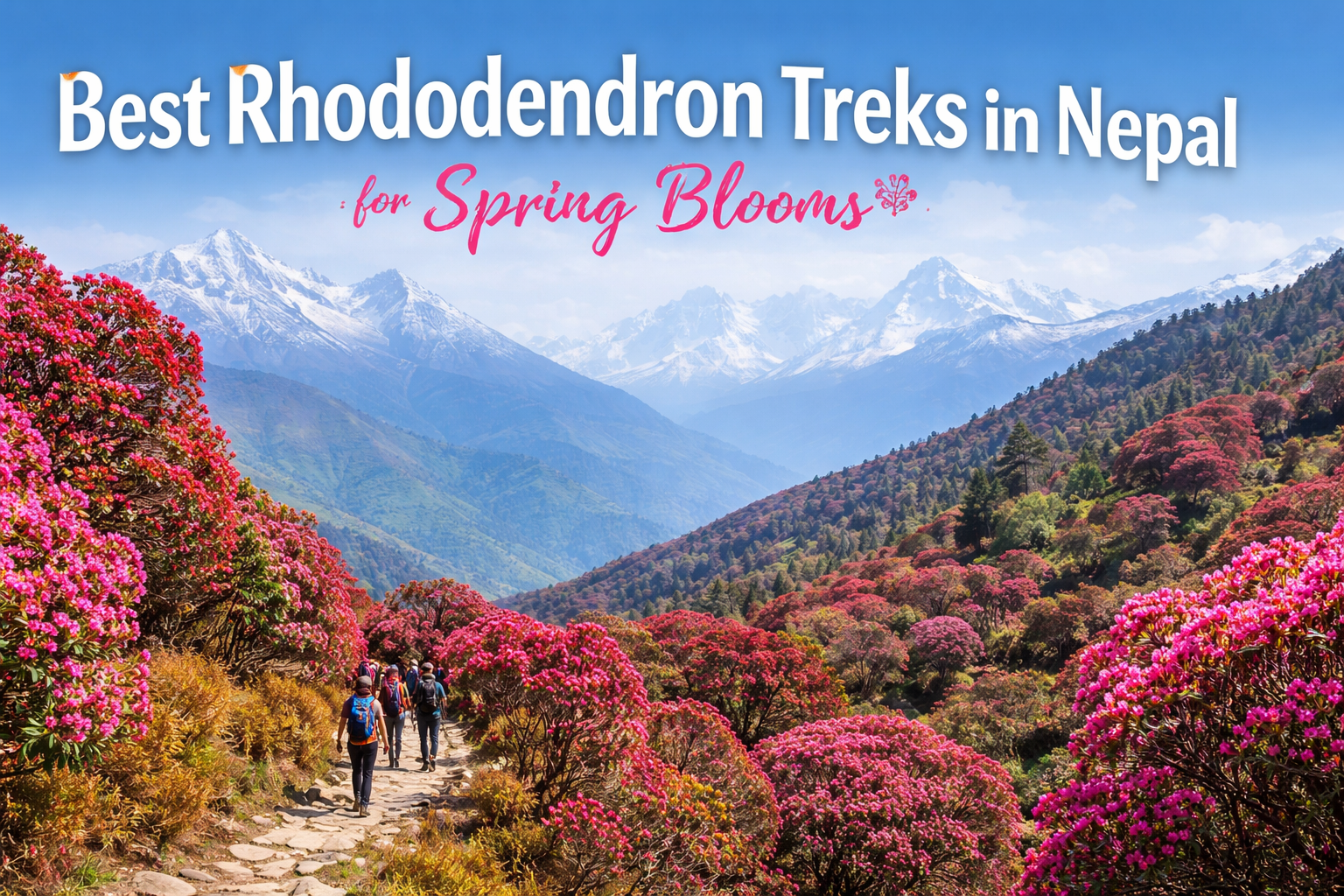
Every spring, something quietly extraordinary happens across Nepal's hills. The forests catch fire, not from flames, but from millions of rhododendron blossoms bursting open in shades of crimson, blush pink, and snow white. Locals call it Lali Gurans, the national flower of Nepal, and for good reason. It is woven into Nepali songs, painted on currency notes, and celebrated in mountain villages long before tourists ever discovered it.
If you have never walked through a blooming rhododendron forest with the Himalayas watching over your shoulder, you are missing one of the most breathtaking experiences this country quietly keeps to itself.
Nepal is home to over 32 species of rhododendron , more per square kilometre than almost anywhere on earth. The blooms follow altitude like a slow upward wave. Lower forests around 2,000 metres ignite in deep red as early as late February. By April and May , higher forests above 3,500 metres open up in rare white and lavender varieties, sometimes still dusted with snow. That staggered bloom means a clever trekker can chase the season upward and stay inside the spectacle for weeks.
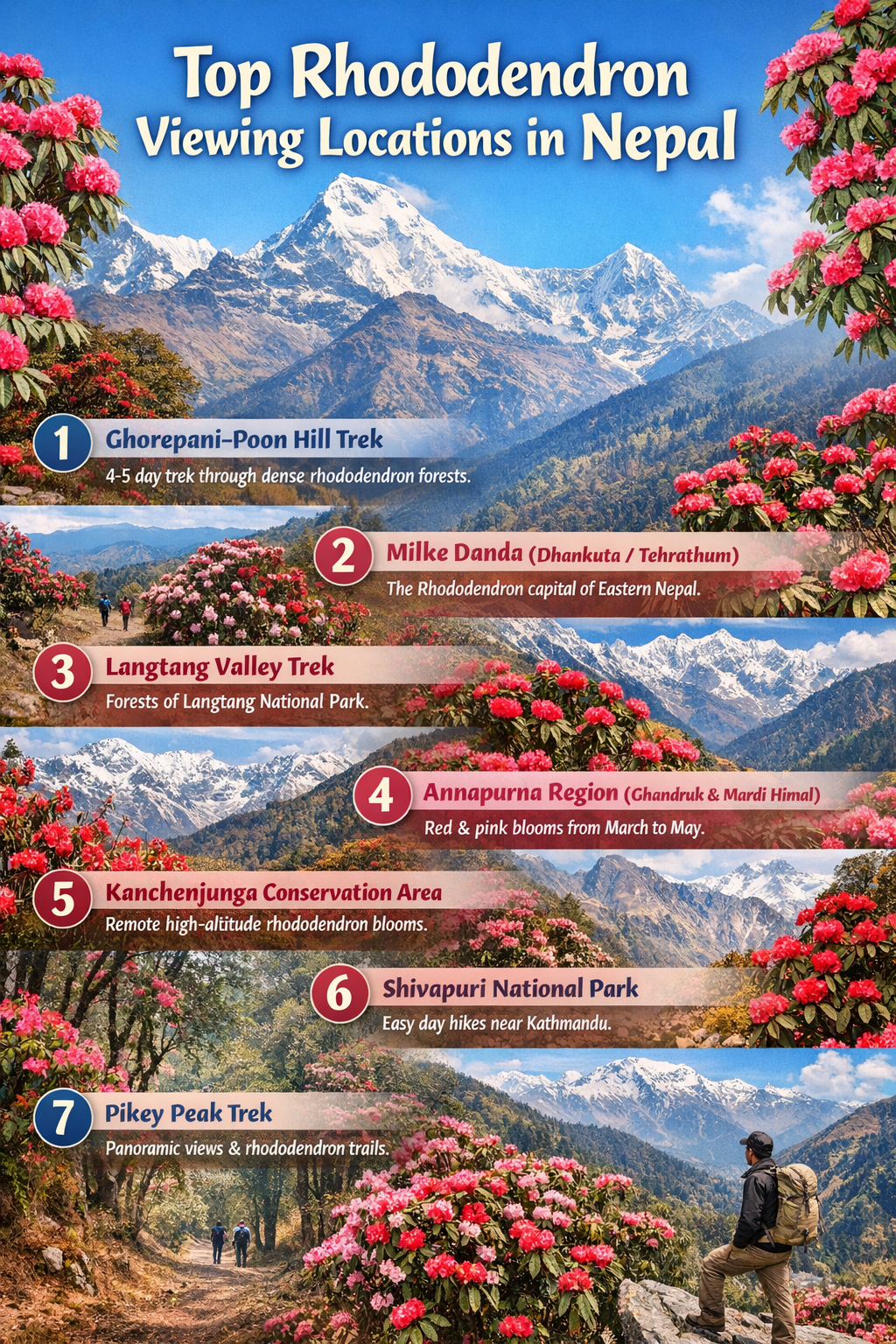
Here are the 7 best treks to experience it in full glory.
1. Ghorepani Poon Hill Trek
Duration: 4-5 days
Difficulty: Moderate
Best Time: Late March to mid-April
If there is one trail that defines rhododendron trekking in Nepal, it is this one. The section between Ulleri , Ghorepani , and Tadapani passes through what many consider the largest rhododendron forest on earth . You are not walking beside the flowers here. You are walking inside them. The canopy closes above you in red and pink, and on clear mornings, Dhaulagiri and Annapurna South peek through the blossoms like something out of a painting.
Poon Hill at sunrise is a well-known reward, but the forest itself is the real show. The trail is well-maintained with stone stairs, teahouses are plentiful, and the whole route is manageable for first-time trekkers. That said, do not let its beginner-friendly reputation fool you; the beauty here hits veteran trekkers just as hard.
2. Milke Danda (Dhankuta / Tehrathum)
Duration: 6-8 days
Difficulty: Moderate
Best Time: April to May
Eastern Nepal does not get the attention it deserves, and Milke Danda is the single best proof of that injustice. This high forested ridge, running through Dhankuta and Tehrathum , is quietly nicknamed the Rhododendron Capital of Nepal , and it earns that title with more than 25 varieties blooming across a single ridge.
The crowds that swarm Poon Hill simply do not make it here. You walk in near-silence through untouched cloud forests, with views of Everest, Makalu, and Kanchenjunga appearing and disappearing through the mist. The flower diversity alone is worth the trip, this is one of the few places where you will spot rare blue and yellow varieties alongside the more familiar reds.
For photographers and botanists, Milke Danda is a dream that barely anyone is talking about yet.
3. Langtang Valley Trek
Duration: 7-10 days
Difficulty: Moderate to Challenging
Best Time: March to May
Just three hours from Kathmandu sits a valley that most international visitors overlook entirely. Langtang National Park is a mosaic of rhododendron forests, glacial rivers, yak pastures, and Tamang villages, and in spring, the whole lower valley turns into a corridor of colour.
The trail from Syabrubesi rises through dense forests where rhododendrons tower overhead like old-growth trees. Langtang village itself sits at 3,430 metres and is surrounded by blooms that contrast dramatically with the icy peaks looming behind it. The cultural experience adds another layer. Tamang hospitality, Buddhist monasteries, and traditional stone homes make this far more than a flower walk.
It is worth noting that Langtang was devastated by the 2015 earthquake and has since been beautifully rebuilt. Trekking here now directly supports the local community's recovery.
4. Annapurna Region: Ghandruk and Mardi Himal
Duration: 5-7 days
Difficulty: Moderate
Best Time: March to May
The Annapurna region gives you options depending on how much time and ambition you have. Ghandruk is a gorgeous Gurung village perched above the Modi Khola valley, surrounded by rhododendron-covered ridges. A circuit through Ghandruk, Australian Camp , and Pothana is one of the most rewarding short treks in Nepal for spring blooms.
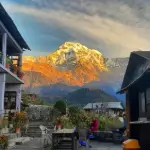
Mardi Himal takes things further. The trail climbs from dense rhododendron forests in the lower sections into an alpine world with jaw-dropping views of the Annapurna massif and Machapuchare. The contrast between the fiery forests below and the icy peaks above is the kind of image that makes people quit their jobs and move to Nepal.
Both trails can be combined with the Poon Hill route for an extended Annapurna circuit through the heart of Nepal's most spectacular spring scenery.
5. Kanchenjunga Conservation Area
Duration: 18-22 days
Difficulty: Challenging
Best Time: April to May
This is not for the casual trekker. Kanchenjunga , the third-highest peak on earth , sits in a remote corner of eastern Nepal that takes real effort to reach. But for those who make the journey, the reward is completely unmatched.
The conservation area around Ghunsa and Sele La Pass contains nearly 28 of Nepal's 32 rhododendron species, blooming in one concentrated area that feels like a botanical garden dropped into the wilderness. There are no crowds. There are no tourist teahouse menus with pasta and pizza. There is just raw Himalayan landscape, extraordinary biodiversity, and an intimacy with the mountains that the more popular routes simply cannot offer.
The Ministry of Culture, Tourism and Civil Aviation has recently recognised this region among Nepal's top 100 new tourist destinations. Book it before everyone else does.
6. Shivapuri National Park
Duration: Half day to full day
Difficulty: Beginner
Best Time: March to April
Not everyone has two weeks and trail-hardened legs. Shivapuri National Park, sitting right at the edge of Kathmandu, answers the question: where can I see rhododendrons in bloom today?
The park's lower trails, accessible within 30 minutes from Thamel , wind through forests that burst into colour by late March. Families with young children, older travellers, or anyone with just a day to spare can experience Nepal's most iconic spring flower without so much as packing a sleeping bag. Sunrise hikes from Budhanilkantha gate are particularly beautiful in April when the morning light catches the blossoms at a low angle.
It is not Poon Hill. But it is genuinely lovely and shockingly underused.
7. Pikey Peak Trek
Duration: 5-7 days
Difficulty: Moderate to Challenging
Best Time: March to May
Pikey Peak sits in the Solu region of eastern Nepal, and its sunrise view, taking in Everest, Makalu, Kanchenjunga, and the Annapurnas in a single panorama, is considered by many to be the finest mountain vista in the entire country. In spring, the trails leading to the summit pass through dense rhododendron forests that frame every viewpoint in vivid colour.
Sir Edmund Hillary, who knew Nepal better than most, once described the Pikey Peak area as his favourite view in the Himalayas. The trail sees a fraction of the foot traffic that Everest-region routes attract, which makes the whole experience feel like a genuine discovery.
Tips to Make the Most of Rhododendron Season
1. Timing is everything
Lower trails peak in late March ; higher altitude routes hit full bloom in late April and early May . If you want to see the full spectrum, plan a mid-elevation trek for late March or an upper-elevation route for late April.
2. What to pack
Mornings on the trail can sit around 5 to 10 degrees Celsius even in April. Lightweight waterproof layers are essential, as spring afternoons often bring short showers. Good trekking boots with ankle support are non-negotiable on wet stone trails. And bring more memory cards than you think you will need.
3. Trek responsibly
The rhododendron is not just Nepal's national flower; it is a keystone species in the Himalayan ecosystem. Never pick the flowers, stay on marked trails, and use established teahouses that reinvest in local communities. The forests you are walking through took centuries to grow.
4. Go with a local guide
Beyond safety, a local guide transforms a walk into an education. They know which side trail holds the rarest species, which teahouse owner makes the best dal bhat, and which viewpoint nobody in the guidebooks has found yet.
Conclusion
Nepal's rhododendron season is short, and that brevity is exactly what makes it so powerful. The bloom window at any given altitude lasts roughly three to four weeks , and the best days inside that window are even fewer. Of the seven treks above, Ghorepani Poon Hill is the most accessible and the most rewarding for first-timers. Milke Danda and Kanchenjunga are for those who want something untouched. Shivapuri answers the call for anyone short on time. And Pikey Peak quietly outperforms them all for sheer panoramic drama.
Whatever your fitness level, your timeline, or your budget, Nepal has a rhododendron trail with your name on it. Getting the timing right, picking the trail that suits you, and having reliable local support on the ground is what makes the difference between a good trip and one you spend the rest of your life talking about.
Hop Nepal has been connecting travellers to authentic Nepal experiences since 2017. From the Ghorepani forests to the remote ridge of Milke Danda, the team knows these trails the way most people know their own neighbourhoods.
Spring in Nepal is waiting. The forests are already waking up.
Explore rhododendron trekking packages at Hop Nepal .
Frequently Asked Questions (FAQs)
When is the best time to see rhododendrons in Nepal?
The best time is between late March and mid-May. Lower altitude trails (around 2,000 metres ) bloom first, usually from late February to early April. Higher trails above 3,000 metres hit peak colour in late April and early May. If you want to see the widest variety of colours and species, plan your trek for the first two weeks of April.
Which trek is best for rhododendron viewing in Nepal?
The Ghorepani Poon Hill Trek is the most popular and accessible option, passing through what is widely considered the largest rhododendron forest in the world. For flower diversity, Milke Danda in eastern Nepal hosts over 25 species on a single ridge. For a remote, once-in-a-lifetime experience, the Kanchenjunga Conservation Area has nearly 28 of Nepal's 32 species blooming in one area.
How many species of rhododendron are found in Nepal?
Nepal is home to over 32 species of rhododendron , ranging from the deep crimson Rhododendron arboreum (the national flower, locally called Lali Gurans ) to rare white, yellow, and lavender varieties found at higher elevations. The eastern regions of Nepal, particularly around Milke Danda and Kanchenjunga, have the highest species concentration.
Do I need a guide for rhododendron trekking in Nepal?
It is not legally required on all routes, but it is strongly recommended. A knowledgeable local guide knows peak bloom timings, lesser-known viewpoints, and the safest trail conditions during spring, when some paths can get slippery with rain. For remote routes like Milke Danda, Kanchenjunga, and Pikey Peak, a guide is practically essential.
Is rhododendron trekking suitable for beginners?
Yes, several routes are ideal for beginners. The Ghorepani Poon Hill Trek is well-marked with stone stairways and regular teahouses, making it comfortable for those with no prior trekking experience. Shivapuri National Park near Kathmandu is even easier, offering a half-day to full-day forest walk through blooming rhododendrons without any altitude concerns.
What should I pack for a rhododendron trek in spring?
Trail mornings in spring range from 5 to 12 degrees Celsius, and afternoons can bring short rain showers. Pack lightweight, moisture-wicking base layers, a fleece mid-layer, a waterproof jacket, sturdy ankle-support trekking boots, sunscreen, a wide-brim hat, and plenty of storage for photos. A refillable water bottle and water purification tablets are also worth adding.
Can I see rhododendrons without going on a multi-day trek?
Absolutely. Shivapuri National Park on the northern edge of Kathmandu offers beautiful rhododendron forests on trails that can be completed in a single morning. The Godavari Botanical Garden in the Kathmandu Valley also showcases several cultivated rhododendron varieties during the blooming season. Both are excellent options for those with limited time or mobility.