
Quick Answer: Budget vs Luxury Trek in Nepal
Most people searching this topic want one clear answer and the honest truth is there is not one. What there is, is a clear picture of what each option actually delivers so you can make the right call for your specific situation. Here is the short version:
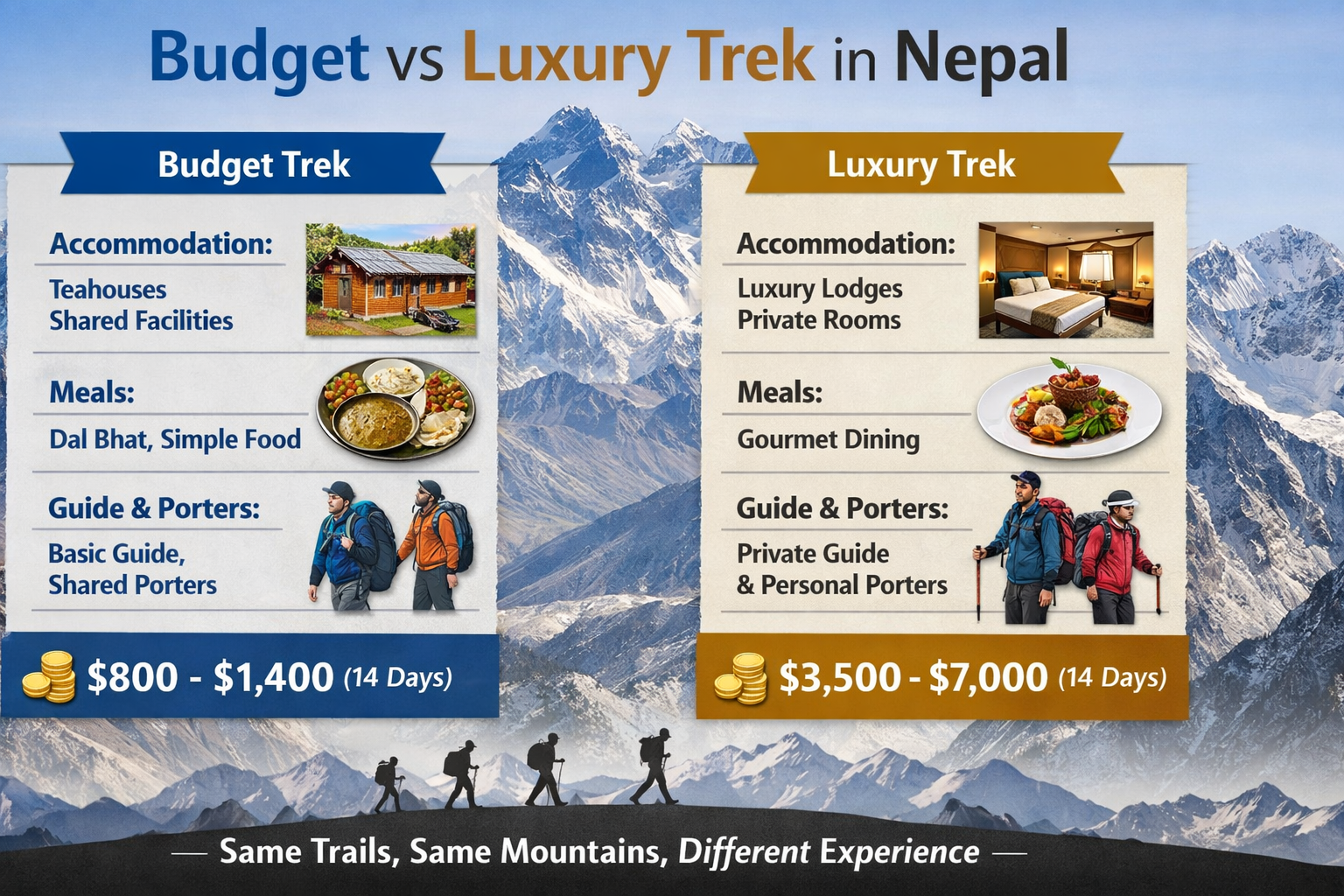
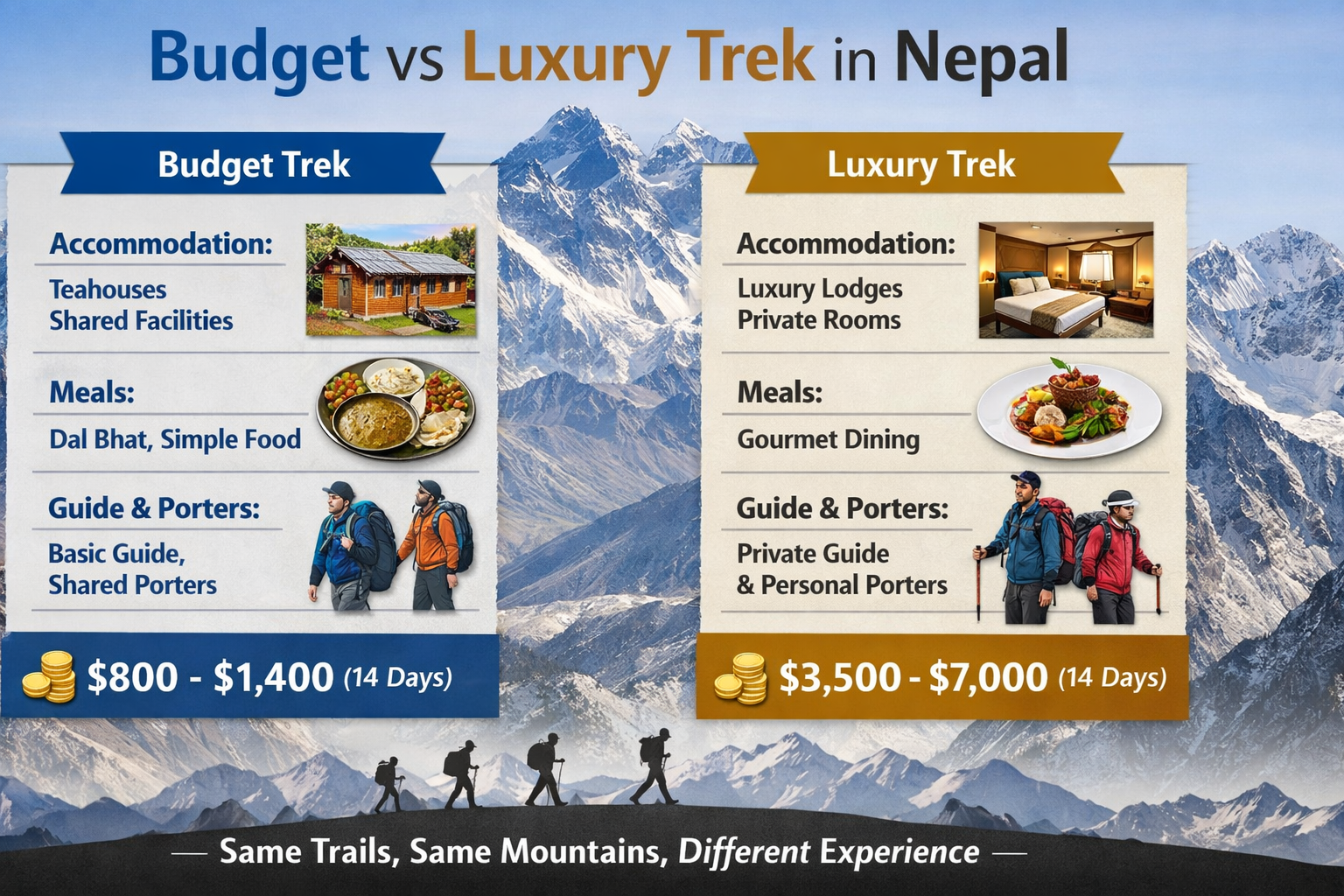
- Budget treks use teahouse accommodation, shared facilities, standard meals, and keep costs as low as realistically possible without sacrificing the trekking experience itself
- Luxury treks replace teahouses with premium lodges, add private guides and porters, upgrade the food significantly, and handle every logistical detail so you never have to think about it
- The trekking route is the same regardless of which option you choose, the mountains do not change based on your budget
- The difference is entirely in how you sleep, eat, travel, and feel at the end of each day on the trail
Full breakdown below, including what each option actually costs, what the hidden expenses are, and which one makes more sense depending on who you are and what you want from Nepal.
What is a Budget Trek in Nepal?
Budget trekking in Nepal is built around the teahouse system that has served trekkers in the Himalayas for decades. Teahouses are small family-run lodges scattered along all the major trekking routes, offering basic rooms, shared bathrooms, and simple meals cooked fresh in the lodge kitchen. They are genuinely functional, often warm enough, occasionally charming, and sometimes memorable in ways that a premium lodge simply cannot replicate.
What Defines a Budget Trek
A budget trek is essentially a self-managed or lightly supported journey where you cover the cost of accommodation, meals, permits, and basic guide or porter services without paying for any premium add-ons. Rooms are basic, often two single beds with thin mattresses and blankets that range from adequate to surprisingly warm depending on the teahouse and the altitude. Bathrooms are shared and hot showers exist at most lodges but cost extra and the water temperature is optimistic at best above 4,000 meters.
Meals on a budget trek are straightforward and honestly pretty good for what they are. Dal bhat is the staple and it is genuinely the best thing you can eat on a Nepal trek regardless of your budget because it is filling, locally sourced, and designed for people doing exactly what you are doing. Noodle soup, porridge, eggs, and pasta round out most teahouse menus.
What Is Included in a Budget Trek
Permits are a fixed cost regardless of budget or luxury status and are included in any properly organized trek package. Basic guide services are included in most organized budget packages though some experienced independent trekkers manage without a guide on well-marked lower altitude routes. Local transportation to and from trailheads is included. Standard teahouse accommodation and meals are the core of the daily cost structure.
Who Should Choose Budget Trekking in Nepal
Budget trekking suits backpackers who genuinely enjoy the social atmosphere of teahouse common rooms where trekkers from every country end up sharing tables and trail stories over dinner. It suits solo travelers who prefer the flexibility of moving at their own pace without the structure of a premium package itinerary. It suits cost-conscious trekkers who want to spend their money on the experience of being in Nepal rather than on the comfort level of where they sleep at night. And honestly it suits a lot of people who simply do not need luxury to have the best time of their lives on a trail.
What is a Luxury Trek in Nepal?
Luxury trekking in Nepal has developed considerably over the past decade and what is available now in terms of accommodation quality and service standard genuinely surprises people who assume the mountains mean roughing it by definition. The landscape is the same. The altitude is the same. The physical demands of the trail are identical. What changes is everything surrounding the walking itself.
What Defines a Luxury Trek
Premium lodges in the Everest and Annapurna regions now offer private rooms with en-suite bathrooms, heated spaces, quality bedding, and dining experiences that would not look out of place in a good city restaurant. The Yak and Yeti properties, the Ker and Downey camps, and several independent boutique lodge operations have built genuine hospitality infrastructure in the mountains over the past fifteen years. A luxury Everest trek or a high-end Annapurna package stays at these properties rather than standard teahouses and the difference in daily comfort is substantial.
Private guides on luxury treks are senior licensed professionals with extensive regional experience who manage every logistical detail of your day. Private porters handle all luggage. Itineraries are customized to the pace and preferences of the specific group rather than following a fixed schedule designed for maximum throughput.
What Is Included in a Luxury Trek Package
Domestic flights including the Lukla flight that starts the Everest region approach are included in most luxury packages rather than being left for the trekker to arrange separately. High-quality accommodation throughout the route with private bathroom facilities where available. Premium meals at each lodge include menu options that go considerably beyond dal bhat and instant noodles. Personalized itinerary design with flexibility built in for acclimatization days, weather holds, or simply moving at a more comfortable pace than a standard teahouse schedule allows. All permits, guide fees, porter fees, and logistics handled without the trekker needing to manage any of it.
Who Should Choose Luxury Trekking in Nepal
Luxury trekking suits travelers who want the Himalayan experience without the accommodation and comfort compromises that teahouse trekking involves. It suits families with children or older parents where physical comfort at the end of a hard day genuinely matters to the viability of the trip. It suits high-end travelers who approach all their travel at a premium standard and see no reason to change that approach in Nepal. It suits anyone who has a limited window of time in Nepal and wants every element of the experience optimized rather than leaving anything to chance or basic luck with teahouse quality on a given night.
Budget vs Luxury Trek: The Key Differences Side by Side
Accommodation Quality
Teahouse rooms on a budget trek are functional and sometimes genuinely characterful. They are also cold at altitude, the walls are thin, and shared bathrooms at 4,500 meters in October at 5 AM are a particular kind of experience. Premium lodges on a luxury trek offer proper beds, private bathrooms, heating, and the kind of sleep quality that genuinely affects how you feel on the trail the next morning at altitude.
Food and Dining Experience
Budget teahouse food is simple, filling, and better than people expect going in. Luxury lodge dining is a different category entirely, with menu variety, quality ingredients, professional kitchen standards, and dining rooms that make the end of a hard trekking day feel like arriving somewhere rather than just collapsing into the nearest chair.
Guide and Porter Services
Budget treks typically involve a single guide shared across a group or a solo trekker, covering the core navigation and logistics functions without the additional personal attention of a private arrangement. Luxury treks provide private guides dedicated to your specific group and separate porters handling luggage so the guide can focus entirely on your experience and safety rather than managing logistics simultaneously.
Transportation and Logistics
Budget trekkers arrange their own flights, manage their own transfers, and handle the organizational details of getting to and from trailheads. Luxury packages handle all of this as part of the service, including booking Lukla flights which is a genuinely stressful process during peak season when seats are scarce and competition for them is fierce.
Overall Experience
Both versions of trekking in Nepal involve walking the same trails under the same mountains in the same thin air. The mountains are not affected by your accommodation tier. What differs is the daily quality of life surrounding the walking itself and how much mental and physical energy you spend managing logistics versus simply experiencing where you are.
Cost Comparison: Budget vs Luxury Trek in Nepal
Trek cost in Nepal is shaped by the region, the duration, the level of service, and whether you are traveling in a group or as a private party. Here is how the cost structure breaks down across the two ends of the spectrum.
What Affects Trek Cost
The trekking region matters because Everest region logistics including the Lukla flight cost more than Annapurna region access from Pokhara. Trek duration affects total cost in straightforward ways, more days mean more accommodation and meal costs plus longer guide and porter hire periods. Service level is the biggest single variable because the gap between basic teahouse accommodation and premium lodge pricing in the mountains is genuinely substantial. Group versus private travel affects per-person cost significantly because shared costs across multiple travelers reduce what each individual pays.
Budget Trek Cost Overview
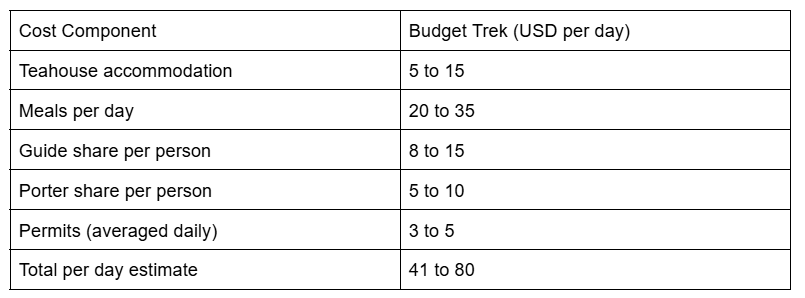
A full 14-day Everest Base Camp budget trek organized independently typically runs between USD 800 and 1,400 per person including permits, accommodation, meals, guide, and porter but excluding international flights and gear.
Luxury Trek Cost Overview
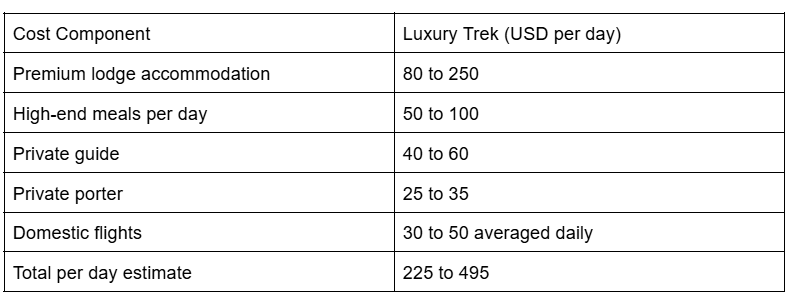
A fully organized 14-day luxury Everest Base Camp trek through a premium operator typically runs between USD 3,500 and 7,000 per person depending on the specific lodge properties used and the level of personalization involved.
Value for Money Comparison
This is where honest conversation gets interesting. Budget trekking delivers the full Himalayan experience, the same mountains, the same trails, the same genuine physical achievement, at a fraction of the luxury cost. Luxury trekking delivers a meaningfully better daily quality of life on the trail and removes every logistical friction from the experience, but the additional spend per person over 14 days is substantial by any measure. Neither is poor value for the right traveler. Both are of poor value for the wrong one.
Everest Base Camp: Budget vs Luxury Comparison
Budget EBC Trek Experience
A budget Everest Base Camp trek means teahouse accommodation from Lukla to Gorakshep, shared dining rooms where you eat alongside twenty other trekkers from every country imaginable, basic rooms that get progressively colder as the altitude rises, and the specific satisfaction of having managed a genuinely hard thing with minimal support infrastructure. The experience is raw, social, occasionally uncomfortable, and for many people absolutely perfect exactly as it is.
Luxury EBC Trek Experience
A luxury Everest Base Camp trek means staying at properties like the Yeti Mountain Home lodges or equivalent premium accommodation at key stops along the route, private dining, heated rooms, a personal guide managing every detail of each day, and arriving at Everest Base Camp feeling considerably better physically than most budget trekkers do after two weeks of teahouse living. The experience is more comfortable, more controlled, and for the right traveler, genuinely worth every dollar of the premium.
Annapurna Trek: Budget vs Luxury Comparison
The Annapurna region offers some of the most developed luxury trekking infrastructure in Nepal outside the Everest corridor. The Sanctuary Lodge at Annapurna Base Camp and the various boutique properties along the circuit route give luxury trekkers genuinely excellent options. Budget trekkers on the Annapurna route benefit from some of the best teahouse infrastructure in the country and the competitive market in this popular region keeps food quality relatively high even at the basic end.
The Annapurna Circuit on a budget is one of the most rewarding value-for-money trekking experiences available anywhere in the world. The Annapurna Sanctuary on a luxury package is a genuinely premium Himalayan experience at a price point that compares favorably with equivalent high-end trekking experiences in other mountain destinations globally.
Group Trek vs Private Trek Cost Comparison
Group Trek: The Budget-Friendly Structure
Group treks spread shared costs across multiple travelers, reducing the per-person expense for guide fees, porter fees, and sometimes accommodation through pre-negotiated group rates. The trade-off is that the itinerary, pace, and daily schedule are set for the group rather than the individual. If you are faster or slower than the group average, or if you want an extra acclimatization day somewhere that is not in the standard schedule, flexibility is limited.
Private Trek: The Luxury Structure
Private treks give you complete control over pace, schedule, and itinerary design. You move at your speed, rest when it makes sense for your body, and make decisions based on your preferences rather than a fixed group program. The per-person cost is higher because all the fixed costs, guide, porter, logistics, fall on your party alone rather than being distributed across a group. For couples or small families the private structure is often the most sensible approach regardless of whether the overall package sits in the budget or luxury category.
Hidden Costs Trekkers Often Miss
This section matters more than most people realize when they are comparing budget versus luxury options because some of these hidden costs hit budget trekkers particularly hard.
Charging electronics at teahouses above Namche Bazaar costs money at every stop and the price per charge increases with altitude. Budget trekkers pay this out of pocket at each lodge. Luxury packages typically include charging facilities in the price.
Hot showers at teahouses are charged separately and the cost is not trivial at higher elevations. Luxury lodge accommodation almost always includes shower facilities in the room rate.
Wi-Fi cards or per-session access fees apply at teahouses along the major routes. Budget trekkers buy these as they go. Luxury packages often include connectivity in the service.
Drinks and snacks between meals add up significantly over 14 days. A bottle of Coke at Gorakshep costs several times what it costs in Kathmandu. Budget trekkers absorb these costs individually. Luxury packages may include some of this depending on the specific operator.
Tips for guide and porter are not included in any package price regardless of budget or luxury tier. Budget trekkers should plan for USD 3 to 6 per day per person for the porter and USD 5 to 10 per day per person for the guide as a genuine expected cost. Luxury trekkers are tipping private guides and porters at comparable or slightly higher rates given the premium service level involved.
Gear rental for items like down jackets, sleeping bags, and trekking poles from Thamel shops is a cost that budget trekkers who do not own equipment need to factor in. Luxury packages sometimes include gear as part of the service.
Which Trek Is Actually Better for You?
Choose a budget trek if you are comfortable with basic accommodation and shared facilities, if the social atmosphere of teahouse common rooms appeals to you, if you want to stretch your Nepal experience across a longer period by keeping daily costs low, or if you genuinely do not need comfort amenities to enjoy being in the mountains.
Choose a luxury trek if daily comfort genuinely affects your enjoyment and physical recovery during a hard multi-week journey, if you have limited time and want every element of the experience optimized without logistical friction, if you are traveling with family members or older companions for whom basic teahouse conditions would create genuine discomfort, or if you simply want the Himalayan experience at the highest possible quality level and the cost is not the primary constraint.
The balanced mid-range option is worth mentioning because it is where a lot of trekkers who have done their research properly end up. Booking an organized budget package through a reputable Kathmandu agency gives you the logistical support and safety structure of a properly managed trek without the teahouse-to-teahouse scramble of fully independent budget travel, at a cost point meaningfully below full luxury pricing. For many trekkers this middle ground delivers the best overall value.
Pros and Cons of Budget Trekking
Budget trekking gives you the full authentic Nepal trekking experience at a cost that makes a two-week Himalayan journey accessible to people who could never justify luxury pricing. The social dimension of teahouse culture is genuinely something that premium lodges cannot replicate. The flexibility of the budget teahouse system means you can adjust your pace and schedule without worrying about losing a non-refundable premium lodge booking.
The downsides are real though. Cold rooms at altitude affect sleep quality and sleep quality affects how you handle altitude. Shared bathrooms at 5,000 meters in the dark at 4 AM are unpleasant in ways that accumulate over 14 days. Basic meals get repetitive. The organizational load of managing permits, guide logistics, and daily teahouse bookings during peak season adds stress that some travelers would rather not carry.
Pros and Cons of Luxury Trekking
Luxury trekking removes every logistical friction from the Nepal experience and replaces the daily discomforts of teahouse living with genuine comfort that improves sleep, recovery, and physical performance on the trail. Private guides at this level bring a depth of knowledge and personal attention that group teahouse treks simply cannot match. The food is substantially better. The sleeping environment is warmer, quieter, and more private.
The cost is the obvious limitation. A luxury Everest trek costs four to six times what a budget equivalent runs for the same route and the same number of days. The premium lodge infrastructure also does not exist at every point on every route, which means some segments of even luxury treks involve teahouse-level accommodation by necessity. And some travelers find the managed, packaged nature of a luxury trek removes exactly the sense of raw adventure that drew them to Nepal in the first place.
Best Time for Budget and Luxury Treks
Peak season from October through early November and again in April through May brings the best weather across both budget and luxury options and also the highest prices across both. Teahouses during peak October can be completely full requiring advance booking. Premium lodges during the same period book out months ahead of time.
Shoulder seasons in late November and early March offer meaningfully lower prices across the board with trail conditions that are reasonable though not at the absolute best level of mid-peak season. Off-season trekking in winter and monsoon brings the lowest prices of the year for both budget and luxury options alongside the trade-offs of cold, wet, or cloud-obscured conditions depending on the specific window chosen.
Frequently Asked Questions
What is the actual difference between budget and luxury trekking in Nepal?
The trekking route, the mountains, and the physical experience of being at altitude are identical across both options. What differs is accommodation quality from basic teahouse rooms to private en-suite lodge rooms, food quality from standard teahouse menus to premium dining, guide arrangement from shared group guides to private dedicated guides, and the level of logistical support surrounding the walking itself.
Is luxury trekking in Nepal worth the extra cost?
For travelers who genuinely value daily comfort, private service, and having every logistical detail managed professionally, yes without question. For travelers who are comfortable with basic conditions and find the teahouse social atmosphere part of what makes Nepal trekking special, the premium cost of luxury trekking does not add proportional value to their specific experience.
How much does a budget trek in Nepal cost?
A properly organized budget Everest Base Camp trek including permits, teahouse accommodation, meals, guide, and porter typically runs between USD 800 and 1,400 per person over 14 days. Annapurna Circuit budget treks cover a similar range depending on duration and the specific route taken. These figures exclude international flights, gear purchase or rental, and tips for guide and porter.
What is included in a luxury trek package?
Standard inclusions in a luxury Nepal trek package cover domestic flights including the Lukla flight, premium lodge accommodation throughout the route, all meals at each property, a private licensed guide, private porter service, all permits and logistics, and in many cases airport transfers in Kathmandu at both ends of the trip. What is typically excluded is international flights, personal gear, tips, and any additional activities or services outside the defined itinerary.
Which trek option is better for beginners?
Beginners benefit from the structure and support of an organized trek regardless of whether the overall package sits in the budget or luxury tier. A properly organized budget package through a reputable Kathmandu agency gives first-time Nepal trekkers the guide support, permit management, and logistical structure they need without the fully independent teahouse approach that works better for experienced trekkers who know the system. First-time trekkers with the budget for it often find that a luxury or mid-range private package removes the organizational stress that can otherwise dominate the mental energy of a first Nepal trek.
Final Verdict: Budget or Luxury Trek in Nepal?
Neither option is objectively better. They are genuinely built for different people with different priorities and different approaches to travel.
Budget trekking in Nepal is one of the most rewarding value-for-money travel experiences available anywhere on Earth. The full Himalayan experience, real mountains, real altitude, real physical achievement, for a total cost that is accessible to most travelers who plan properly. If you are comfortable with basic conditions and willing to manage the organizational details of teahouse trekking, the budget path delivers everything that matters.
Luxury trekking in Nepal takes that same experience and wraps it in a quality of daily life that genuinely changes how you feel physically and mentally across a multi-week mountain journey. If comfort matters to you, if your time is limited and you want every day optimized, or if you are traveling with people for whom teahouse conditions would genuinely affect their enjoyment, the luxury investment pays off in ways that show up every single day on the trail.
The mid-range organized package is where most experienced Nepal trekkers who have done the research end up landing. Proper logistical support, reputable guide services, and reasonable accommodation standards without the full luxury premium. For a first Nepal trek it is often the most sensible starting point before you know enough about what you actually want from the mountains to commit to either extreme.