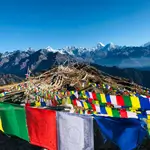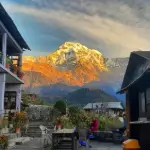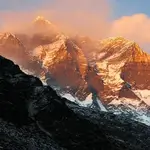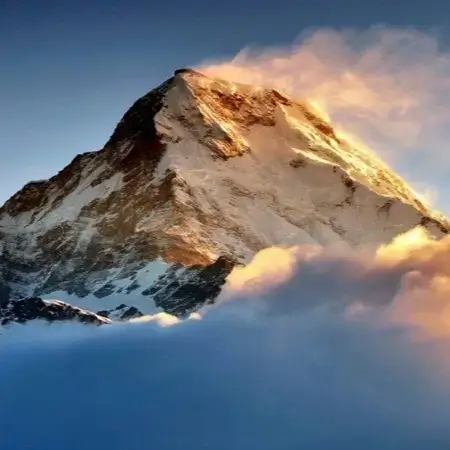

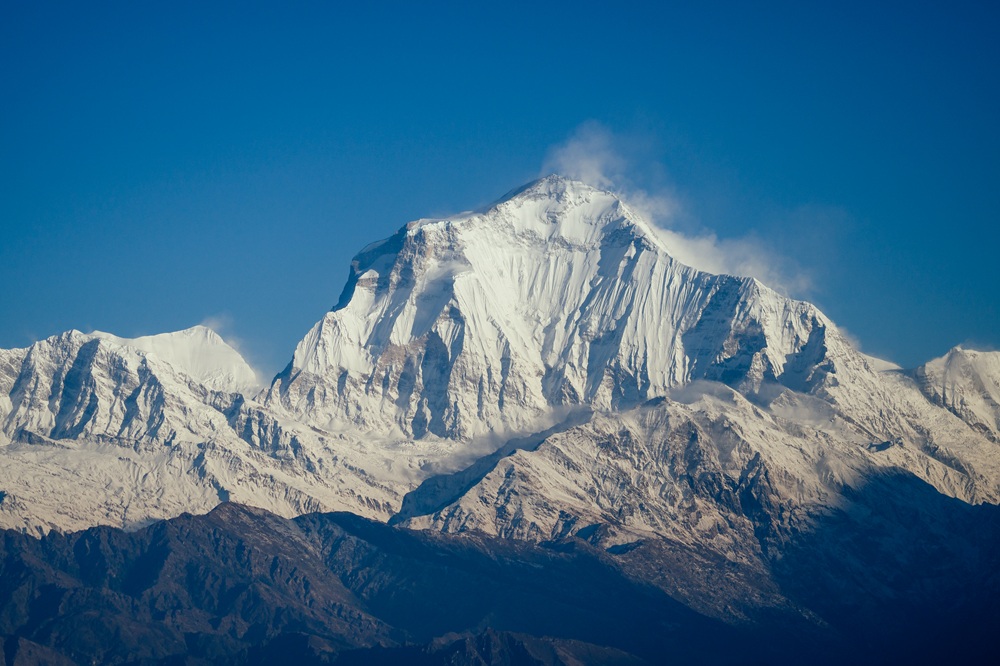
High altitude trekking in Nepal is one of the most thrilling and demanding mountain adventures on the planet. The Himalayas offer perhaps the best opportunities anywhere to trek among the highest peaks on earth, and a successful trip demands exhaustive preparation, recognition of the physiological challenges of altitude trekking, and comprehension of the special risks of extremely high-altitude trekking.
Above 3,500 meters is considered high altitude, where the body starts to face a serious oxygen deficiency. Above 5,500 meters is extreme altitude, where even an acclimatised body begins to deteriorate rather than adapt. The most popular trekking destinations in Nepal are all within the 4,000–5,500 meter range, placing them firmly in the highest range of trekking difficulty.
This is a comprehensive guide that offers everything an adventurer needs to know about high-altitude trekking, including the highest routes, appropriate preparations, and understanding symptoms of altitude sickness. From a beginner planning their first-ever trek to Everest Base Camp, to an advanced mountaineer attempting the Three Passes trek, this is a critical piece of literature.
Quick Summary:
- High Altitude Defined: Over 3,500 meters, or 11,483 feet in Nepal
- High Trek Point: Thorong La Pass - Annapurna Circuit
- Key Challenge: This is the dreadful acute mountain sickness affecting 50%-75% of trekkers above high altitude in Nepal.
- Principal Preparation: 6-8 weeks of physical training and proper acclimatisation
- Best Time to Visit: March to May and September to November.
What Is High Altitude Trekking in Nepal?
In high-altitude areas of Nepal, one must trek above 3,500m, where air pressure is lower, resulting in lower oxygen levels than at sea level. While one treks at 3,500m, they can utilise 65% of oxygen, but as they trek to 5,500m, they are left to utilise only 50%. One must endure acclimatisation.
Due in part to its geography, Nepal is the world’s preeminent destination for high-altitude trekking expeditions, with eight of the world’s ten highest mountains rising within or alongside its borders, including Mount Everest (8,848 meters), Kanchenjunga (8,586 meters), Lhotse (8,516 meters), and Makalu (8,485 meters), whose bases can be reached along one of its numerous trekking trails, with passes above 5,000 meters or high enough in their own right for any other country on Earth to consider them mountaineering routes.
Altitude Classifications in Nepal Trekking
- Moderate Altitude (2,500-3,500m): In most cases, it is the first point of Acclimatisation, with noticeable mild or no altitude sickness during a trek. Treks such as Ghorepani Poon Hill lie in this altitude region.
- High Altitude (3,500-5,500m): Substantial Acclimatisation Needed, Risk of Acute Mountain Sickness Substantially Increases, and Most Popular Nepal Hikes Fall within this Zone, i.e., Everest, Annapurna, & Manaslu Circuits
- Extreme Altitude (Above 5,500m): The body cannot fully acclimatise, and deterioration begins. Only experienced, well-acclimatised trekkers should venture here. Some trekking passes, like Thorong La (5,416m) and Kongma La (5,535m), reach the lower extreme altitude.
Regions with High Altitude Trekking Routes
- Everest Region (Khumbu): The highest trekking routes on earth, where trekkers reach 5364m to trek to Everest Base Camp, 5357m to see the Gokyo Lakes from Gokyo Ri, and where the Three Passes trek crosses three 5000m peaks. This is one of the most popular trekking spots.
- Annapurna Region: Features the famous Annapurna Circuit crossing Thorong La Pass (5,416m) and Annapurna Base Camp (4,130m) surrounded by towering peaks.
- Manaslu Region: Manaslu Circuit crosses the Larkya La Pass (5,160m) over remote valleys with stunning mountain views and genuine Tibetan culture.
- Dolpo & Mustang: Remote & inaccessible areas at extreme altitudes, passing via high desert landscapes & untouched Tibetan Buddhist Culture dating back centuries.
Highest Altitude Treks in Nepal
Understanding the highest-altitude trek option in Nepal can help you choose appropriate routes based on your experience and tolerance.
Top High Altitude Treks in Nepal
- Everest Base Camp Trek with Kala Patthar (5,644m): The best-known high-altitude trek in Nepal reaches Everest Base Camp at an altitude of 5,364m, although most hikers continue to the viewpoint at Kala Patthar (5,644m) for views of the roof of the world. This trek begins in the village of Lukla and reaches the base of Everest in 12-14 days, passing through Sherpa villages and Buddhist monasteries. Although not as difficult a trek, high altitude requires due care.
- Three Passes Trek (5,535m): The most challenging tea house trek in Nepal circumnavigates the Everest region, crossing three high passes: Kongma La (5,535m), Cho La (5,420m), and Renjo La (5,360m). This 18-21-day adventure combines the best of the Everest Base Camp route with the Gokyo Lakes, offering spectacular variety and some of the most amazing scenery in the Himalayas. Only experienced trekkers who have previously been to high altitudes should attempt this route.
- Annapurna Circuit with Thorong La Pass (5,416m): The Annapurna Circuit Trek takes approximately 15 to 18 days and involves circumnavigating the Annapurna mountain range by crossing Thorong La Pass at an altitude of 5,416m, one of the highest passes in the world accessible to trekkers. The scenery ranges from subtropical valleys and forests to high-altitude desert landscapes. Accurate acclimatisation planning calls for important rest days before climbing the pass.
- Manaslu Circuit Trek with Larkya La Pass (5,160m). This 14-16-day trek circles Mount Manaslu (8,163m), the world's eighth-highest peak, and crosses the Larkya La Pass (5,160m). Less crowded than the Everest or Annapurna routes, Manaslu offers authentic cultural experiences and pristine mountain wilderness. The trek requires restricted area permits and mandatory guide accompaniment.
- Upper Dolpo Trek: This is a long trek that takes one across several passes over 5,200m through rugged, arid, mountainous terrain. This trek takes one to ancient Buddhist culture, but it is for experienced trekkers due to various challenges and expenses.
Having mentioned the most famous trek routes, we should think about good routes for inexperienced high-altitude trek enthusiasts. Choosing the right trek route for your first adventure is important.
For instance, for new high-altitude treks, the route from the Mount Everest Base Camp to Lhasa would be the optimal choice for the trekking experience. This is because the preplanned route incorporates acclimatisation, accommodation in tea houses, an experienced guide, and a heli rescue facility for trekkers heading to Mount Everest Base Camp.
Annapurna Base Camp Trek is a good option for beginners who want an easily accessible altitude (only at 4,130m). Usually, it's an easier option than Everest Base Camp and takes 7 to 10 days.
How to Prepare for High Altitude Trekking
Proper preparation is the most important factor in ensuring the success of a high-altitude trek. Preparation includes physical fitness, mental preparedness, and knowledge of how to acclimate.
Physical Preparation
Cardiovascular Training: High-altitude trekking requires sustained effort with reduced oxygen. Train 8-12 weeks in advance with these exercises:
- Hiking with Elevation Gain: Practice on hills/mountains, carrying a 5- 8 kg backpack. The distance covered and elevation gained must be gradually increased to up to 6-8 hours and 800-1,000m, respectively, per session.
- Benefits of Walking and Hiking Stair Climbing: Grossly underrated for great leg strengthening and aerobic conditioning. Start with 20-30 minutes and build to 60 minutes with a weighted backpack.
- Running/Cycling: 3-4 times a week, 3-4 sessions each, 30-45 minutes to build cardiovascular basic fitness, which is a must.
Strength Training: Focus on legs, core, and back to handle long trekking days and carrying daypacks:
- Leg exercises: Squats, lunges, step-ups, and calf lifts help build the muscles you use most for trekking uphill or downhill.
- Core strengthening: Plank poses, bridges, and twisting exercises help your body maintain stability as you traverse uneven ground.
- Back & Shoulders: Acclimatise to carrying day packs of 5-8 kg with rowing exercises & shoulder strengthening.
Endurance Building: Expect 5-7 hours of trekking daily for up to 20 days. Use these methods:
- Back-to-Back Training: This involves practising consecutive day hiking. This enables you to train your muscles for a multi-day event without a full rest between each day.
- Long weekend hikes: Gradually build up the duration of your longest hikes to between 6 and 8 hours.
Mental Preparation
Physical fitness alone doesn't guarantee success at high altitude; mental preparation is equally critical.
- Understand the Challenges of Altitude: Recognise that high-altitude trekking is uncomfortable. Everyone experiences some symptoms; it is normal to have headaches, reduced appetite, disrupted sleep, and general fatigue. Mental awareness and honesty about your condition will help differentiate between the typical effects of altitude and the onset of dangerous altitude sickness.
- Patience and Pacing: The guiding principle, whereby pole pole or slowly slowly in Swahili is adopted in various forms in Nepal, reflects the philosophy of high-altitude trekking. Speed, or hastening, in mountain walking always promises altitude problems. There is mental preparation involved in making hill walking seem slow-paced, almost comically so, at lower elevations.
- Decision-Making Preparedness: Be in a state of mind prepared to go down, especially when conditions worsen. Most altitude emergencies occur due to summit fever, which persists despite warning signs. Successful trekkers on high-altitude journeys value safety over reaching summits.
Acclimatization Planning
Preparation for high-altitude trekking focuses on proper acclimatisation, or the gradual physiological adaptation to reduced oxygen.
It means following the Climb High, Sleep Low Principle. Your sleeping elevation is more critical than your maximum daily elevation. Thus, it is prudent to plan an itinerary that ascends to a higher point each day, then descends to lower elevations to sleep. These types of activities spur acclimatisation without undue overnight stress to the body.
Limit daily elevation gain to 300-500m of sleeping elevation above 3,000m: This very conservative rate gives the body time for safe additional red blood cell production and equips it with an adaptation to low blood oxygen.
Include Rest Days: Acclimatisation days should also be included after every 1,000m of altitude gain. This includes consecutive nights at the same altitude. The climb high, sleep low concept may also include short hikes to high altitude before returning to sleep at your present altitude.
Altitude Sickness in Nepal: Symptoms & Prevention
Incidence of High Altitude Sickness: Throughout Nepal, the incidence of high-altitude sickness ranges from 50-75% among trekkers who reach 4,000m. High-altitude trekking is perhaps the most important health aspect for adventure travel.
What Is Altitude Sickness?
Altitude sickness encompasses three conditions of varying severity:
- Acute Mountain Sickness (AMS): The least serious yet the most frequent problem faced by trekkers above an altitude of 2,500 meters, particularly above 3,500 meters. This occurs because the body ascends rapidly to higher elevations before it can acclimate to the new altitude. Though it may be unpleasant, it's not life-threatening if managed properly.
- High Altitude Pulmonary Edema (HAPE): This is a potentially life-threatening condition in which fluid accumulates in the lungs, making it difficult to exchange oxygen. HAPE occurs at altitudes above 4,000m, and immediate descent is required to treat the condition. HAPE is lethal within hours if not treated.
- High Altitude Cerebral Edema (HACE): Severe altitude sickness characterised by swelling of the brain due to fluid accumulation. This is an extremely dangerous form of altitude sickness because it leads to confusion, illogical coordination, and, eventually, coma if not treated in time.
Common Symptoms of Altitude Sickness
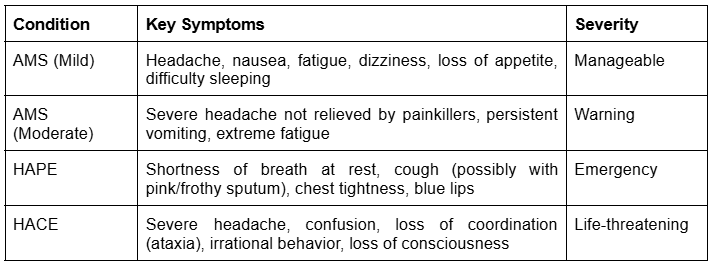
Critical Recognition Points:
- Headache plus at least one other symptom = probable AMS
- Difficulty breathing while resting leads to possible HAPE
- Loss of balance or coordination leads to possible HACE
- Any HAPE or HACE symptoms = descend immediately.
How to Prevent Altitude Sickness
- Proper Acclimatisation Schedule: Follow itineraries that have gradual altitude gain with regular rest days. Acclimatisation stops for most high-altitude treks are included in the trek schedule at Namche Bazaar (3,440 meters), Dingboche (4,410 meters), and other strategic locations.
- Adequate Hydration: Drink 4-5 litres of water daily at altitude. Dehydration accentuates altitude symptoms and leads to thickened blood, which reduces oxygen delivery to tissues. Clear, frequent urination indicates proper hydration.
- Proper Nutrition: Eat regularly, despite a decrease in appetite. High-carbohydrate meals are metabolised most efficiently at altitude. High carbohydrate includes 70% carbs with 30% of protein and fat combined. Heavy, fatty meals use a great deal of digestive energy.
- Avoid Alcohol Consumption and Smoking: Alcohol leads to dehydration, depresses breathing, and hence increases symptoms of altitude. Smoking decreases oxygen-carrying capacity. In addition, these increase the risk of altitude sickness manyfold.
- Slow, Steady Ascent: Don't succumb to the temptation of hiking faster than your planned itinerary. Often, the slowest member of your party will acclimate the best, as he or she is adjusting in a suitable fashion.
- Altitude Medication: Acetazolamide (Diamox), prevents and treats AMS by accelerating acclimatization. Consult your doctor before your trek about prophylaxis use starting 24 hours before reaching 3,000m.
What to Do If Symptoms Worsen
Mild AMS Treatment:
- Stop ascending and rest at the current altitude for 24-48 hours.
- Hydrate thoroughly
- Take pain relievers (ibuprofen or paracetamol) for headaches.
- Continue monitoring symptoms closely.
Moderate to Severe AMS:
- Do not ascend with symptoms.
- If symptoms worsen despite rest, descend 300-500m
- Symptoms should improve within hours of descent.
- Do not continue ascending until symptoms completely resolve.
HAPE or HACE Emergency Response:
- Descend immediately; this is the only effective treatment.
- Descend at least 500- 1,000 m or until symptoms improve.
- Arrange a helicopter evacuation if descent is impossible.
- Administer supplemental oxygen if available.
- Use portable altitude chambers (Gamow bag) as a temporary measure while arranging evacuation.
- Never leave the affected person alone.
Essential Gear for High Altitude Trekking in Nepal
Good equipment is essential for high-altitude treks in Nepal, concerning comfort, safety, and success.
Layered Clothing System:
- Base layers: Merino wool or tops and bottoms made from synthetic materials for wicking moisture
- Mid Layers: Fleece jacket, insulated jacket, etc.
- Outer Shell: Waterproof, Windproof Jacket and Pants
- Insulation: Down jacket rated to -10 degrees C minimum, best for high camps
- Accessories: warm hat, sun hat, Gloves, neck gaiter
Footwear:
- Trekking boots: waterproof, provide ankle support, well-worn before departure
- Camp Shoes: Lightweight sandals for feet in the evenings with down booties
- Socks: Four to five pairs of good-quality trekking socks made of wool or synthetic material
Sleeping Gear:
- Sleeping bag: -10°C minimum rating
- Sleeping Bag Liner: Offers warmth and hygiene.
- Many tea houses may supply blankets, but to be sure, it is recommended to carry one’s own blanket.
Altitude-Specific Items:
- Sunglasses: Category 3-4 UV protective
- Sunscreen: Using a broad-spectrum sunscreen with a very high protection factor of at +50 SPF
- Headlamp: For those starting their day at dawn or living without electricity at home
- Water bottles: 2 x 1 liter each
- Water purification: tablets, filter, or SteriPEN
Medical and Safety:
- First aid kit: Medications, blister treatment, pain reliefs
- Altitude Medication: Diamox after a doctor's consultation
- Pulse Oximeter: Oxygen Saturation
- Diamox: Altitude medication, prescription only
Best Time for High Altitude Trekking in Nepal
Timing is crucial for the high-altitude trek in Nepal, with distinct advantages in different seasons.
- Spring (March to May): Excellent: The second-best time to trek at high altitudes, with increasing temperatures and rhododendron bloom in mid-altitude regions, makes spring one of the best seasons to trek in Nepal. Although it’s chilly in March, April and May present favourable temperatures. During this time, clouds may lower, obscuring the afternoon sun on some mountain vistas, but usually not in the morning. Daytime temperatures vary between -5°C and 5°C in places around 5,000m.
- Autumn (September, November - Best): The exceptional clarity of view during the post-monsoon season gives trekkers some of the most beautiful, sharp mountain vistas that Nepal has to offer, making Autumn the best season for high altitude trekking in Nepal. The weather is stable, the temperatures moderate (-10° - 10° Celsius, 5,000 meters), and rainfall is minimal during the peak season of October and November.
- Winter (December to February - Challenging): The extreme cold from -15°C to -25°C at altitudes above 5000m with snowfall at high altitudes makes it quite difficult to cross passes like Thorong La without mountaineering equipment. The lower-elevation treks below 4000m are good options in winter, as they are peaceful with fewer tourists around. Only expert cold-altitude walkers should opt for passes in these months.
- Monsoon (June to August - Avoid): Monsoon is not advisable in the Himalayas because of heavy rain, leeches, and obstructed mountain vistas. But monsoon is good in rain-shadow areas such as Mustang and Dolpa, as monsoon rains are negligible in these areas.
Guided vs Independent High Altitude Trekking
Preparing for a trek in Nepal includes deciding whether to hire guides, a decision with significant safety implications at high altitude.
- The Significance of a Guide at High Altitudes: The educated guides understand the dangers that come with altitude sickness before it becomes a serious condition; they know well when they should be resting instead of climbing or descending; and they have good connections with rescue helicopters in case of an accident or injury.
- Navigation and Route Finding: Indistinct trail markers are common in high altitude; snow, fog, and whiteout can completely disorient any experienced trekker. Guides know how to safely navigate in conditions where independent trekkers may become dangerously lost.
- Cultural Bridge: Guides shall ensure meaningful interaction with the local people, facilitate lodge bookings, handle all the permit procedures, and solve problems on treks.
- Updated Nepal Regulations: The new regulations were promulgated in 2023, requiring guides for trekkers in certain regions, including those of Everest and Annapurna. They do this in the interest of better trekker safety and boosting local employment.
Conclusion
High altitude trekking in Nepal is a fantastic adventure that requires dedication, perseverance, and respect for the mountains. Trekking above an altitude of 3,500 meters is a significant challenge because it requires sufficient acclimatisation, a steady approach, and consideration of the consequences of altitude sickness, whereas physical, mental, and geographical conditions are of major importance instead of speed and past trekking skills.
Whether you have set your sights on reaching Everest Base Camp or other mountain passes such as Thorong La Pass or Kong Ma Pass, the way to reach them successfully lies in trekking smart rather than trying to reach any summits first! Ensuring the season is right and that you have adequate equipment with you, high-altitude trekking in Nepal may turn out to be one of the best experiences in your life in the Himalayas.
Frequently Asked Questions
Q. What is considered high altitude in Nepal?
A. Elevations above 3,500 meters (11,483 feet) are classified as high altitude, where the risk of altitude sickness increases significantly. Above 5,500 meters, the extreme altitude causes the body to deteriorate, and the body cannot fully acclimatise.
Q. What is the highest trekking altitude Nepal offers?
A. The highest trekking altitude is 5,644m up to Kala Patthar on the famous trekking route to the Everest Base Camp. The highest trekking pass is Kongma-La at 5,535m on the Three Passes trek route. There are some treks around the 6,000m mark, but they extend beyond trekking and pass over into the realm of mountaineering.
Q. How fit do you need to be for high-altitude trekking?
A. You should be comfortable hiking 5-7 hours daily with a 5-8kg backpack. Most high-altitude treks aren't technical climbs but require good cardiovascular fitness, leg strength, and mental toughness. Training should start 8-12 weeks before your trek, with longer and more steeply hilled hikes gradually being introduced.
Q. Is altitude sickness common in Nepal?
A. Altitude sickness is very common in Nepal, with as many as 50 to 75 per cent of trekkers showing symptoms of altitude sickness above an altitude of 4,000 meters. Severe HAPE-HACE occurs in about 1 to 3 per cent of trekkers who mostly rush to higher elevations despite showing signs of altitude sickness.
Q. Are beginners allowed to trek at high altitudes?
A. Yes. For beginners to trek at high altitudes in Nepal, they can consider trekking to places like the Everest Base Camp Trek or the Annapurna Base Camp Trek under the guidance of an experienced guide. Physical condition matters more than prior trekking experience for beginners to trek at high altitudes.