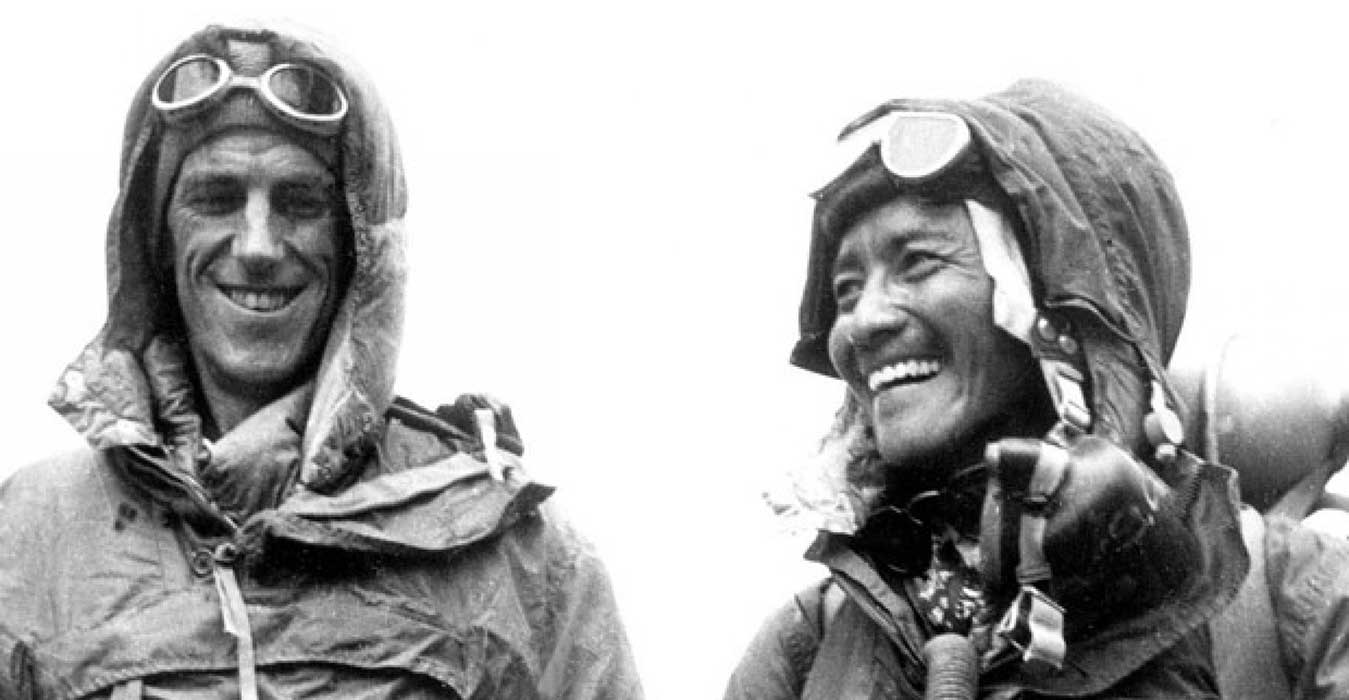
When Tenzing Norgay climbed Mount Everest with Edmund Hillary in 1953, the Sherpas of the Himalayas, including Tenzing, finally gained recognition worldwide. However, the Sherpas have been the spine of mountaineering in the Himalayas for many years, not as porters but as exceptional mountaineers, guides, and natives of a culture that has been shaped by life on the "roof of the world.”
Despite this clarity in Nepal, confusion persists elsewhere. Many apply the sherpa label to any high-altitude porter or guide in error. The Sherpa may be more than just summiteers on Everest; indeed, the Sherpa people represent much more: “a hardy people whose ancestors migrated over the Himalayas many centuries ago,” “a people with Buddhist traditions that color their perception of the world,” “a people whose genetic makeup enables them to thrive at high altitudes.
Understanding who the Sherpa people truly are reveals not just mountaineering history but a fascinating story of human adaptation, cultural preservation, and a community navigating rapid change while honoring ancient traditions.
Sherpa People Origin: Where Did They Come From?
Originating in eastern Tibet, specifically the region of Kham, they migrated down the Himalayas to what is now northeastern Nepal around 500 years ago. In fact, their name, Sherpa, holds an origin related to this, with "shar" being the Tibetan word for "east" and "pa" meaning "people." In other words, they mean people from the east.
This migration took place over a series of waves during the 15th to 17th centuries, with motivations ranging from political instability in Tibet to the pursuit of improved grazing land to economic opportunities. Unlike other refugee groups who migrated away from disaster, the Sherpas continued to migrate until they occupied the upper valleys in the Solukhumbu region, which had few inhabitants. Subsequently, with altitudes of 3,000 to 4,500 meters making it difficult for most people to settle, an advantageous topographic position for yak herding and barley farming, which they could easily practice on the Tibetan Plateau, attracted the Sherpas.
These pioneer Sherpas founded villages in areas such as Namche Bazaar, Khumjung, Thame, and Pangboche, which remain to this day. The ease with which the region is accessible to Tibet permitted the preservation of cultural and commercial ties while simultaneously allowing the evolution of the distinct identity characteristic of the Sherpas. Isolation in the mountains in the northeastern part of Nepal ensured the preservation of their language, religion, and culture.
The Sherpa people slowly expanded from Solukhumbu into other high-altitude areas, including Rolwaling, Helambu, and the Langtang region. Today, around 150,000-200,000 ethnic Sherpas reside in Nepal, with small communities in the Indian States of Darjeeling and Sikkim, in Bhutan, and Tibet. However, their spiritual and cultural heartland remains the Khumbu region of Mount Everest.
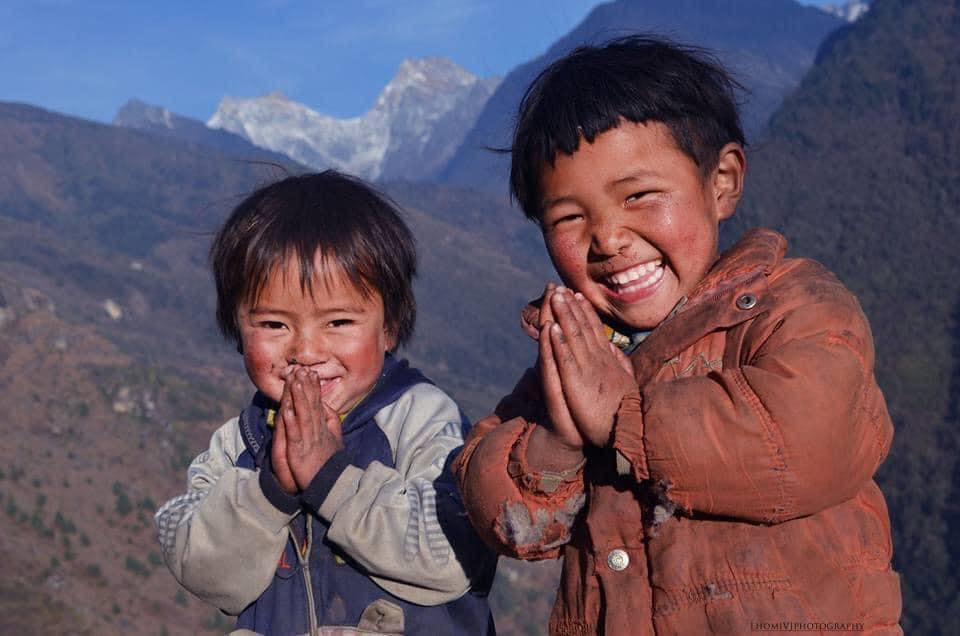
History of the Sherpa People in Nepal
The Sherpas had existed through agro-pastoralism and cross-Himalayan trade. They were pastoralists in summer seasons when they raised yaks in the high pastures. They migrated to lower villages in winter when there was little pasture. They also practiced farming, growing barley and potatoes in mountain terraces. Most famously, however, they dominated the trade routes from Tibet to Nepal. They carried salt, wool, and livestock from Tibet in exchange for grains, textiles, and manufactured products from lower Nepal and India.
This was the trade-based economy that existed in early Sherpa culture. Wealth was gained through successful trading, not land ownership. Caravans of traders crossing passes such as Nanga La, which stands at 5,716m, demanded the very same set of skills that would later serve Sherpas well in mountain climbing.
Thus, the Sherpa culture was significantly affected by Tibetan Buddhism from its inception. This is because monasteries became informal social hubs in the culture, while the teachings of Buddhism emphasized social behavior traits such as kindness and concern for the welfare of all living things. The establishment of the monastery in Tengboche in 1916 became a significant spiritual landmark in Sherpa culture, and it continues to be central to their religious practices. Inherently connected to the environment and culture was the timing of Buddhist celebrations.
The 1950s saw a revolution in Nepal. Nepal was opened up to foreigners in 1950, and in 1953, the First Ascent of Everest by Hillary and Tenzing put Sherpas at the center of the world stage. Porter activities in trekking that began in these expeditions quickly escalated into climbing, becoming the driving force of the Sherpa economy. Trading was rendered impossible following the Chinese government's closure of Tibet's border in 1959, following the uprising in Tibet.
This transition happened remarkably quickly, within a single generation. The transition from traders and herders to world-class mountain climbers and guides seemed to happen overnight for the Sherpas. This brought economic success but also problems related to the environment, cultural shifts, and the death toll climbing the challenging mountains.
Sherpa Culture and Traditions
Sherpa culture is shaped by their Tibetan Buddhist heritage and by adaptations to life in the mountains of Nepal.
Religion and Spirituality
Tibetan Buddhism is integral to all facets of Sherpa life. In contrast to the Hinduism practiced by the majority of Nepal, the Sherpas practice the Nyingma tradition, the oldest form of Tibetan Buddhism. Buddhist monasteries are not merely religious institutions, as in Nepal, but also common meeting places, places for learning, and focal points for the community.
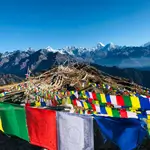
The teachings of Buddhism also serve as a basis of Sherpa ethical foundations, such as compassion (karuna), correct actions, and kindness to all living beings. Prayer flags with prayers hang around people’s dwellings and trekking routes to blow in the wind. Mani stones with mantras carved on them line the routes. Stupas are located near sacred sites. Before a large climb, Sherpas conduct a puja ceremony in Base Camp to seek permission and protection from the mountain deities.
Language
Sherpas speak Sherpa, a distinct Tibetan dialect, but not Nepali. However, they are generally multilingual, with Sherpa spoken at home, Nepali used for administrative purposes, and an increasing number using English, largely for tourist-related jobs. It retains strong Tibetan syntax but includes words from other languages, including Nepali and English.
Sherpa is considered an exclusively spoken language, although it utilizes Tibetan script for religious texts. However, among the younger generation of Sherpas, Nepali or English is used extensively, raising concerns about the preservation of the Sherpas' language.
Dress and Material Culture
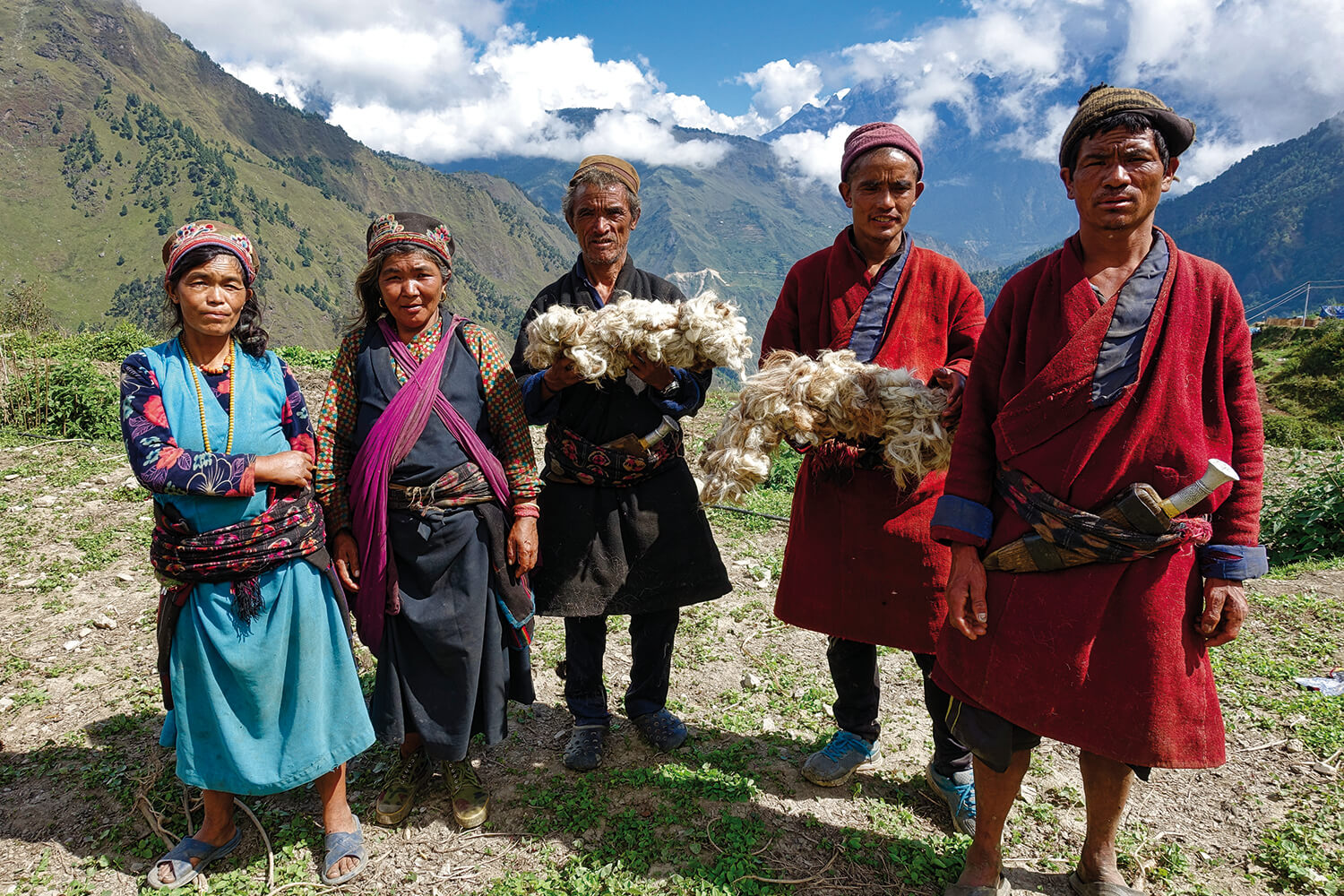
The chuba, a thick wool robe, is part of Sherpa traditional dress, which men and women wear with a belt. Aprons with strips of various colors, depending upon whether they are married or unmarried, that men and women of the Sherpas wear are known as pangden. Modern Sherpas wear Western-style clothing.
The Sherpa house includes the family temple, which features a butter-lamp shrine, offering cups, and images of deities. Structural adaptations of their housing to the high-altitude setting include stone buildings with small windows and a centrally fired fireplace. Modern-style Sherpa houses of the more well-to-do are designed incorporating an altar room.
Festivals and Celebrations
Mani Rimdu follows the lunar calendar and usually occurs in November, falling under the full moon. It is the most important Sherpa festival and takes place at Tengboche Monastery with an elaborate three-day celebration of masked dances, religious ceremonies, and community gatherings. Sherpas travel from throughout Khumbu to attend, making it both a spiritual occasion and a major social event.
"Losar" (Tibetan New Year) includes family reunions, traditional cuisine, visits to monasteries, and celebrating the arrival of the new year. "Dumje" marks the birthday of Guru Rinpoche, who introduced Buddhism in Tibet. These events remain popular enough that many younger and educated members of the Sherpa community are involved in tourism-related activities.
Social Structure
The conventional Sherpas were more in favor of community interest than of individual gain. "Pemge" was an important factor in which people from a community aided one another during harvest, house building, or emergencies, without demanding payment in return. Although modernization has affected traditions to a lesser extent, support for traditions is stronger in the community than in modern society.
Gender roles are relatively egalitarian compared to some other Nepali ethnic groups. Sherpa women own property, make household decisions, and participate in economic activities. Many successful lodge owners, trekking company operators, and even climbers are women.
Sherpa People of Nepal Today
Contemporary Sherpa culture seeks to maintain stability between economic development and cultural heritage. With the influx of tourists, Khumbu, formerly the poorest region in Nepal in the 1950s, now boasts one of the top per capita incomes in the country. The village of Namche Bazaar grew from a simple trading center to a thriving town with access to electricity, the internet, accommodations, bakeries, and outfitter shops.
Access to education has improved immensely. Today, many Sherpa children are enrolled in boarding schools in Kathmandu or abroad, only to return home qualified with BAs in business, medicine, or engineering. However, such education offers opportunities but poses an utmost challenge for the educated generation, which prefers to settle in Kathmandu.
Mountain climbing and trekking tourism in the region provides a livelihood for thousands of Sherpas, including guides, mountain porters, lodge owners, and support staff. A mountain climbing Sherpa earns a lot of money in peak seasons despite the ever-present risk. Most households have either lost fathers, sons, or brothers in mountain accidents.
With the rise of tourism, there are also concerns about the environment. Garbage, water pollution, deforestation, and the saturation of famous spots are just some of the problems that might compromise the pristine condition of the environment, which has long been protected by the Sherpas.
Despite the changes, certain cultural elements are retained. Monasteries are functional, and the attendance is significant. Festivals witness a massive turnout. Tibetan Buddhism is still their guiding source of values and worldview. Ethnically, the Sherpas remain intact as they progress towards modernization.
Sherpa People and Mount Everest
What Is a Sherpa on Everest?
This question sparked significant confusion, which irritates many ethnic Sherpas. "Sherpa" is a term for the ethnic group of Sherpas, but not necessarily for mountain climbers. The word has been misused worldwide to describe anyone who helps with mountain climbing when altitude is involved.
In “My Sherpa Carried My Pack” or “The Sherpas Established Camp,” climbers are usually referring to ethnic Sherpas, though sometimes Tamang, Rai, Magar, or other Nepal ethnicities are meant, employed as porters or guides. To reduce ethnic identity to an occupational label is to destroy Sherpa identity as an ethnicity. “Italian” as “chef” would be the equivalent.
On Everest specifically, most high-altitude guides and support staff are indeed ethnic Sherpas, making the confusion somewhat understandable. However, proper terminology matters. Ethnic Sherpas working on mountains are "Sherpa guides" or "Sherpa climbers." Non-Sherpa high-altitude workers should be called "high-altitude porters," "guides," or "support staff."
Sherpa People on Mount Everest
The Sherpas have always been an important part of Everest expeditions from day one. In early attempts to climb Everest in the 1920s, the Sherpas served as porters on British expeditions. The Sherpas were efficient porters for the British expeditions. Moreover, the Sherpas appeared better equipped to deal with Mount Everest than the British.
Tenzing Norgay’s ascent in 1953 with Edmund Hillary started the shift, showing that Sherpas were equals, not simple support staff. Since then, Sherpas have climbed Everest more than any other ethnic group, sometimes several times. Kami Rita Sherpa currently holds the most Everest ascents, with 30+ as of 2024.
Expeditions to Everest today rely utterly on the expertise of Sherpa guides. Sherpa guides fix ropes through hazardous sections such as the Khumbu Icefall, set up and supply camps, guide clients to the summit, and rescue them when things go wrong. On an average commercial Everest expedition, there could be anything from 8 to 15 Sherpa staff for every 6 to 8 Western clients.
This condition poses ethical dilemmas. Sherpas face many challenges compared to clients because they have to ascend and descend through risky routes, while clients simply ascend. Sherpas also have to lug heavier bags and work longer hours while receiving less praise for their efforts. There have been attempts to boost the pay and benefits for Sherpas in recent years.
Tragic incidents bring home the price Sherpas pay. There was the 2014 avalanche in the Khumbu Icefall that killed 16 Sherpas, forcing the cancellation of the season and protests for better working and pay conditions. Then, of course, the 2015 earthquake claimed 22 lives who were camping at the Everest Base Camp. Sherpa families are severely impacted, having lost hundreds of relatives in mountain incidents.
In spite of such risks and, at times, a lack of recognition, mountaineering has become a source of national and international recognition and, most importantly, a means of livelihood for Sherpas, which, in turn, allows extended families to be raised and children to be educated. Super mountaineers of this tribe are stars in Nepal, and children of such mountaineers aspire to be mountaineers.
Sherpa People Strength: Why Are They So Resilient?
Nepal's Sherpas’ strength and endurance are not merely the result of training and hardiness, something that could be achieved through training, but are instead genetic and have been developed over many centuries at such a high altitude.
Genetic Adaptations
Various genetic differences have been identified that explain why Sherpas can live comfortably when others would suffer. These genetic differences relate to their bodies' handling of oxygen in environments with low oxygen levels. Key points include:
- The Sherpas produce more nitric oxide, which dilates blood vessels and thereby increases oxygen delivery to tissues. The bodies of Sherpas use oxygen more efficiently. They require less oxygen to do similar tasks. There are more capillaries in the muscles of the Sherpas. Energy metabolism occurs efficiently at low oxygen levels in their bodies.
- Studies have been conducted on Sherpas and lowlanders, and they have found that Sherpas have higher blood oxygen saturation levels, fewer symptoms of high altitude, and faster recovery times after exercise. There are no training differences here, and these are completely genetic, derived from people who have lived for many generations above 3,000 meters.
Physiological Advantages
In addition to all of these genetic traits, Sherpas also exhibit physiological adaptations from lifelong exposure to high elevations. Since birth, their lungs expand; their bodies increase red blood cell production, not excessively, as with some adapted populations; and their cardiovascular systems become incomparably efficient.
However, recent studies have indicated that the adaptive advantages for Sherpas may be more closely tied to enhanced oxygen utilization than to increased oxygen capacity. Rather, they can utilize oxygen because they have "more function" rather than simply more blood.
Lifestyle Factors
Body conditioning is also important. For Nepalese Sherpas, physical conditioning is often acquired by carrying heavy loads up difficult trails while herding yaks in thin air and by engaging in heavy physical labor at high altitudes. Such childhood conditioning instills physique-developing qualities into them.
Diet may also have a role: their traditional high-carb foods are great for energy. Cultural knowledge, such as acclimatization (Sherpas know how to pace themselves and recognize signs of altitude sickness), may also contribute to their success.
Mental Resilience
Along with physical strength, Sherpas have equally high levels of mental strength. They are emotionally stable, aware of risky areas, and able to make sound judgments, ensuring that, along with physical strength, their abilities are equally important for mountaineering.
Buddhist Philosophy: Buddhist philosophy can also be a factor in the Sherpas’ resilience. Acceptance of suffering, emphasis on the present, and understanding of impermanence can enable the Sherpas to deal with the risks of mountain climbing with utmost calmness, leaving Western mountaineers amazed.
10 Facts About Sherpas
- It should be noted that "Sherpas" is not a job title. Rather, they are an ethnic community who have their own language and culture.
- They follow Tibetan Buddhism. Their religion shapes their values and their interactions with the mountains they revere.
- People inhabit areas above 4,000 meters. Villages like Khumjung and Pangboche lie in areas where most people find it difficult to breathe, but Sherpas lead normal lives.
- Altitude adaptation in Sherpas differs from that of people living in other high-altitude environments. Research has verified that they have a biological advantage for such conditions.
- These help conduct most expeditions on Everest. As estimated, 90% of climbs up Everest are done with the help of Sherpa Guides.
- The Sherpa people’s name, Sherpa, translates to "people from the east." This refers to their origins from the Tibet region, which is indicated in their language: ‘shar’ means ‘east’ while ‘pa’
- Women play an equally important role. Sherpa women own lodges, guide, and even climb at high altitudes, with a few having summited Everest.
- Sherpas observe the Mani Rimdu festival. This important religious festival takes place at Tengboche Monastery and includes mask dances, rituals, and social gatherings.
- Many Sherpas are good climbers. Apart from climbing, many Sherpas have recorded several climbing records, especially on Mount Everest.
- The Sherpas are community-based people. They are humble people. It takes a great deal of effort for such people to maintain a tradition of helping others.
Nepali Sherpa People vs "Sherpa" as a Job
When "sherpa" becomes generic for any climbing assistant, it erases Sherpa ethnic identity and further cultural appropriation. It further conceals that non-Sherpa Nepalis, Tamangs, Rais, Magars, and Gurungs also work in mountain tourism and deserve recognition for their particular ethnic identities.
Using proper terms will, in turn, promote the Sherpa identity along with those of other mountain staff in Nepal. The terms to use are: Sherpa guide in the case of ethnic Sherpa climbers, high-altitude guide or mountain guide in the case of non-Sherpa mountain guides, and either porter or support staff in the case of mountain porters.
A contributing factor here is the confusion that exists or has existed between Sherpas and other locals in the tourism industry. It’s tourism companies and the media that have contributed to the confusion. The use of 'sherpa' in a generic sense in advertising or the news, without making a clear ethnic distinction between Sherpas and others in the industry, has confused people.
Conclusion: Respecting the Legacy of the Sherpa People
The Sherpa people are much more than merely mountain guides or high-altitude laborers on Everest. The Sherpa people are an ancient civilization that traversed the globe’s highest mountain ranges, learning to thrive in an extreme environment that would be lethal to most other cultures, preserving their Buddhist heritage in a rapidly changing world. The Sherpa people’s resilience lies not only in their biology, physiology, or adaptability, but also in their shared culture.
Knowledge of Sherpa history, culture, and identity is, of course, rich context for any adventure in the Himalayas. Trekking in Khumbu is more than simply witnessing stunning views. One immerses oneself in Sherpa culture, where every village, monastic site, and trail through the forests has cultural significance. It means your guides, your leaders to the top of a Himalayan peak, are not only sharing knowledge passed down through countless generations, they are, through their genes, destined for their tasks.
It also involves taking the time to speak Sherpa’s name correctly. It involves recognizing the value of the Sherpas' efforts in helping climbers reach new heights. It involves recognizing that without the Sherpas, there would be no great feats of high-altitude achievement in the world. Indeed, it all depends on the Sherpas.
Frequently Asked Questions (FAQs)
Are all Everest guides Sherpas?
No, although the majority are. Although members of the ethnic Sherpas are the largest group of high-altitude guides on the summit of Mount Everest due to their genetic abilities and familiarity with mountain climbing, members of other ethnic groups from Nepal, as well as foreign guides, also work on the mountain. Nevertheless, Sherpas still lead in mountain guiding due to their distinct biological makeup and extensive experience on mountain climbs.
What are the advantages for Sherpas at high altitudes?
They have certain genetic adaptations due to prolonged exposure to a high-altitude environment above 3,000 meters. They produce more nitric oxide in the body, which helps increase oxygen transport to cells and their proper utilization, and this raises blood oxygen levels above normal in people living in low-altitude regions.
Where are the Sherpas found in Nepal?
Most of the Sherpas are settled in the Solukhumbu District of Nepal, especially around the Khumbu area, which includes Namche Bazaar, Khumjung, Kunde, Thame, and Pangboche. There are also other Sherpa settlements in Rolwaling, Helambu, and around the Langtang area. There are also Sherpas who have settled around Kathmandu.
Is Sherpa a surname, an ethnicity, or both?
Sherpa is an ethnic group/tribe name. Many ethnic Sherpas adopt "Sherpa" as their surname, which sometimes can cause confusion. Not all persons with the surname "Sherpa" hail from the ethnic group "Sherpa"; other ethnic groups use the surname, although most persons using "Sherpa" as their surname belong to the said ethnic group. You can consider this as an ethnicity and a "common surname among that ethnicity".